
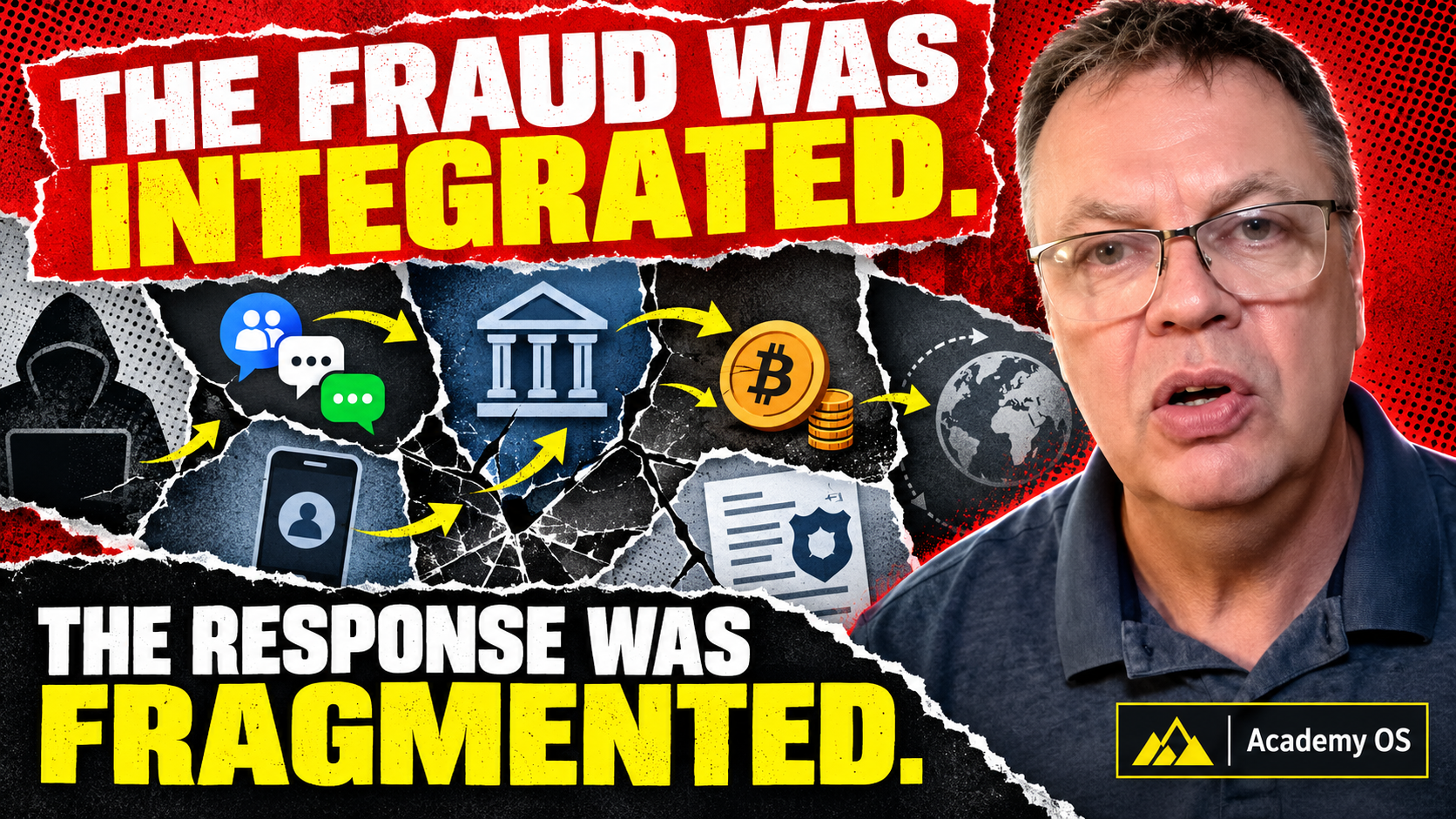
A scam rarely happens in one place.
A fraudulent advert may appear on Facebook. The conversation moves to WhatsApp. A convincing phone call follows. Money leaves a bank account, passes through another institution and eventually reaches a cryptocurrency platform.
The criminal sees the entire journey.
Each institution sees only its own part.
And the victim is left trying to put the system back together.
Fraud is integrated when it is committed—and fragmented when it is investigated
New research from Which? illustrates the scale of the problem.
Which? surveyed 1,501 UK adults who had lost money to fraud during the previous two years. It found that:
- 63% said the scam involved at least one app or website;
- 55% of reported online scams were spread through social media;
- Facebook was cited by 28% of authorised-fraud victims;
- WhatsApp was cited by 17%;
- Instagram was cited by 10%;
- only 21% of authorised-fraud victims received a full refund;
- around half of those scammed through Facebook or WhatsApp recovered nothing.
The research does not prove that an individual Meta user is more likely to be scammed than someone using another platform. Meta’s enormous user base matters, and different platforms are associated with different payment methods and types of fraud.
But it does demonstrate something important.
Meta’s platforms feature prominently in the journeys of fraud victims, while the companies operating those platforms generally sit outside the system responsible for reimbursing them.
That reveals a deeper structural problem.
The Fraud Liability Gap
The organisations capable of enabling, detecting or interrupting a scam are not necessarily the organisations required to bear its cost.
The social media platform provides reach.
The advertiser creates apparent legitimacy.
The messaging service provides private access to the victim.
The telecoms network carries the call.
The bank sends the payment.
Another institution receives it.
A cryptocurrency platform may move or convert it.
Yet when the fraud is discovered, each organisation examines only the part that passed through its own systems.
This creates what we might call the Fraud Liability Gap:
The organisation that enables the attention, trust or contact is rarely the organisation required to compensate the resulting loss.
The platform may say it did not process the payment.
The sending bank may say the customer authorised it.
The receiving institution may say its customer passed the required checks.
The cryptocurrency platform may say the assets have already moved.
Law enforcement may record the crime but not investigate the individual case.
Every organisation can be technically correct about its own fragment while the system fails the victim as a whole.
An authorised payment is not necessarily an informed decision
The distinction between authorised and unauthorised fraud remains central to reimbursement.
Where criminals steal card or bank details and make payments without the account holder’s authority, banks will usually be required to reimburse the customer unless particular exceptions apply.
Where the victim makes the payment personally, recovery can be much harder.
But this binary distinction conceals what actually happened.
A person may have physically pressed the button, but only after:
- being deceived about the recipient’s identity;
- seeing a fraudulent advertisement;
- receiving fabricated documents;
- being subjected to sustained psychological manipulation;
- being shown fictitious investment returns;
- having caller identification spoofed;
- being placed under artificial time pressure;
- or being persuaded that the payment was necessary to protect existing funds.
The payment was technically authorised.
The decision was engineered.
That distinction matters because the system often examines the final payment instruction without reconstructing the environment in which the decision was produced.
Criminals operate across the system
Which? rightly calls for online platforms, telecommunications providers and financial institutions to share intelligence.
Fraudsters already work this way.
They share scripts, data, identities, phishing kits, payment routes and methods for overcoming institutional controls. They move freely across organisational boundaries because they do not recognise those boundaries.
The organisations trying to stop them do.
A victim might therefore be required to contact:
- the social media platform;
- the messaging provider;
- their own bank;
- the recipient bank;
- a payment processor;
- a cryptocurrency exchange;
- Action Fraud;
- the police;
- the Financial Ombudsman Service;
- and, potentially, a solicitor.
Each requires different information, different terminology and a different presentation of the same underlying events.
The criminal operated an integrated model.
The victim encounters a fragmented response.
The individual becomes the system integrator
This is one of the cruellest features of modern fraud.
At precisely the moment someone may be experiencing shock, shame, fear and financial distress, the system places upon them the burden of reconstructing the crime.
They must find payment confirmations, download conversations, preserve online profiles, identify companies, trace transfers, explain the chronology and repeat the story to multiple organisations.
Evidence may disappear while responsibility is being passed around.
This is not merely an information problem. It is an agency problem.
The institutions possess specialist teams, internal records and established procedures. The victim must learn the system while trying to recover from what has happened.
That is why Academy OS approaches the problem from the individual’s side.
Recoverer™ reconstructs the whole fraud journey
Recoverer™ helps people who have lost money to investment fraud build their case and begin the recovery process themselves before engaging a solicitor or recovery firm.
It brings the scattered elements of the case together:
- payment confirmations;
- emails and messages;
- advertisements and online profiles;
- company and individual identities;
- bank correspondence;
- reports to authorities;
- promises, representations and inconsistencies;
- and the complete chronology of events.
It then helps the individual prepare calm, factual and structured reports for the relevant firms, banks and authorities.
Recoverer does not pretend that every report will lead to reimbursement. Nor does it promise that one route can solve the whole problem.
Its purpose is to ensure that the individual can see and present the complete case—even when every institution sees only a fragment.
Recoverer reconstructs the crime.
Goliathon™ contests the institutional response
Sometimes the initial reports produce action.
Sometimes an institution denies responsibility, fails to investigate, overlooks evidence or provides an inconsistent explanation.
At that point, the problem changes.
It is no longer solely about reconstructing the fraud. It has become a dispute about how a powerful organisation responded.
Goliathon™ helps individuals investigate disputes, organise evidence and prepare a structured account of what happened when dealing with large organisations.
It can help someone:
- build a clear chronology;
- identify missing evidence;
- compare statements and correspondence;
- expose inconsistencies and unanswered questions;
- assess the strengths and risks of the case;
- and prepare a structured complaint, witness statement or case summary.
Recoverer reconstructs the crime. Goliathon contests the institutional response.
Together, they create a victim-side operating model for a problem that crosses institutional boundaries.
From fragmented evidence to continuous agency
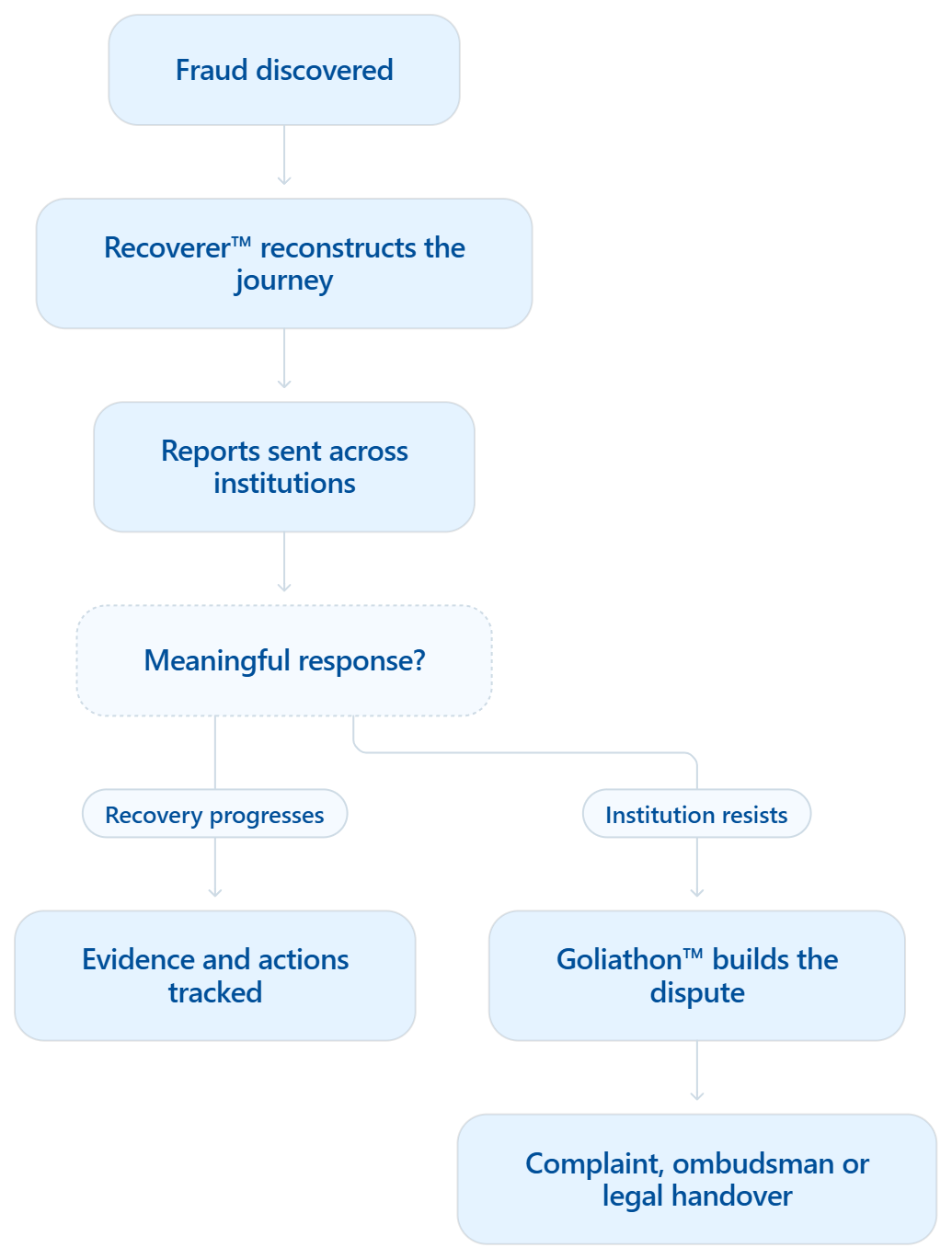
The pathway is straightforward:
- Recoverer reconstructs the complete fraud journey.
- It helps the individual prepare reports for each relevant institution.
- The responses and continuing evidence are preserved within one organised case.
- If an institution denies, delays or deflects responsibility, Goliathon helps examine and challenge that response.
- The resulting case can be handed to an ombudsman, regulator, solicitor or court in a clearer and more usable form.
Neither tool replaces professional legal advice, law enforcement or regulated financial services.
They do something deliberately different.
They help the individual understand what happened, preserve the evidence, ask better questions and decide when specialist support is required.
This is what restoring human agency looks like in practice.
It does not mean leaving people alone to fight complex systems.
It means giving them the capability to participate effectively, retain control of their own evidence and understand the decisions being made about their case.
Someone must hold the complete picture
Shared institutional intelligence could prevent more scams. Wider responsibility for fraudulent advertising may also help correct the imbalance between those who profit from online activity and those who pay when it causes harm.
But victims cannot wait for every institution to become fully integrated.
They need a way to build the complete picture now.
Fraudsters exploit the spaces between platforms, banks, telecommunications companies, regulators and law enforcement. Recovery fails when the victim’s evidence falls into those same spaces.
The Academy OS response is therefore based on a simple principle:
Institutions may divide the case between themselves. Academy OS gives the individual a complete view of the system.
The system may remain fragmented.
The person no longer has to be.
Explore the free Academy OS tools, including Recoverer™ and Goliathon™, at Academy OS.
Source: “Scammers are thriving on Meta’s social media platforms,” Which?.

