
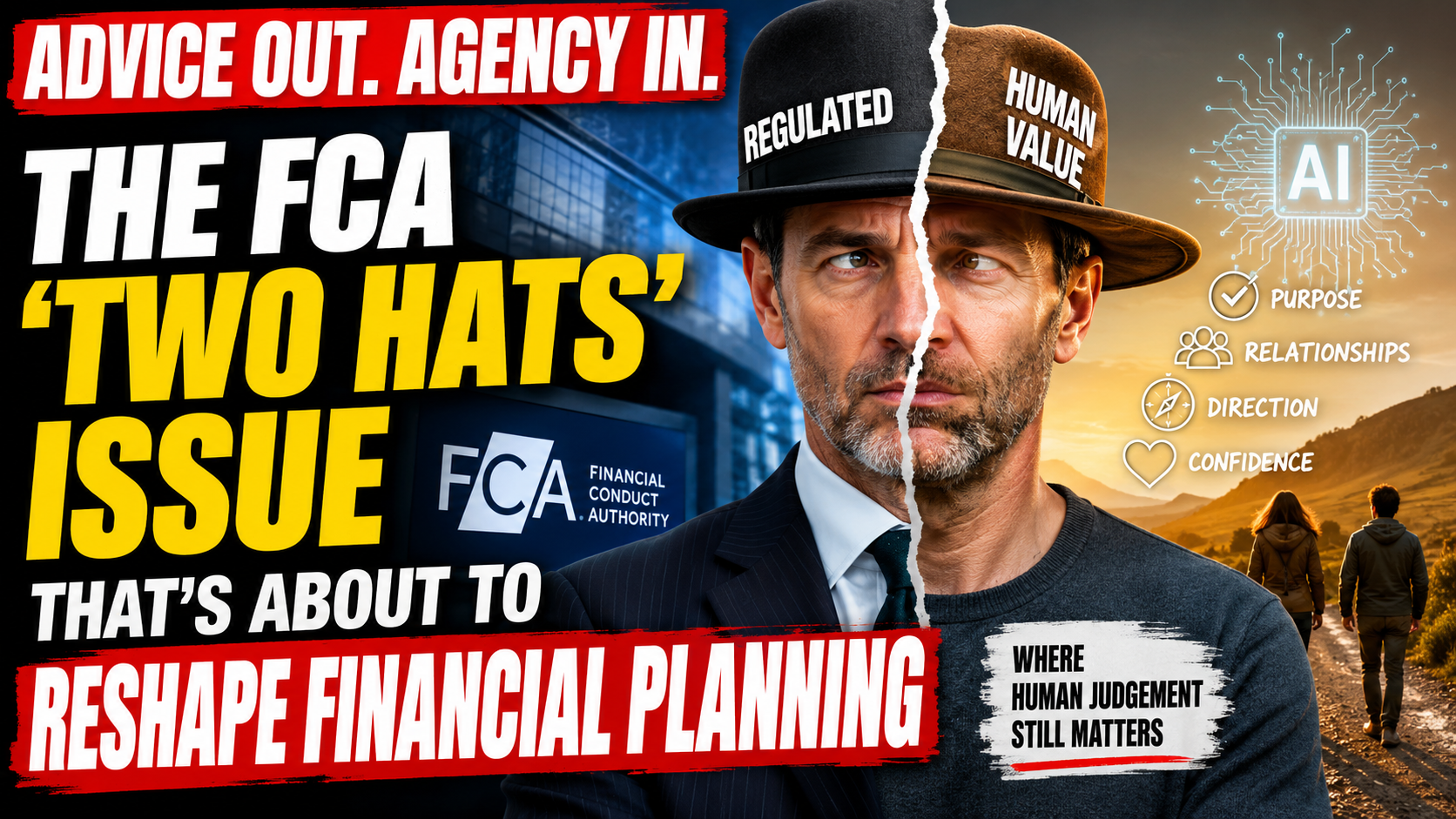
Why the FCA “Two Hats” Problem Is About to Become One of the Biggest Strategic Issues in Financial Planning
For years, the UK financial advice profession has operated within a relatively stable identity structure.
You were either:
- an authorised firm,
- an appointed representative,
- or a regulated financial adviser operating under a regulated permissions framework.
The boundary between regulated and non-regulated activity was often relatively easy to identify.
But that boundary is beginning to blur.
And artificial intelligence is accelerating the shift.
Across the profession, more advisers are quietly evolving from:
- product intermediaries,
- investment managers,
- and regulated recommendation providers,
towards:
- planners,
- educators,
- behavioural guides,
- thinking partners,
- coaches,
- accountability partners,
- and human translators of complexity.
In simple terms:
The market is shifting from advice… towards agency.
And that creates a growing structural problem many firms are not yet fully recognising:
the FCA “two hats” issue.
What is the “two hats” issue?
The “two hats” problem emerges when an individual operates simultaneously:
- inside the FCA regulated perimeter,
- and outside it.
For example:
- a regulated adviser also running a planning business,
- an adviser providing coaching alongside regulated advice,
- a financial planner running educational workshops,
- a lifestyle planning brand linked to a regulated practice,
- or an AI-supported planning service sitting alongside authorised advice.
In many cases, these businesses are entirely legitimate.
The problem is not necessarily the activity itself.
The problem is consumer clarity.
The FCA’s concern is usually not:
“Are you innovating?”
It is:
“Can consumers clearly understand which hat you are wearing?”
That distinction matters enormously.
Because different activities carry different:
- liabilities,
- protections,
- permissions,
- complaint rights,
- compliance obligations,
- and expectations.
Why this issue is growing now
Historically, much of the commercial value in financial services sat inside regulated product distribution:
- investments,
- pensions,
- insurance,
- mortgages,
- and ongoing asset management.
That is where fees were generated.
But AI is beginning to commoditise large parts of the information layer.
Consumers can now increasingly access:
- basic explanations,
- pension information,
- modelling tools,
- tax guidance summaries,
- cashflow projections,
- and educational support,
without necessarily needing a traditional adviser relationship.
This does not eliminate the need for human support.
In many ways, it increases it.
But the human value is shifting.
The future value may sit less in:
- information asymmetry,
- product access,
- and technical gatekeeping,
and more in:
- judgement,
- emotional stability,
- behavioural understanding,
- contextual thinking,
- accountability,
- ethics,
- and helping people navigate complexity under stress.
In other words:
the distinctly human layer.
And much of that activity may fall outside regulated advice.
That creates tension.
Because many advisers now find themselves operating across both worlds simultaneously.
The new strategic divide
Increasingly, advisers are asking:
“Which parts of my value are regulated?”
And:
“Which parts are fundamentally human?”
That is not a small question.
It may become one of the defining commercial questions of the AI era.
Because machine systems are exceptionally good at:
- processing rules,
- summarising information,
- identifying patterns,
- and automating repeatable technical tasks.
But humans still matter enormously in areas such as:
- identity,
- meaning,
- motivation,
- family dynamics,
- fear,
- purpose,
- uncertainty,
- and life transition.
The irony is that some of the most valuable human support may sit outside the traditional FCA perimeter.
Not because it lacks value.
But because it is not regulated activity.
This is where firms must become very careful.
The danger is not innovation.
The danger is ambiguity.
Where firms get into trouble
The risk usually emerges when:
- consumers cannot distinguish regulated from non-regulated services,
- branding merges multiple activities together,
- websites imply permissions that do not exist,
- or regulated status creates a “halo effect” around unrelated services.
For example:
- a planning company appearing FCA regulated when it is not,
- a coaching service presented alongside regulated advice without separation,
- or educational content being mistaken for personal recommendations.
The FCA is increasingly focused on:
- fair, clear and non-misleading communications,
- operational clarity,
- accountability,
- and consumer understanding.
In practice, the regulator often asks a very simple question:
“What would an ordinary consumer reasonably believe?”
If the answer is unclear, the structure may already be risky.
The profession is evolving faster than the perimeter language
One reason this issue is becoming more common is that the profession itself is changing faster than the old categories.
Many advisers no longer see themselves primarily as:
- investment salespeople,
- portfolio managers,
- or product distributors.
They increasingly identify as:
- life planners,
- strategic thinking partners,
- financial coaches,
- behavioural guides,
- or human development professionals.
That evolution is understandable.
In many ways, it reflects a healthier direction for the profession.
But it also requires a more sophisticated understanding of:
- regulatory boundaries,
- communication structures,
- liability separation,
- and role clarity.
Especially when AI enters the equation.
Because AI is accelerating the separation between:
- machine-deliverable value,
and - human-deliverable value.
The future may not belong solely to regulated advice firms.
Nor solely to AI platforms.
It may belong to those who can responsibly integrate:
- human judgement,
- technological capability,
- and clear ethical boundaries.
Clarity becomes the strategy
The firms likely to navigate this transition best may not be those with the most sophisticated technology.
They may be the ones with the clearest architecture.
Clear:
- consumer communication,
- activity separation,
- role definition,
- disclosures,
- expectations,
- and operating boundaries.
Not because regulation is the enemy of innovation.
But because trust depends on clarity.
And in the age of AI, clarity itself may become one of the profession’s most valuable assets.
If you’re a financial planner trying to navigate this shift — between regulated advice, human planning, AI capability, and consumer agency — you’re not alone.
The profession is changing quickly.
The Academy of Life Planning exists to help planners think clearly about where real human value sits in the age of AI, and how to build sustainable, ethical practices around it.
Around 4 in 10 of our Total Wealth Planners are also regulated financial advisers, navigating these same questions in real time.
If you want professional support, strategic clarity, and access to a network experienced in these evolving boundaries, explore the Academy of Life Planning.
Because the future may not belong to those who simply deliver advice faster.
It may belong to those who help restore human agency more effectively.

