
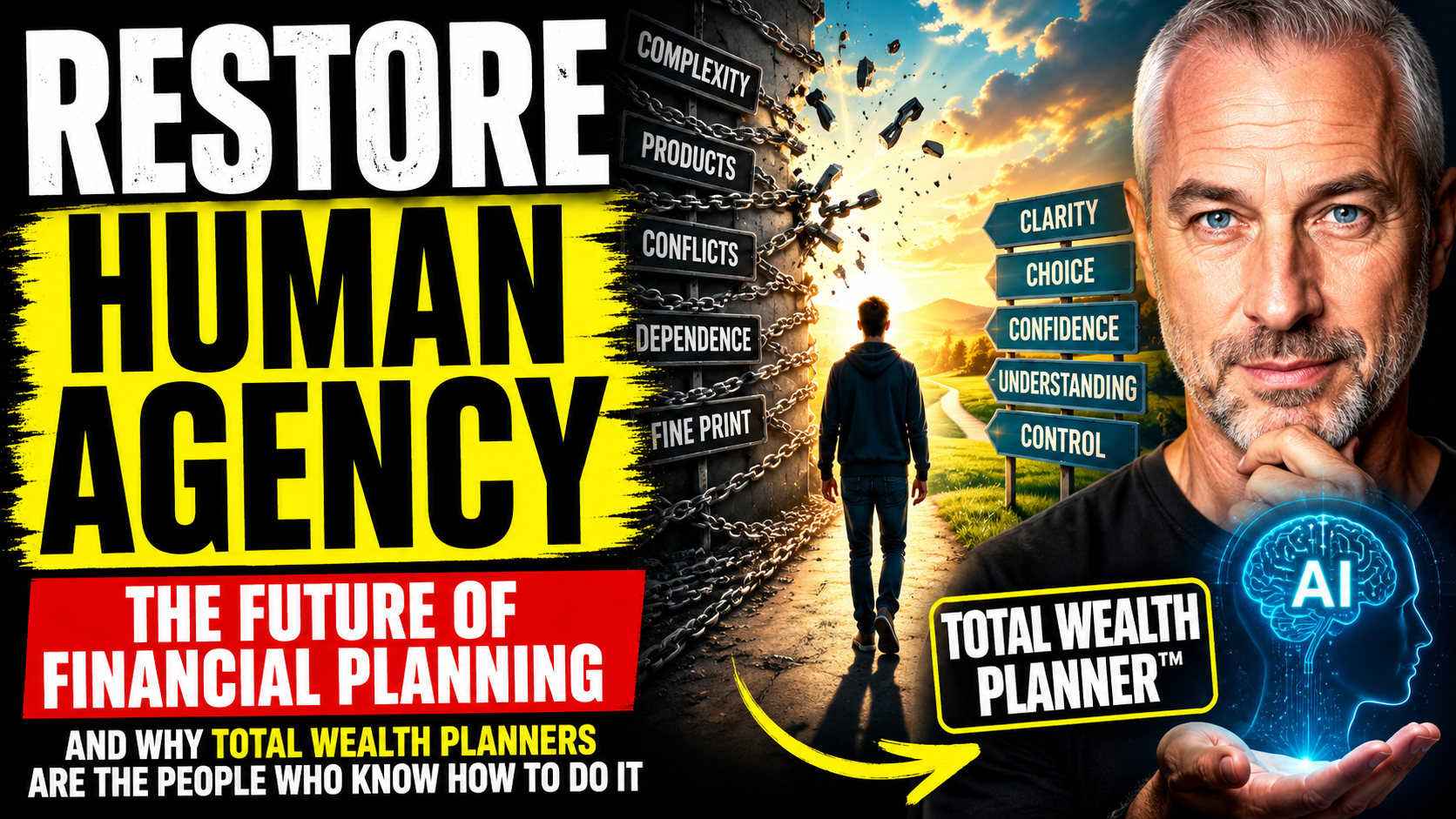
For years, the financial planning profession has largely been built around one central assumption:
People need experts to take control.
Control of investments.
Control of products.
Control of complexity.
Control of decision-making.
That model made sense in an era where financial information was scarce, expensive, fragmented, and difficult for ordinary people to access.
But the world has changed.
Artificial intelligence is rapidly reducing information asymmetry. Financial modelling, pension analysis, cashflow forecasting, tax explanations, and scenario exploration are becoming increasingly accessible to ordinary people — often instantly, and often at little or no cost.
The value of financial professionals can no longer rest primarily on access to information.
The future belongs to something else.
Not replacing human beings with AI.
Not removing professionals.
Not abandoning expertise.
But restoring human agency.
What “restoring human agency” actually means
Human agency means helping people remain capable of thinking, deciding, adapting, and acting in their own interests.
It means:
- understanding before committing
- clarity before delegation
- participation rather than dependence
- confidence without coercion
- support without surrendering control
This matters because complexity has not disappeared.
In fact, complexity may increase in the age of AI.
People still face:
- retirement decisions
- pension choices
- inheritance planning
- business transitions
- taxation complexity
- care costs
- relationship breakdown
- redundancy
- uncertainty about work and identity
At these moments, people do not simply need “more information.”
Very often, they need:
- interpretation
- perspective
- emotional steadiness
- structured thinking
- behavioural insight
- scenario exploration
- judgement
They need someone who can help them think clearly without taking over their life.
That is the emerging role of the Total Wealth Planner™.
The old model was built around distribution
Much of traditional financial advice evolved inside a product-distribution system.
The economics of the industry were shaped around:
- gathering assets
- product placement
- ongoing management
- platform relationships
- recurring fees tied to financial capital
The planner often became:
- gatekeeper,
- intermediary,
- or controller of financial decision-making.
But AI changes the economics of information.
When clients can increasingly access:
- analysis,
- modelling,
- education,
- and explanations themselves,
the role of the professional shifts.
The future professional is not the person who hides information behind complexity.
The future professional is the person who helps human beings navigate complexity without losing themselves inside it.
That requires a different orientation.
Less:
“Trust me and delegate.”
More:
“Let’s think clearly together.”
Why this matters now
Many financial professionals already sense the shift.
Clients are arriving:
- better informed,
- more questioning,
- more independent,
- and increasingly AI-assisted themselves.
At the same time, trust in institutions continues to weaken.
Consumers are becoming more aware of:
- conflicts of interest,
- hidden incentives,
- opaque charging structures,
- and systems optimised around institutional outcomes rather than human flourishing.
Against that backdrop, planners face a choice.
Continue competing primarily on:
- information,
- products,
- and technical access,
or evolve toward a more human role:
- thinking partner,
- strategic guide,
- behavioural interpreter,
- capability builder,
- and clarity provider.
The second path is where the future is heading.
The rise of the Total Wealth Planner™
At the Academy of Life Planning, we believe a new category of professional is emerging.
The Total Wealth Planner™.
Not anti-advice.
Not anti-technology.
Not anti-expertise.
But beyond the limitations of a purely product-led model.
A Total Wealth Planner helps individuals:
- align money with life
- navigate uncertainty
- maintain optionality
- build resilience
- think clearly during transitions
- and remain capable in a complex world
AI becomes part of the toolkit — not the replacement for human judgement.
Technology can model outcomes.
But human beings still need help with:
- meaning,
- trade-offs,
- priorities,
- behaviour,
- relationships,
- fear,
- identity,
- and purpose.
Financial planning is becoming more human, not less.
The GAME Plan™ approach
At the centre of the Academy’s framework is the GAME Plan™:
Goals → Actions → Means → Execution
The sequence matters.
Traditional financial systems often begin with products, money, or execution.
The GAME Plan starts with life.
What matters to this person?
What kind of life are they trying to build?
What trade-offs are acceptable?
What does “enough” look like?
What future are they attempting to create?
Only then do we ask:
“What financial architecture best supports that life?”
This is not simply a technical process.
It is a human process.
Why this is commercially important for planners
This is not only a philosophical shift.
It is also a strategic one.
As AI commoditises information, planners who rely solely on technical access may face increasing pressure.
But professionals who can:
- facilitate clarity,
- build trust,
- support judgement,
- and help people navigate complexity
become more valuable, not less.
The future financial planner is unlikely to win by being the human calculator.
They win by becoming the trusted thinking partner.
That is a different proposition entirely.
And importantly, it is harder to automate.
The future of planning
The future of financial planning is not about creating more dependency.
It is about helping people remain capable, informed, and autonomous while navigating increasingly complex systems.
That does not diminish the role of professionals.
It elevates it.
The best planners of the future may not be those who control clients most effectively.
They may be those who help people think most clearly.
That is the direction the Academy of Life Planning is building toward.
And that is why the role of the Total Wealth Planner™ matters now more than ever.
Curious how others see this.
 Academy of Life Planning