
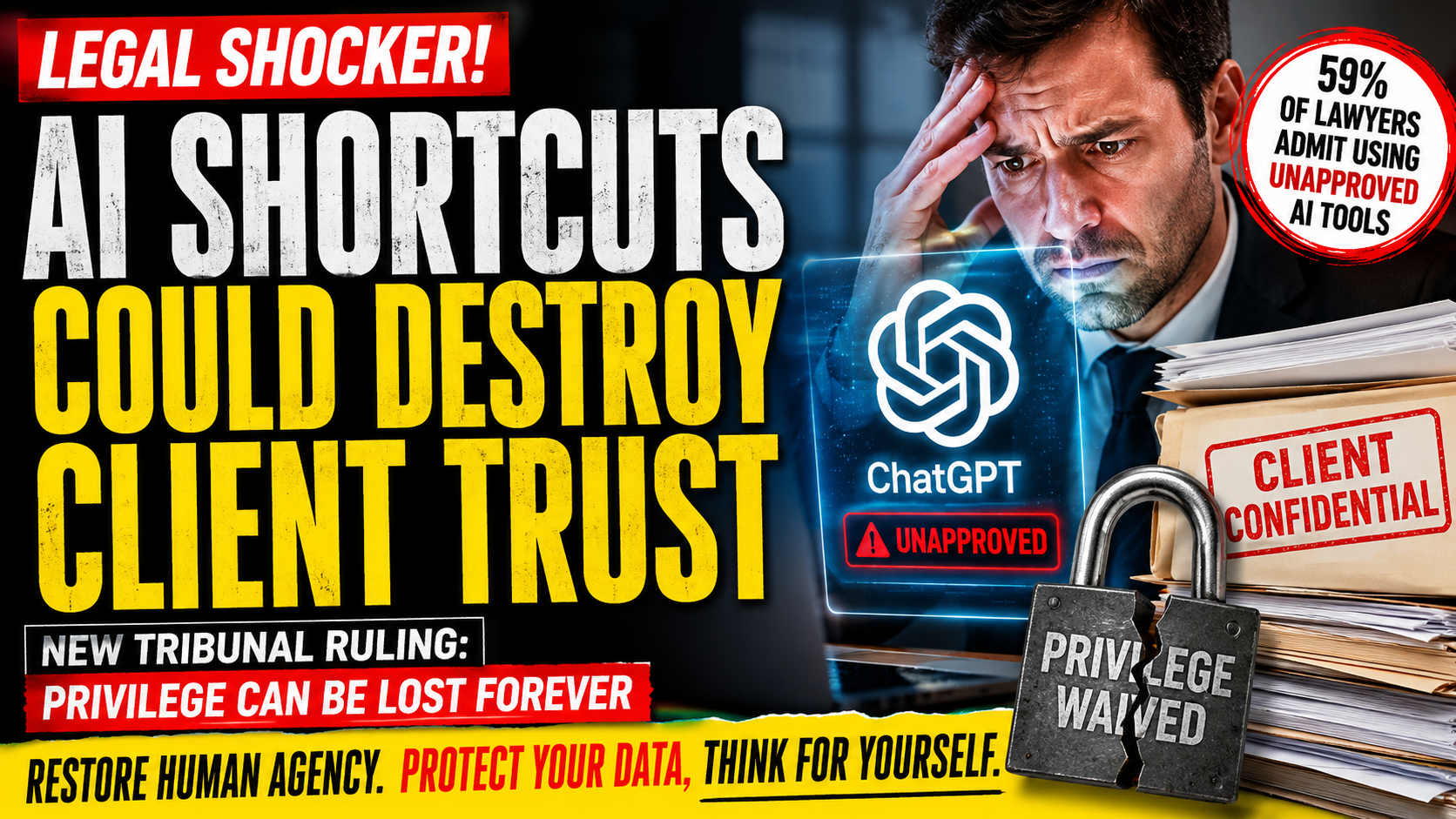
A recent legal sector survey revealed something deeply important — and not just for lawyers.
Nearly 60% of legal professionals admitted using unapproved public AI tools such as free versions of ChatGPT for client work, despite confidentiality obligations and professional conduct rules. At the same time, many firm leaders believed their organisations faced “zero risk” from unauthorised AI use.
Then came the legal warning shot.
In Munir v Secretary of State for the Home Department [2026], the Upper Tribunal reportedly confirmed that uploading privileged material into open AI systems may permanently waive legal professional privilege and breach confidentiality obligations.
The legal profession is now confronting a difficult truth:
The problem is not simply AI.
The problem is uncontrolled dependency on opaque systems.
And that lesson extends far beyond law.
It reaches into:
- financial planning
- banking
- healthcare
- education
- HR
- government
- insurance
- consumer technology
- and increasingly, everyday life itself.
Because the central challenge of the AI age is not merely technological.
It is civilisational.
Who controls the systems shaping human decisions?
And who controls the data, judgement, and autonomy of the people inside them?
The Real Issue Is Not AI — It Is Agency
Much of the public discussion around AI still focuses on capability.
What can AI do?
How powerful will it become?
Which jobs will disappear?
Which professions are “safe”?
But beneath the surface, a more important question is emerging:
What happens to human agency when critical thinking, personal judgement, and decision-making become increasingly mediated through systems people do not understand and cannot control?
That is the deeper issue.
Because modern institutional systems increasingly encourage dependency:
- dependency on experts
- dependency on platforms
- dependency on algorithms
- dependency on black-box recommendations
- dependency on systems optimised for institutional outcomes rather than human flourishing.
The legal profession’s AI dilemma is simply an early warning signal.
Professionals under pressure quietly adopted tools that made their work easier.
Not because they were reckless.
But because the systems around them were already strained:
- excessive workloads
- complexity overload
- administrative burden
- rising client expectations
- shrinking cognitive bandwidth.
In many ways, this mirrors what has already happened across financial services.
Consumers overwhelmed by complexity often surrender judgement to systems they barely understand:
- investment platforms
- recommendation engines
- automated risk profiling
- opaque suitability processes
- behavioural nudges
- product-led advice models.
The result is not always empowerment.
Sometimes it is simply technologically enhanced dependency.
AI Is Amplifying an Existing Problem
The uncomfortable truth is this:
Most people already lacked meaningful agency before AI arrived.
AI is merely accelerating the consequences.
For decades, modern systems have conditioned people to outsource thinking:
- “Trust the expert.”
- “Trust the institution.”
- “Trust the process.”
- “Trust the model.”
- “Trust the recommendation.”
But trust without understanding is not empowerment.
And when systems become sufficiently complex, individuals can gradually lose:
- confidence
- discernment
- participation
- adaptability
- and eventually responsibility for their own lives.
This is why the Academy of Life Planning increasingly frames the future challenge as one of restored human agency.
Not anti-technology.
Not anti-AI.
But pro-human capability.
Because the danger is not that AI becomes intelligent.
The danger is that humans become passive.
Opaque Systems Create Structural Vulnerability
The legal sector example illustrates a wider societal pattern.
When systems become opaque:
- users stop understanding consequences
- responsibility becomes blurred
- incentives become hidden
- risks become externalised
- and human judgement weakens.
This creates structural vulnerability.
We see this everywhere:
- consumers signing agreements they do not understand
- users accepting terms and conditions without informed consent
- investors following portfolio models they cannot explain
- citizens trusting algorithmic systems they cannot interrogate
- professionals relying on AI outputs they cannot verify.
Convenience quietly replaces comprehension.
And over time, people become increasingly disconnected from the systems governing their lives.
This is one reason why trust in institutions continues to deteriorate globally.
Not because people reject expertise.
But because they increasingly sense:
- asymmetry
- opacity
- hidden incentives
- and loss of control.
The Future Is Not Human vs AI
Much of the current debate frames AI as a competition between humans and machines.
But this framing misses the point entirely.
The real future challenge is:
Can humans remain psychologically, economically, and cognitively sovereign while using increasingly powerful systems?
That is a completely different question.
Because AI can absolutely enhance human capability.
It can help people:
- model scenarios
- organise information
- improve clarity
- reduce cognitive overload
- explore options
- identify blind spots
- learn faster
- regain confidence
- and participate more actively in decision-making.
But only if the architecture itself supports agency.
This is why the distinction between open public AI and controlled, trustworthy AI environments is becoming critically important.
The issue is not simply whether AI exists.
The issue is:
- who controls the environment
- where the data goes
- how the outputs are generated
- what incentives shape the system
- whether the user remains in control
- and whether the system increases or reduces independent judgement.
The Next Era Will Reward Trustworthy Architecture
The legal sector’s AI wake-up call is likely only the beginning.
Financial services, healthcare, insurance, and public services will face similar tensions.
Because the challenge is no longer simply digital transformation.
It is governance transformation.
The winners of the next era may not be the loudest AI companies.
They may be the organisations that create trustworthy human-centred systems.
Systems that:
- preserve privacy
- enhance understanding
- support informed consent
- strengthen capability
- reduce dependency
- maintain transparency
- and keep the individual psychologically engaged in the process.
This is why the Academy of Life Planning increasingly speaks about public-interest protection tools.
Not because technology itself is bad.
But because technology without agency can become extractive.
And in the age of AI, protecting human agency may become one of the defining public-interest challenges of our time.
Advice Out. Agency In.
For decades, many systems have been designed around institutional optimisation:
- gathering assets
- reducing friction
- increasing retention
- scaling influence
- improving behavioural compliance.
But the AI era creates an opportunity to reverse the direction.
To move from:
- dependency → capability
- opacity → transparency
- persuasion → understanding
- delegation → participation
- institutional control → human agency.
This does not mean people will never seek advice or support.
Of course they will.
But the relationship itself may change.
The future may belong less to systems that tell people what to do…
…and more to systems that help people think clearly enough to participate meaningfully in their own lives.
A More Important Question
Perhaps the most important question in the AI age is no longer:
“What can AI do?”
But rather:
“What kind of human beings are we becoming while using it?”
Because a society that automates judgement without strengthening wisdom risks creating highly efficient dependency.
Whereas a society that uses AI to restore clarity, capability, and participation may unlock something far more valuable:
Human flourishing with technological support — rather than technological submission.
That is the deeper mission behind restoring human agency.
Not resisting the future.
But ensuring the future still belongs to human beings.
Addendum: Why Local-First Planning Matters in the Age of AI
One of the most important questions emerging in the AI era is not simply:
“What can AI do?”
But:
“Where does your data go when you use it?”
This matters far more than most people realise.
Because many modern AI systems operate by sending user information to external servers, cloud platforms, third-party processors, or institutional environments that the individual neither controls nor fully understands.
In practical terms, this can mean:
- personal financial information
- sensitive life details
- behavioural patterns
- health concerns
- relationship circumstances
- goals, fears, vulnerabilities, and intentions
…being processed inside systems outside the individual’s direct control.
That creates both privacy risk and power asymmetry.
Why the Academy Takes a Different Approach
At the Academy of Life Planning, we increasingly believe that restoring human agency requires restoring informational sovereignty.
In simple terms:
People should be able to think, plan, model, and reflect without automatically surrendering their private lives to institutional databases.
This is one reason many AoLP tools are designed around a local-first philosophy wherever possible.
Here’s a simple way to think about it:
Traditional cloud systems often work like this:
- your information leaves your device
- it is stored externally
- processed remotely
- and governed by institutional infrastructure you do not control.
Local-first systems reverse much of that relationship.
The processing and storage remain primarily under the individual’s control on their own device or within tightly constrained environments.
Why This Matters
Local-first architecture reduces several important risks.
1. Reduced Data Exposure
If data is not routinely stored centrally, there is less:
- mass aggregation
- centralised surveillance risk
- third-party exposure
- attack surface for breaches
- institutional dependency.
Large centralised datasets are attractive targets.
Distributed local control naturally reduces concentration risk.
2. Greater Psychological Safety
People think differently when they feel watched.
One overlooked consequence of cloud-era systems is self-censorship.
Individuals may hesitate to:
- explore uncertainty
- model difficult scenarios
- ask sensitive questions
- reflect honestly
- or investigate options openly
if they believe their data is permanently stored, monitored, profiled, or commercially exploited.
A private planning environment creates space for clearer thinking.
And clearer thinking improves decision quality.
3. Separation Between Planning and Selling
Many institutional systems are not neutral.
Their commercial models may depend upon:
- retention
- behavioural influence
- product distribution
- engagement optimisation
- or monetisation of user behaviour.
AoLP’s philosophy is different.
The objective is not to maximise extraction from the individual.
It is to strengthen the individual’s own decision-making capability.
That changes the architecture itself.
4. Human Agency Requires Cognitive Ownership
If AI becomes a system that simply tells people what to do, dependency increases.
But if AI helps people:
- understand trade-offs
- organise complexity
- test scenarios
- reflect on consequences
- and improve clarity
then capability increases.
That distinction matters enormously.
AoLP tools are increasingly designed to function as:
- thinking environments
- decision-support systems
- capability enhancers
—not autonomous replacement systems demanding blind trust.
5. Institutional Trust Is No Longer Assumed
Across society, trust in institutions has weakened:
- financial institutions
- technology companies
- governments
- media organisations
- and even professional bodies.
At the same time, AI dramatically increases the scale at which personal data can be analysed, profiled, and inferred.
This creates a new public-interest challenge:
How do individuals benefit from AI without becoming digitally dependent upon opaque institutional systems?
AoLP’s answer is not anti-technology.
It is pro-human control.
A More Balanced Future
The future does not need to become:
- humans versus AI
- privacy versus innovation
- or institutions versus individuals.
But healthier systems may require a rebalancing of power.
One where:
- individuals retain meaningful control
- planning happens before persuasion
- understanding comes before commitment
- and AI strengthens independent judgement rather than replacing it.
That is why the Academy increasingly describes its tools as public-interest protection tools.
Not because technology is bad.
But because human agency is too important to surrender carelessly.
And in the age of AI, protecting the individual’s ability to think clearly, privately, and independently may become one of the defining responsibilities of ethical system design.

