
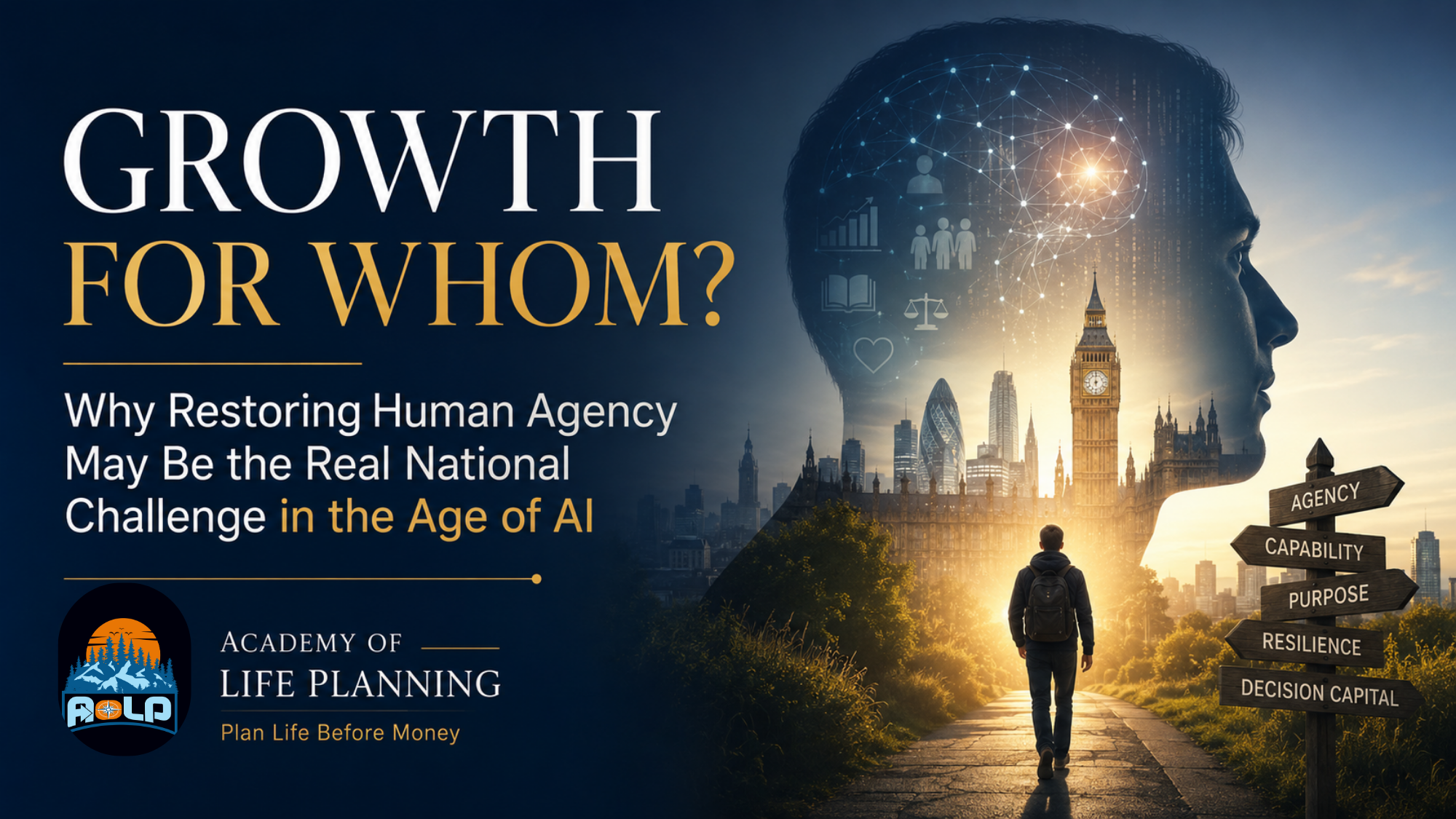
Growth for Whom? Why Restoring Human Agency May Be the Real National Challenge
In a recent article, Rishi Sunak argued that economic growth remains the defining challenge facing Britain. Without stronger growth, he warned, public finances worsen, politics becomes more volatile, and increasingly difficult decisions must be made regarding regulation, the size of the state, and social protections.
Few would dispute that economic stagnation creates serious national problems. Yet there is something revealing about the way modern politics continues to frame the question. Across much of Westminster, from left to right, growth is treated not merely as an important objective, but as the central organising principle of national life itself.
The assumption beneath this consensus is rarely examined closely enough.
When politicians speak about “growing the economy”, what they are often describing in practice is the expansion and optimisation of institutions: larger markets, greater financial activity, higher productivity metrics, stronger corporate performance, more transactions, more consumption, more tax revenue, and more scalable systems. Gross Domestic Product becomes the dominant proxy for national success.
But GDP is not a measure of human flourishing.
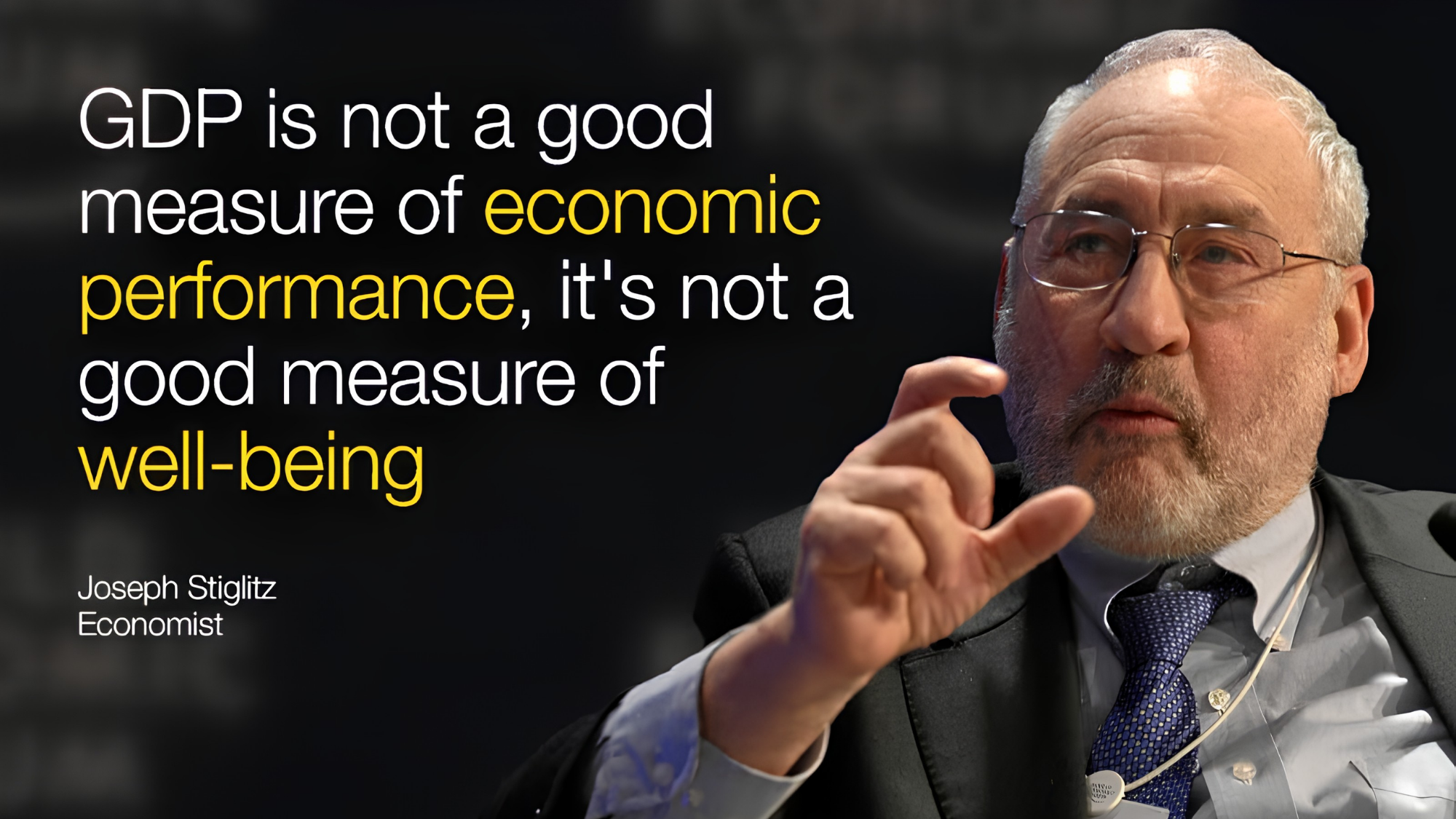
As the economist Joseph Stiglitz has argued for many years, GDP measures economic activity, not whether life is actually improving for ordinary people. A nation can experience rising output while simultaneously facing worsening insecurity, declining trust, deteriorating mental health, growing inequality, and environmental or social breakdown. Economic statistics may strengthen while lived experience weakens.
Stiglitz famously observed that what we measure shapes what we pursue. If governments primarily measure production, consumption, and transaction volume, then political systems inevitably become oriented toward expanding those activities — even if they do not meaningfully improve human wellbeing.
This becomes particularly important in an era where institutional success and human flourishing are no longer moving neatly together.
A country can experience rising GDP while simultaneously producing populations that feel exhausted, insecure, disconnected, financially anxious, and increasingly unable to navigate the complexity of modern life without institutional mediation. Economic growth can coexist with declining resilience, declining trust, and declining confidence in personal agency.
This distinction matters profoundly in the age of artificial intelligence.
For much of the industrial era, economic advantage depended heavily upon scarcity. Information was scarce. Expertise was scarce. Planning capability was scarce. Analysis, coordination, forecasting, and technical knowledge were concentrated inside institutions and professional classes. Individuals depended upon systems because systems possessed capabilities individuals simply could not access on their own.
AI changes this relationship fundamentally.
For the first time in history, advanced cognitive tools are becoming widely available to ordinary individuals. Analysis, strategic thinking, forecasting, simulation, personalised learning, and content creation are no longer the exclusive preserve of large organisations. Intelligence itself is becoming increasingly abundant and accessible.
This changes the nature of what societies should value.
The defining challenge of the next decade may not be how to make institutions incrementally more efficient. It may instead be how to help human beings remain adaptive, capable, sovereign, and psychologically resilient within increasingly intelligent systems.
That requires a very different policy conversation.
The most valuable forms of capital in the coming era may not primarily be financial. They may increasingly be forms of human capability: judgement, adaptability, emotional regulation, relational intelligence, ethical reasoning, creativity, practical wisdom, and what might best be described as decision capital — the ability to think clearly, navigate uncertainty, weigh trade-offs, and act intentionally within complex environments.
These are not peripheral “soft skills”. They are becoming core economic competencies.
Yet modern systems often appear structurally oriented in the opposite direction. Across finance, healthcare, education, welfare, and technology, individuals are frequently encouraged to delegate, comply, consume, and outsource judgement to systems they do not fully understand. Institutional convenience increasingly risks taking precedence over human capability development.
This is why the philosophy emerging from Bhutan remains so intellectually provocative.
Bhutan’s concept of Gross National Happiness, popularised by the Fourth King, Jigme Singye Wangchuck, challenged the assumption that GDP alone should define national progress. The principle was rooted in an older legal and philosophical tradition which held that if government could not create happiness for its people, then government itself had little purpose.
Whether one agrees entirely with Bhutan’s framework is secondary. The significance lies in the direction of the question being asked.
What is the economy for?
Western political systems often behave as though human beings exist primarily to sustain economic machinery. Bhutan inverted the hierarchy, asking instead what kind of economic system best supports human wellbeing and flourishing.
First define what human wellbeing and flourishing actually require, and then build an economic system designed to support and sustain those conditions.
That distinction becomes increasingly important as AI accelerates.
If societies focus exclusively on institutional optimisation while neglecting the development of human agency, the likely outcome is not empowerment but dependency. Systems may become more intelligent while individuals become progressively less confident in their own ability to think, decide, adapt, and participate meaningfully without guidance from institutional structures.
This may ultimately prove socially and politically destabilising.
Healthy economies are downstream of healthy people. Economies depend upon populations capable of trust, cooperation, adaptation, creativity, emotional resilience, and long-term thinking. If those human foundations weaken, institutional growth alone cannot compensate indefinitely.
At the Academy of Life Planning, we believe the future requires a broader understanding of wealth and progress — one that recognises the strategic importance of human agency itself. Planning life before money is not anti-growth. Nor is it anti-business or anti-technology. Rather, it reflects the belief that economies should ultimately serve the development of capable human beings, not merely the perpetuation of increasingly optimised systems.
This is particularly relevant in Britain today, where political debate often appears trapped between competing managerial approaches to administering institutional complexity. One side promises greater redistribution. Another promises greater efficiency. Yet both frequently remain oriented around the preservation and optimisation of large-scale systems.
Meanwhile, millions of individuals face a quieter crisis of capability and confidence. Many feel overwhelmed by financial complexity, technological acceleration, institutional distrust, and uncertainty about their future place in society.
The real national question may therefore not simply be how to grow the economy.
It may be how to grow human capability within the economy.
Because in the age of AI, the societies most likely to flourish may not be those that merely produce the largest institutions or the highest GDP figures. They may instead be those that succeed in developing populations that are adaptive, capable, purposeful, psychologically resilient, and able to participate meaningfully in shaping their own lives.
Not simply richer systems.
But stronger human beings.

