
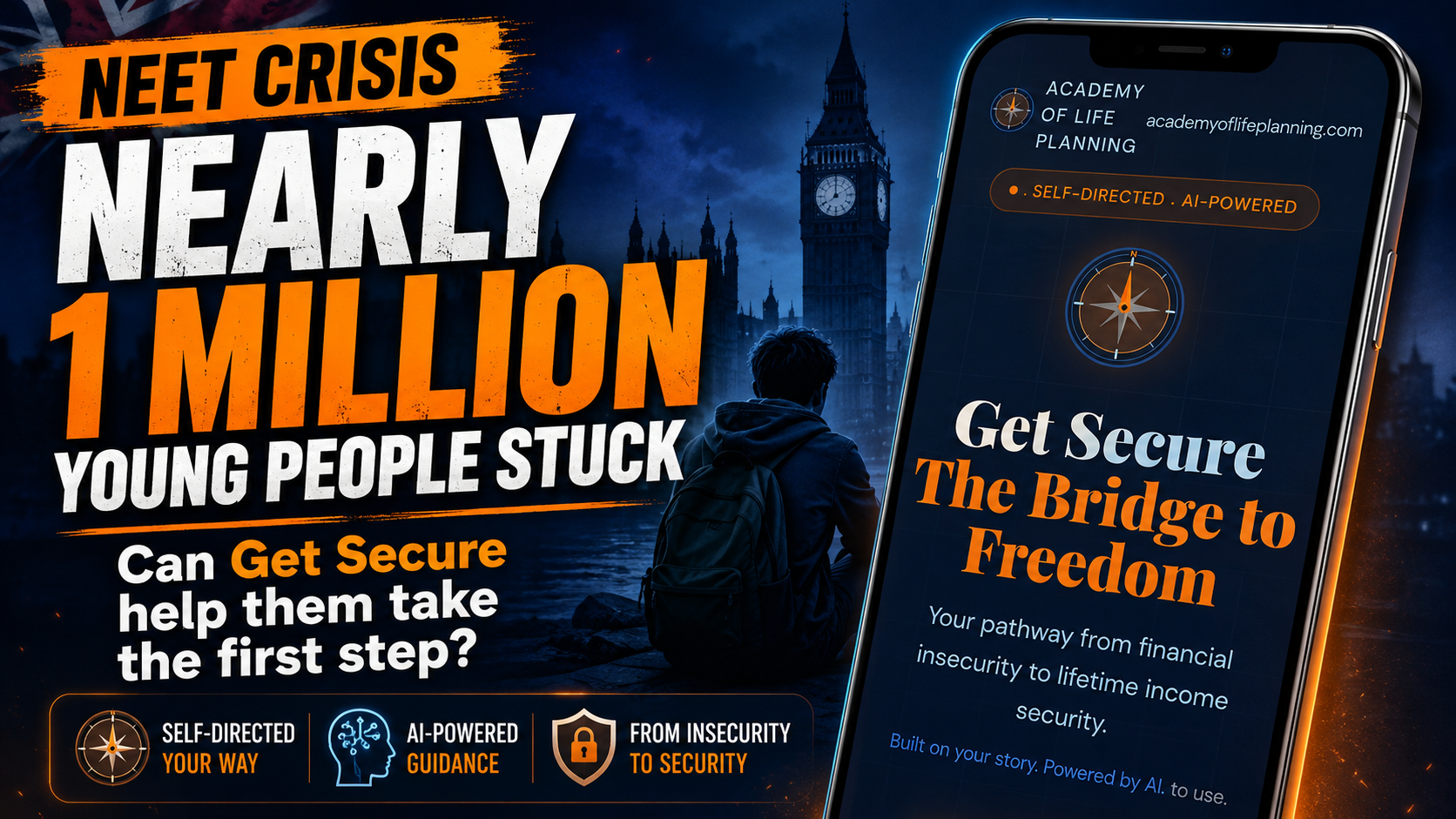
The app is here, accessible for all and available free of charge:
It will not solve everything.
But it may help someone take the first step from drift to direction.
Nearly one million young people in the UK are not in education, employment or training.
Alan Milburn’s recent review into young people and work should stop us in our tracks.
See: Independent report. Young people and work: interim report. Published 28 May 2026.
The shorthand is NEET, but we should be careful with that label. It can make a human crisis sound like an administrative category.
Behind the acronym are young people who may have lost routine, confidence, purpose, income, social connection, and belief in the future.
That matters.
Not just because it affects the economy. Not just because it increases future pressure on public services. Not just because it damages productivity, tax receipts, and long-term financial resilience.
It matters because a society that allows young people to drift at the very stage when they should be discovering their strengths, building confidence, and finding their place in the world has lost sight of something fundamental.
It has lost sight of agency.
This Is Not Simply a Jobs Problem
The public conversation often moves too quickly towards jobs, benefits, training schemes, or economic inactivity.
All of those matter. But they are not the whole story.
A young person who is out of education, employment, or training is not simply missing an income. They may also be missing structure, encouragement, trusted relationships, and a believable route forward.
That is why the question cannot simply be: “How do we get young people into work?”
A better question is:
How do we help young people begin again?
That beginning may be small. It may not look like a job application. It may not start with a CV, a college course, or a government programme.
It may start with a conversation.
What are you good at?
What do you care about?
What have you survived?
What do people come to you for?
What would you like to learn?
What problems in the world do you notice?
What could you build, offer, practise, repair, teach, create, support, or improve?
These are not soft questions. They are human capital questions.
Human capital means the skills, strengths, experience, character, creativity, relationships, and practical capability already present within a person. For many young people, especially those who have been overlooked or labelled as disengaged, that human capital has never been properly seen.
The Missing Bridge
Policy tends to work at system level. Schools, colleges, employers, benefits, apprenticeships, health services, local authorities, and careers guidance all have a role to play.
But the lived experience of a young person is often much more personal.
They may not know where to start.
They may not believe they have anything valuable to offer.
They may have been told, directly or indirectly, that they are a problem to be managed rather than a person with potential to be developed.
They may be overwhelmed by forms, expectations, interviews, rejection, comparison, anxiety, or shame.
So the missing bridge is often not information.
It is confidence.
It is structure.
It is a first step that feels safe enough to take.
This is where the Academy of Life Planning believes technology can help, provided it is used in the right way.
Not to replace human support.
Not to automate judgement.
Not to push people into unsuitable pathways.
But to help people think clearly, recognise what is already present, and begin to turn possibility into a plan.
Introducing Get Secure
Get Secure has been created as a simple AI-assisted planning tool for people facing income insecurity.
It is designed to help someone move from feeling stuck to seeing possible routes forward.
The idea is straightforward. Before asking someone to save, invest, budget better, or plan for retirement, we should first help them build income security. For many people, the most important asset they have is not financial capital. It is human capital.
Get Secure helps a person explore:
- what they are good at;
- what they enjoy or care about;
- what the world needs;
- what others might value or pay for;
- what skills, relationships, experience, and personal assets they already have;
- how AI might help them turn those assets into practical opportunities.
This could lead towards employment, self-employment, training, volunteering, enterprise, portfolio work, or simply a clearer next step.
It is not a magic answer.
It is not a substitute for education, youth services, mental health support, careers guidance, or good employment policy.
But it may offer something that is often missing: a structured first conversation about agency.
Why AI Matters Here
AI is often discussed as a threat to young people’s futures. There is truth in that concern. Entry-level jobs may be disrupted. Traditional career ladders may narrow. Some employers may reduce opportunities for young people to learn through work.
But AI can also be a human capital multiplier.
Used well, it can help someone with limited resources explore ideas, structure a plan, improve communication, learn faster, practise interviews, identify opportunities, build confidence, and turn dormant strengths into practical action.
For a young person without access to expensive advice, coaching, mentoring, or professional networks, that matters.
The question is not whether AI will shape the future of work. It already is.
The question is whether young people will be passive recipients of that change, or active participants in it.
Get Secure is built around the second possibility.
From Rescue to Prevention
One of the most important messages in the current NEET debate is that Britain intervenes too late.
We wait until a young person has dropped out, disappeared from the system, lost confidence, entered crisis, or developed a long gap in their CV. Then we ask why support is expensive and difficult.
A more human approach would lean in earlier.
It would notice when someone is drifting.
It would offer a first step before confidence collapses.
It would treat disengagement not as laziness, but as a signal that something has broken in the relationship between the person and the available pathways.
That does not mean removing responsibility. It means restoring the conditions in which responsibility can be exercised.
Agency is not the same as abandonment. Telling someone to “sort themselves out” is not agency. Nor is taking over their life and making decisions for them.
Agency means helping someone become the author of their own next step.
A Role for Parents, Grandparents, Teachers, Planners, and Community Supporters
The opportunity here is not only for policymakers.
Many people are worried about a young person in their family, community, school, workplace, or network.
They can see the drift. They can sense the loss of confidence. They may want to help, but not know how to begin the conversation without sounding critical, patronising, or unrealistic.
Get Secure can be used as a simple starting point.
Not as a lecture.
Not as pressure.
Not as another adult telling a young person what they should do.
But as an invitation:
“Would you like to explore what might be possible from what you already have within you?”
That is a very different conversation from:
“Why haven’t you got a job yet?”
The first restores dignity. The second often deepens shame.
Planning Life Before Money
At the Academy of Life Planning, we have long argued that financial planning should begin with life, not money.
That principle matters even more when someone has very little money.
Traditional financial services often start too late and too high up the wealth ladder. They serve people who already have assets, pensions, investments, and surplus income.
But if we are serious about reducing poverty and restoring human agency, planning must start much earlier.
It must start with the person.
Their strengths.
Their story.
Their energy.
Their relationships.
Their capacity to learn.
Their ability to create value.
Their sense of meaning.
Their next safe step.
That is why Get Secure exists.
It is a small contribution to a much larger national challenge. But small first steps matter when people feel stuck.
The Invitation
Nearly one million young people outside education, employment, or training should not be accepted as a normal feature of national life.
This is not only a policy failure. It is a failure of imagination.
We need better systems, better support, better vocational pathways, better employer engagement, better mental health provision, and better early intervention.
But we also need better first conversations.
Get Secure is one attempt to provide one.
If you know a young person who feels stuck, or someone supporting young people through family, education, youth work, community work, coaching, mentoring, employability, or financial wellbeing, please share it with them.
The app is here, accessible for all and available free of charge:
It will not solve everything.
But it may help someone take the first step from drift to direction.
And sometimes, that first step is where agency begins.

