
Why the next era of financial planning will not be built around products — but around connected systems that help people thrive
For most of modern history, people have lived inside systems they did not fully understand.
Financial systems. Legal systems. Pension systems. Healthcare systems. Education systems. Employment systems.
Each evolved separately. Each developed its own language, incentives, gatekeepers, and intermediaries. And over time, those systems became so complex that ordinary citizens were increasingly forced to delegate understanding and decision-making to institutions and professionals.
That model shaped the industrial age.
But something profound is now changing.
Artificial intelligence is beginning to collapse information asymmetry — the historic advantage institutions held over individuals. For the first time in history, ordinary people can access tools capable of helping them understand complexity, model decisions, analyse contracts, organise evidence, and navigate systems that once required specialist intermediaries.
This shift is much bigger than “AI productivity.”
It is a shift in agency.
And once agency begins shifting from institutions back to individuals, a deeper question emerges:
If people are going to operate with greater agency, what kind of ecosystem do they need around them to succeed?
That question sits at the heart of the Academy of Life Planning and the emerging Total Wealth Planning movement.
Part 1
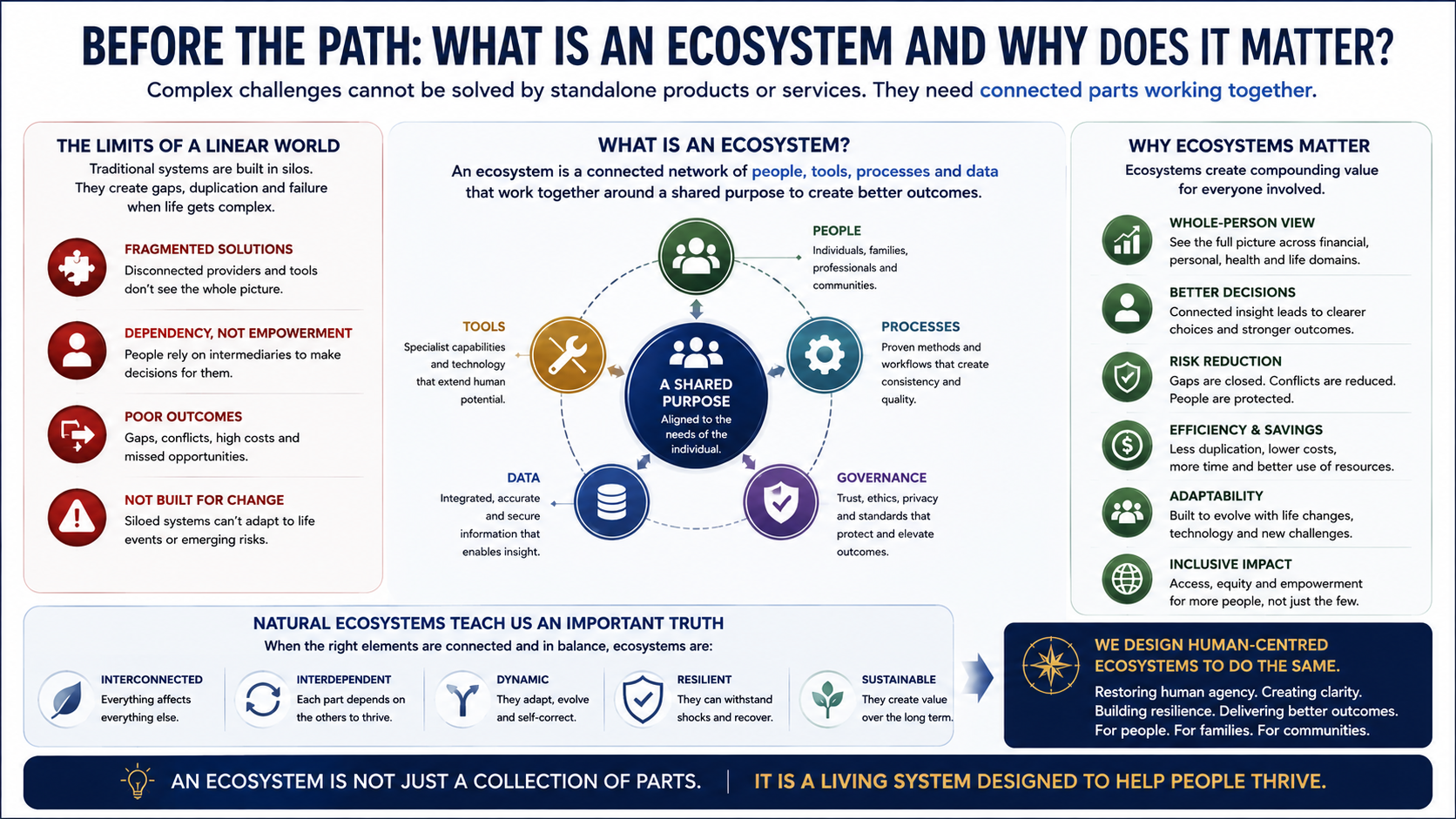
What Is an Ecosystem — and Why Does It Matter?
The word “ecosystem” is often used casually in business and technology. But in reality, ecosystems are one of the most important organising principles in nature, society, and human development.
An ecosystem is not simply a collection of parts.
It is a connected living system in which different elements interact, support one another, exchange information, adapt to change, and create outcomes that no isolated component could achieve alone.
Forests are ecosystems.
Communities are ecosystems.
Families are ecosystems.
Human life itself is an ecosystem.
Every ecosystem contains:
- people,
- resources,
- relationships,
- flows of information,
- feedback loops,
- support structures,
- and adaptive mechanisms.
When ecosystems are healthy:
- resilience increases,
- learning improves,
- resources circulate more effectively,
- and individuals are more capable of thriving.
When ecosystems are fragmented:
- complexity rises,
- coordination breaks down,
- duplication increases,
- vulnerabilities emerge,
- and people fall through the cracks.
This matters enormously in financial life.
Because most modern financial systems were not designed as coherent human ecosystems.
They evolved as fragmented institutional silos.
One company handles pensions.
Another handles investments.
Another handles insurance.
Another handles mortgages.
Another handles legal matters.
Another handles debt.
Another handles regulation.
Another handles complaints.
Another handles recovery after harm.
The individual sits in the middle trying to coordinate all of it.
And when life becomes complicated — bereavement, illness, redundancy, divorce, fraud, retirement, caring responsibilities, stress, cognitive overload — the fragmentation becomes visible.
People do not simply struggle financially.
They struggle systemically.
This is one reason why traditional financial planning models often feel incomplete.
Many were built primarily around financial capital.
But human life is larger than financial capital.
Human beings also operate through:
- human capital,
- social capital,
- emotional resilience,
- community support,
- practical capability,
- health,
- meaning,
- purpose,
- and adaptive capacity.
A person may have financial assets yet still lack agency.
Another may have little financial wealth yet possess extraordinary human and social capital capable of transforming their future.
This is where ecosystems become important.
Because ecosystems allow us to move from isolated products and transactions toward integrated human-centred support structures.
They allow us to stop asking:
“What financial product does this person need?”
And begin asking:
“What ecosystem would help this person thrive?”
That is a fundamentally different question.
Part 2
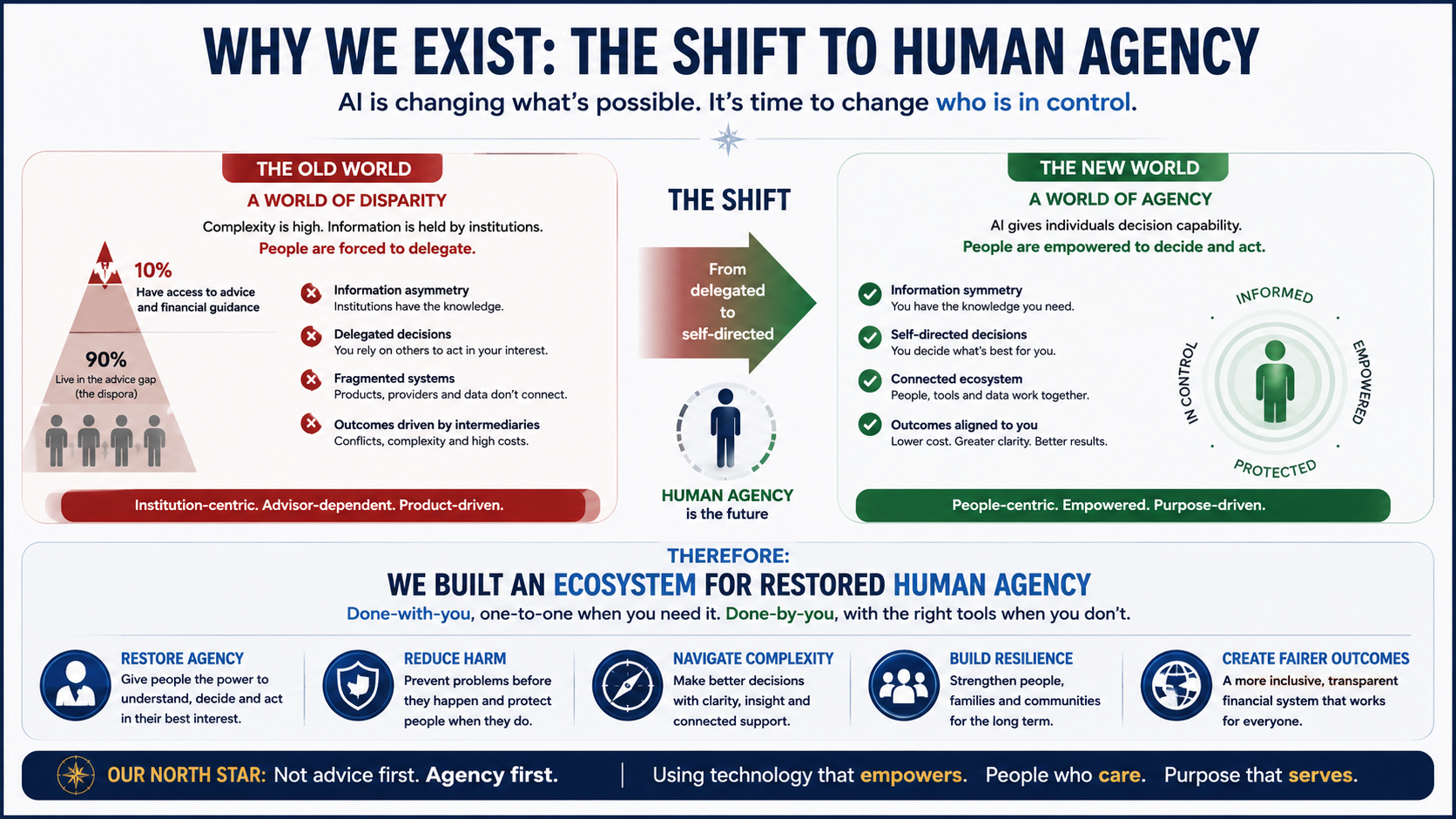
The Need for an Ecosystem for Restored Human Agency
For decades, the dominant financial model was built around delegated expertise.
Institutions held the information.
Professionals interpreted complexity.
Consumers relied on intermediaries.
This was understandable in a paper-based world.
Information was scarce.
Analysis was difficult.
Access was limited.
Decision-making capability was concentrated.
But AI changes the economics of capability.
Today, an individual with access to tools like Claude, Gemini or ChatGPT can:
- analyse documents,
- compare options,
- model decisions,
- summarise complexity,
- identify risks,
- draft correspondence,
- organise evidence,
- and understand concepts that once required specialist gatekeepers.
The implications are profound.
The future is unlikely to be a world where every citizen delegates life decisions to institutions.
It is increasingly becoming a world where individuals operate with enhanced decision capability — supported by technology, trusted frameworks, and human guidance when needed.
This does not eliminate the need for professionals.
But it changes the role of professionals.
The future professional is less likely to function as:
- gatekeeper,
- controller,
- product intermediary,
- or institutional representative.
And more likely to function as:
- guide,
- educator,
- second brain,
- strategic thinking partner,
- systems navigator,
- and capability builder.
This is the philosophical foundation behind Total Wealth Planning.
At its core, Total Wealth Planning is not primarily about selling financial products.
It is about restoring human agency.
The central idea is simple:
People should increasingly be capable of understanding, navigating, and directing their own lives — with support where needed, but without unnecessary dependency.
This matters because the modern world is becoming simultaneously:
- more complex,
- more data-driven,
- more cognitively demanding,
- and more structurally untrustworthy.
Individuals increasingly need:
- clarity,
- capability,
- resilience,
- and systems that help them think clearly under pressure.
The Academy of Life Planning was built around this shift.
Not simply to train financial professionals.
But to help build a new ecosystem capable of supporting human agency in the age of AI.
An ecosystem where:
- people can understand before they commit,
- navigate complexity during life transitions,
- and recover with dignity after harm.
An ecosystem that recognises that financial wellbeing cannot be separated from human wellbeing.
An ecosystem designed not around extraction —
but around empowerment.
Part 3
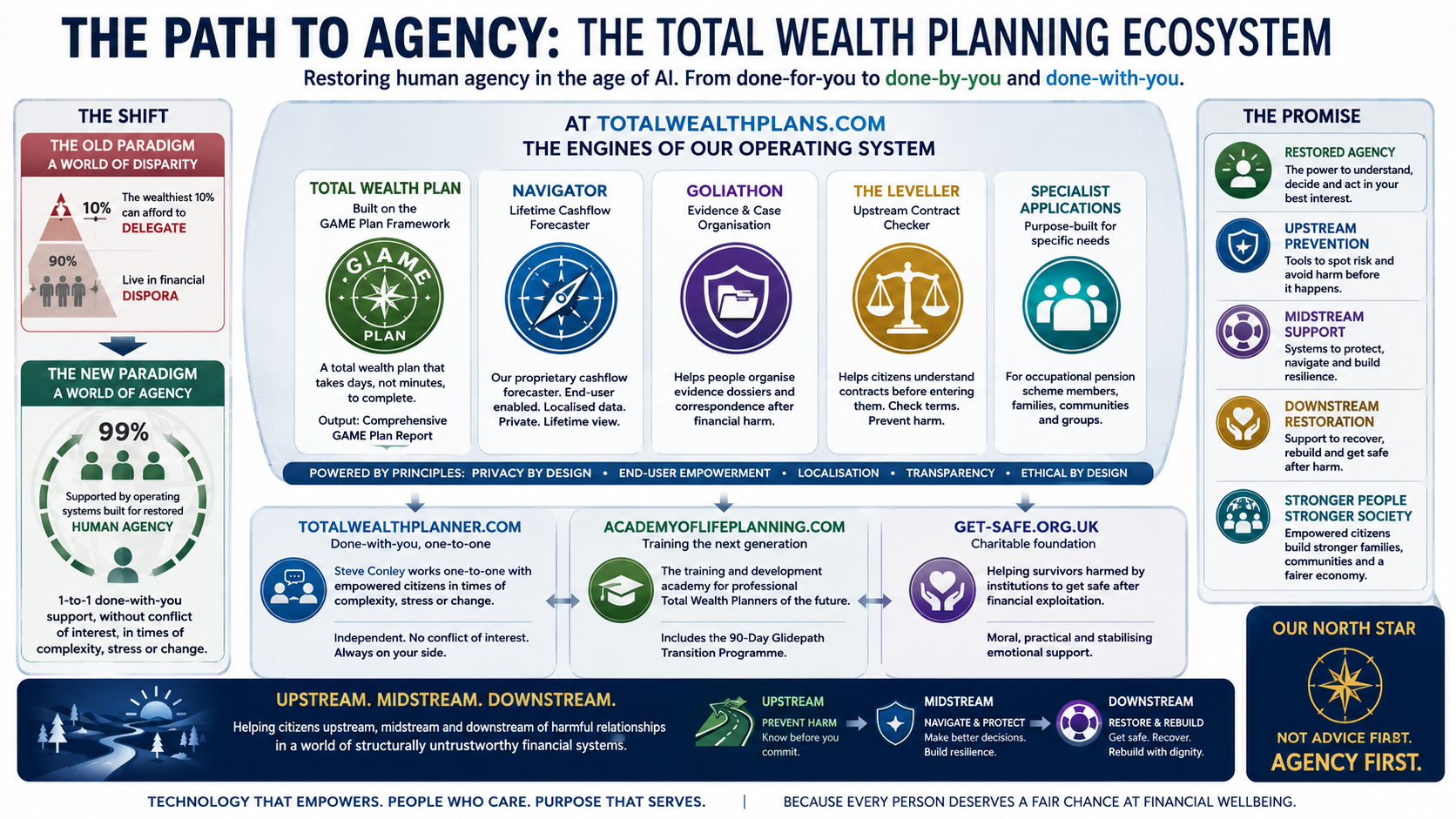
The Components of an Ecosystem for Restoring Human Agency
Once we understand ecosystems and the shift toward agency, the next question becomes practical:
What actually constitutes an ecosystem for restored human agency?
At the Academy of Life Planning, we increasingly see this ecosystem as consisting of interconnected layers that support individuals upstream, midstream, and downstream of complexity and harm.
Each component exists for a different purpose.
But together, they form a connected architecture.
1. The Total Wealth Plan
A framework for thinking before reacting
The Total Wealth Plan is built around the GAME Plan framework:
- Goals,
- Actions,
- Means,
- Execution.
Unlike traditional financial planning, it begins with life before money.
It asks:
- What matters?
- What kind of life are you trying to build?
- What resources already exist?
- What capabilities can be developed?
- What trade-offs exist?
- What future are you trying to create?
The purpose is not simply financial optimisation.
It is coherent decision-making.
In a world overloaded with information, people increasingly need structured thinking systems capable of helping them process complexity without becoming overwhelmed.
The Total Wealth Plan functions as a cognitive architecture for life planning.
2. Navigator
A modelling engine for life and decision-making
Navigator is the lifetime cashflow and scenario-planning layer of the ecosystem.
Its purpose is not merely forecasting.
Its deeper role is helping individuals safely explore:
- choices,
- uncertainty,
- trade-offs,
- timing,
- resilience,
- and long-term direction.
Importantly, Navigator was designed as an end-user system rather than a traditional adviser-controlled system.
That distinction matters.
Historically, most planning software was built around institutional workflows:
- adviser-owned data,
- platform integration,
- compliance oversight,
- centralised storage,
- and delegated control.
Navigator instead reflects a local-first philosophy:
- user-owned data,
- privacy by design,
- reduced dependency,
- and empowerment architecture.
The individual remains the primary agent.
3. The Leveller
Reducing information asymmetry before harm occurs
One of the biggest structural problems in modern life is asymmetry.
Institutions often possess:
- legal teams,
- technical language,
- specialist expertise,
- and informational advantages.
Citizens frequently sign agreements they do not fully understand.
The Leveller was designed to help rebalance that relationship.
It allows individuals to analyse contracts, identify risks, surface unusual clauses, and better understand what they are agreeing to before commitment.
This is upstream prevention.
Not after-the-fact remediation.
The aim is simple:
restore informed consent.
4. Goliathon
Organising clarity after financial harm
When harm occurs, people often experience:
- emotional overwhelm,
- fragmented evidence,
- confusion,
- cognitive exhaustion,
- and loss of confidence.
Goliathon was developed to help individuals organise:
- timelines,
- evidence,
- correspondence,
- narratives,
- and case structures.
Its purpose is not legal representation.
Its purpose is restoring coherence.
Because one of the greatest losses after financial harm is not simply money.
It is agency itself.
5. The Academy of Life Planning
Developing the next generation of Total Wealth Planners
An ecosystem also requires people.
Not simply software.
The Academy exists to help professionals transition from product-centred financial models toward human-centred planning models.
This includes:
- capability building,
- mentorship,
- ethical frameworks,
- systems thinking,
- and understanding how AI changes the relationship between institutions and individuals.
The emerging Total Wealth Planner is not merely an adviser.
They increasingly operate as:
- educator,
- guide,
- strategic partner,
- ecosystem navigator,
- and human capability developer.
6. Get SAFE
Restoring dignity after exploitation
Finally, ecosystems must account for recovery.
Because in structurally untrustworthy systems, harm will still occur.
Get SAFE exists to support people after financial exploitation through:
- stabilisation,
- emotional support,
- procedural clarity,
- evidence organisation,
- and practical next steps.
Not everyone needs intensive intervention.
But everyone deserves dignity, clarity, and a fair chance to recover.
From Fragmentation to Coherence
Taken individually, these components may appear separate.
But viewed together, they form something larger:
An ecosystem designed to help human beings think more clearly, act more intentionally, and navigate complexity with greater agency.
That is the real shift taking place beneath the AI conversation.
The future is not simply about smarter institutions.
It is about more capable humans.
And perhaps the defining question of the next decade will not be:
“How do we make systems more efficient?”
But rather:
“How do we build ecosystems that help people thrive inside increasingly complex systems?”
At the Academy of Life Planning, we believe that question may define the future of planning itself.
Not advice first.
Agency first.

