
The problem isn’t the tool. It’s where we start.
There’s a familiar pattern in financial services.
A product is introduced.
Its benefits are explained.
Case studies are shared.
And somewhere along the way, it begins to feel like the answer.
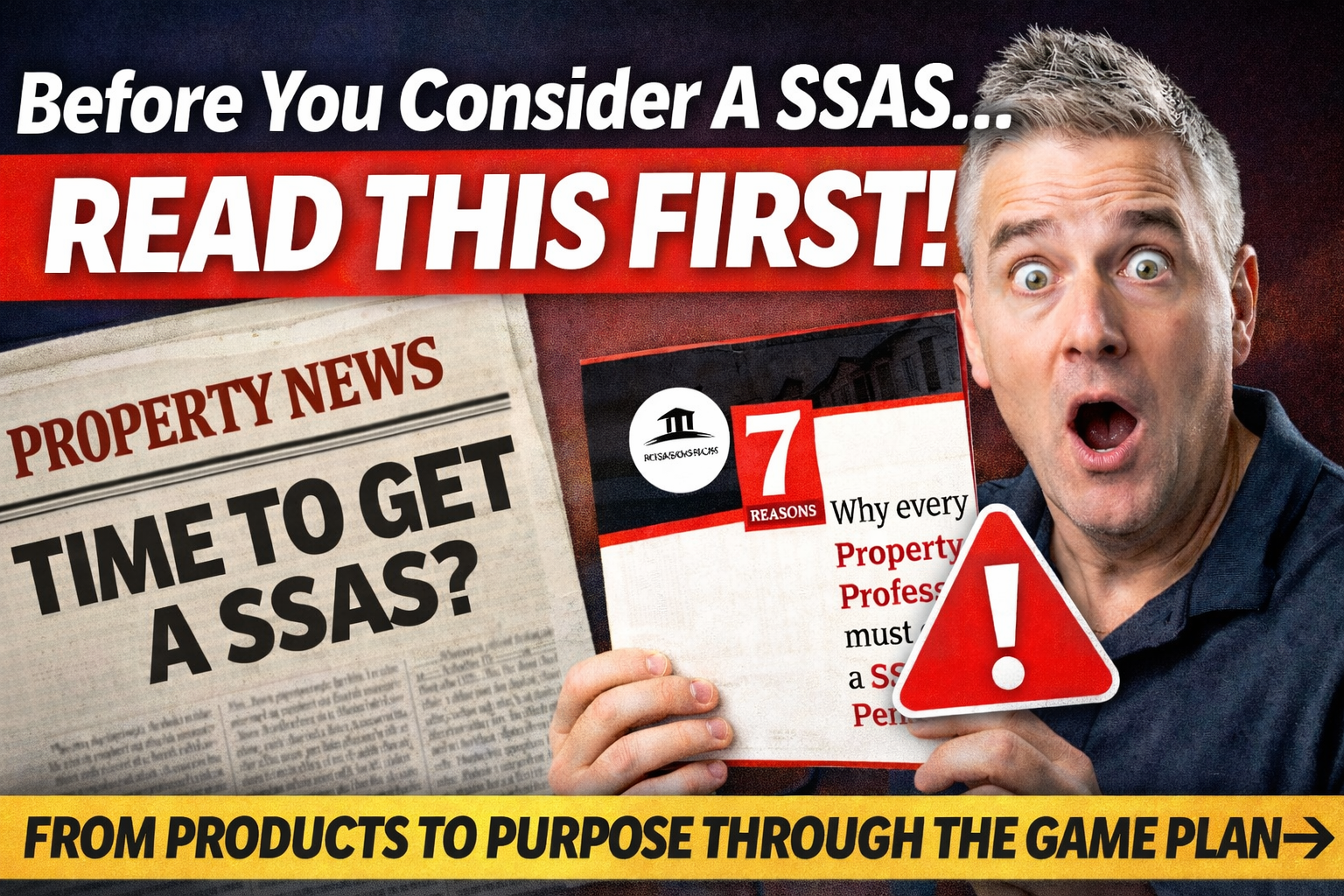
A recent SSAS property booklet is a good example.
It speaks the language of control.
It highlights flexibility.
It promotes using pensions as active capital.
All of which—on the surface—align with a more empowered future.
But there’s a subtle inversion.
The conversation begins with the tool.
And that changes everything.
Planning doesn’t start with a pension
At the Academy of Life Planning, we take a different view:
All planning begins with what is already present.
Not with products.
Not with tax wrappers.
Not with structures.
But with:
- Your life direction
- Your capabilities
- Your responsibilities
- Your existing capital (financial, human, social, emotional)
A SSAS is not a strategy.
It is a Means.
And Means only make sense once the Goal is clear.
Reframing SSAS through the GAME Plan
Let’s place the SSAS in its proper context using the GAME Plan:
1. Goals (What are we trying to create?)
Before considering any pension structure, we ask:
- What does your ideal life look like over the next 10–20 years?
- What role does work play?
- What level of income is enough?
- What are you building—for yourself, your family, your community?
For some, the goal may include:
- Building a property-based income stream
- Creating a family legacy
- Increasing autonomy over capital
But for others, it may not.
And that distinction matters.
2. Actions (What behaviours move us forward?)
Only once goals are clear do we explore actions:
- Building or scaling a business
- Acquiring assets
- Developing new skills
- Reducing dependency on external institutions
A SSAS does not create these actions.
It may support them—but it does not define them.
3. Means (Which tools are appropriate?)
Now—and only now—does the SSAS enter the conversation.
At this stage, we ask:
- Does this structure support the goals?
- Does it enhance flexibility or introduce complexity?
- Does it improve outcomes, or concentrate risk?
A SSAS can offer:
- Greater control over pension capital
- The ability to align capital with business activity
- Potential tax efficiencies
But it also introduces:
- Governance responsibilities
- Regulatory constraints
- Concentration risk (especially where business + property + pension overlap)
- Behavioural risk (confidence, overreach, illiquidity)
In AoLP, we hold both sides of the equation.
4. Execution (How is this implemented safely?)
Execution is where most harm occurs in traditional planning.
Not because the tool is wrong—but because:
- It was selected too early
- It wasn’t stress-tested
- It wasn’t aligned to the full life context
If a SSAS is appropriate, execution requires:
- Clear governance structures
- Independent oversight where needed
- Defined risk boundaries
- Ongoing review aligned to life changes
Execution is not “set and forget”.
It is conscious stewardship.
The hidden risk: when everything points in one direction
One of the most important considerations—often underplayed—is concentration.
When:
- Your business generates your income
- Your investments are in property
- Your pension is deployed into that same ecosystem
You create a single-point dependency.
This can work well.
Until it doesn’t.
True planning asks:
“What happens if this one system fails?”
Not to create fear—but to preserve resilience.
The opportunity: reclaiming agency without losing balance
The most valuable insight in the SSAS conversation is not the product itself.
It’s the shift it represents:
From passive participation → active engagement
That shift is real.
And it’s necessary.
But agency is not:
- Owning more complex structures
- Taking on more leverage
- Concentrating control
True agency is:
- Clarity of direction
- Alignment of decisions
- Balance across life domains
- The ability to choose—and adjust—over time
A better way to approach it
If you’re considering a SSAS—or any financial structure—start here:
1. Define your life first
- What are you building?
- What does “enough” look like?
2. Map your existing capital
- Financial
- Human (skills, earning power)
- Social (relationships, networks)
3. Identify your strategy
- Income
- Security
- Growth
- Legacy
4. Then evaluate tools
- SSAS
- ISA
- SIPP
- Business reinvestment
- Or none of the above
Each is just a vehicle.
From “must consider” to “may be appropriate”
The language we use matters.
“Must consider” implies inevitability.
“May be appropriate” invites thinking.
At AoLP, we don’t promote products.
We promote clarity.
Because when clarity is present:
- The right tools become obvious
- The wrong tools fall away
- And the individual—not the system—remains in control
Final thought
A SSAS can be powerful.
But power without context is risk.
And context only comes from planning life first.
If this resonates…
Explore how the GAME Plan helps you move from:
Products → Purpose
Advice → Agency
Complexity → Clarity
And build a Total Wealth Plan that starts with what is already present.
Curious how others are approaching this shift from product-led to life-led planning? I’d be interested in your perspective.

