
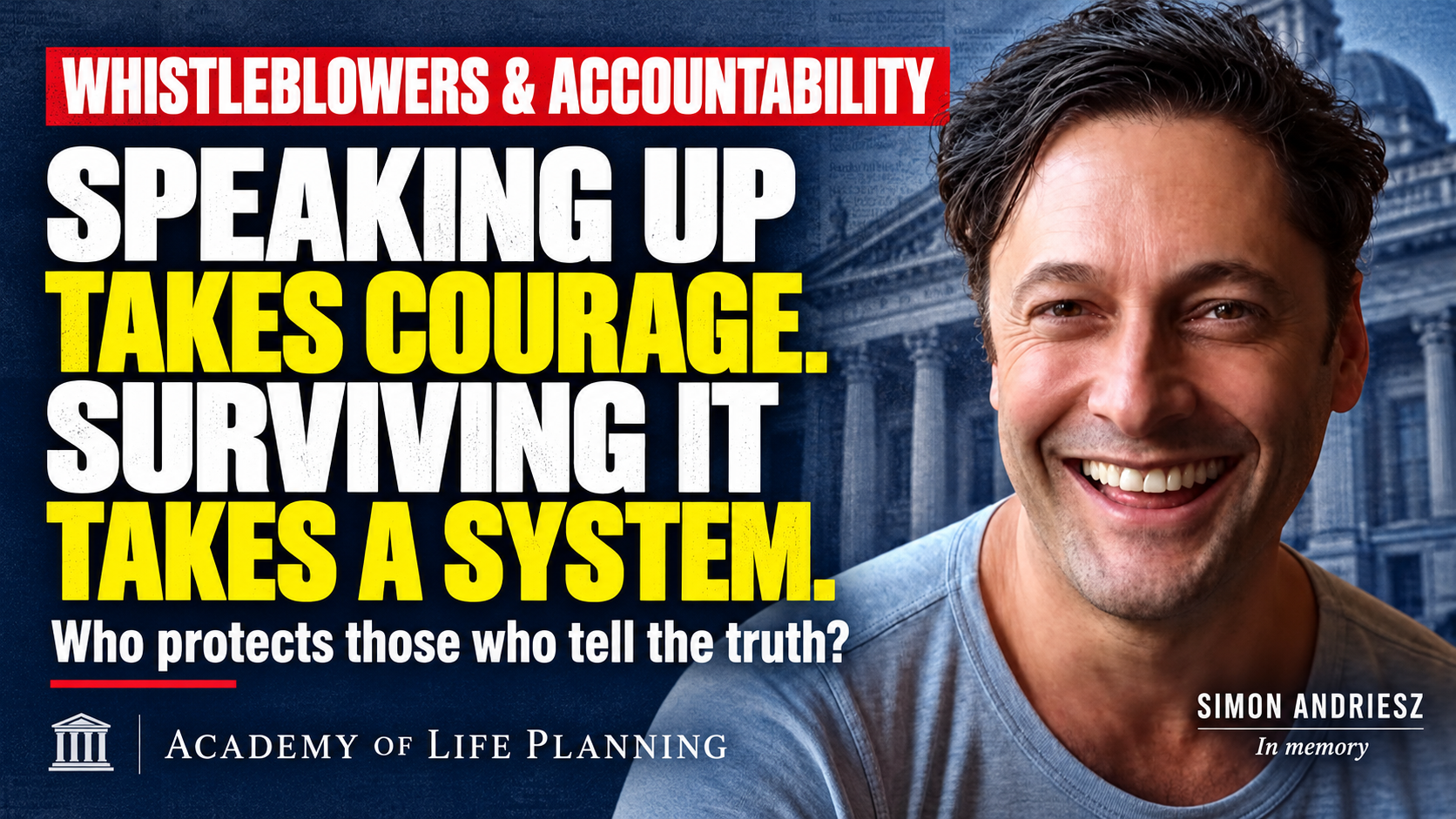
By Steve Conley | Academy of Life Planning | 21 October 2026
We tell people to speak up.
Report wrongdoing. Challenge misconduct. Take responsibility. Do the right thing.
But what happens after they do?
Who carries the cost when their income disappears, their career stalls, their health deteriorates and their family begins to struggle? Who helps them navigate the institutions to which we encouraged them to turn?
And who holds those institutions accountable when the person asking for protection becomes the person left defending themselves?
These questions sit at the heart of the case of Simon Andriesz, and the wider debate about the Financial Conduct Authority’s treatment of whistleblowers.
They also go to the heart of human agency.
The person behind the disclosure
On 21 October, the All-Party Parliamentary Group on Investment Fraud and Fairer Financial Services issued a press statement and supporting anthology dedicated to Simon’s memory. It brings together accounts from whistleblowers and advocates across several countries, alongside earlier testimony about dealings with the FCA.
According to the statement, Simon repeatedly reported retaliation and told the regulator that he and his family were in crisis. It records that the FCA acknowledged giving him incorrect information about his whistleblower protection and apologised. Simon died by suicide on 23 September 2026.
His representative, John Robertson, makes a particularly important point: complaints about Simon’s treatment were already live before his death. Simon had been actively challenging what had happened to him while he was alive.
Those concerns deserve examination on their evidence and chronology.
Suicide is complex. No single explanation can account for every factor involved. Recognising that complexity is compatible with examining the conduct, decisions and requests for help documented in this case.
There is a family behind this story. That must remain central to how it is discussed.
The freedom to speak needs somewhere safe to land
At the Academy of Life Planning, we describe agency as the capability to understand, question, choose, act and retain control.
Whistleblowing can express all of those capabilities. Someone recognises a problem, questions what they have been told, makes a difficult choice and acts in the public interest.
Yet their ability to retain control can collapse immediately afterwards.
Consider the imbalance. An institution may have salaried legal teams, established procedures, extensive records and years in which to respond. The individual may have savings running down, a mortgage to pay and a family depending on them.
The institution can continue operating while the individual’s capacity to continue challenging it diminishes.
That creates an agency gap: the distance between having a formal right to act and having the practical means to sustain that action.
A reporting channel can exist while that gap remains enormous.
Receiving information and protecting people are different responsibilities
A whistleblower can provide valuable intelligence. Their evidence may help an organisation identify misconduct, understand risk or take action.
But a system’s success in using information tells us little about the experience of the person who supplied it.
Did anyone respond meaningfully to reported retaliation? Was incorrect guidance corrected quickly enough to matter? Were the limits of each institution’s role explained clearly? Was there a workable route to support, challenge and redress?
The anthology describes recurring experiences of delay, fragmented responsibility, financial pressure and isolation. These are contributors’ accounts and allegations, requiring proper scrutiny. Their recurrence makes a broader examination necessary.
The danger is a system that benefits from a person’s courage while leaving that person to absorb the consequences.
Who controls the questions?
The FCA has appointed newly joined non-executive director Lea Paterson to review its interactions with Simon.
The APPG argues that this is insufficient. Its concern extends beyond the identity of the reviewer to who controls the scope, terms of reference and boundaries of the evidence.
That distinction matters.
A review can be conducted conscientiously and still answer too narrow a question. Examining communications with one person may reveal mistakes. Establishing whether similar experiences recur across cases requires a wider remit.
Independence therefore needs to run through the whole process: who sets the questions, who obtains the evidence, who reaches conclusions, what is published and who checks that recommendations are implemented.
That protects the credibility of the findings, including findings favourable to the institution under examination.
John Robertson’s contribution offers a useful example of agency in practice. He continues to engage constructively with the FCA while making clear that participation does not amount to endorsing the review’s independence, scope or adequacy.
People should be able to engage with a process and challenge its design at the same time.
The accountability test
The anthology is a collection of testimony and argument. The APPG explicitly acknowledges that every contributor’s statement should not be treated as irrefutable fact. Calling for independent investigation does not require us to prejudge its findings.
It requires us to recognise that serious questions deserve a process capable of answering them.
For me, a credible response should meet five practical tests:
- Independent scrutiny. Serious allegations about an institution’s own conduct need examination with demonstrable separation from that institution’s interests.
- A scope wide enough to identify patterns. Comparable cases and earlier warnings should be considered where relevant, alongside the individual chronology.
- Clear responsibility for responses to retaliation and distress. People need to know who can act, what action is available and how urgent concerns will be escalated.
- Support people can actually use. Independent guidance, help organising evidence and access to appropriate legal and wellbeing support can determine whether someone can continue.
- Visible follow-through. Recommendations need named owners, deadlines and independent checks on whether they have improved people’s experiences.
These are standards against which arrangements can be assessed. They are also design principles for building something better.
Capability and accountability belong together
The Academy’s mission is to help people become more capable of directing their own lives.
That includes scrutinising powerful institutions. People need the ability to organise evidence, understand explanations, ask better questions and make informed decisions about their next steps.
AI can help with parts of that work: arranging a chronology, comparing documents or preparing questions for a qualified professional. Its output still needs checking. It cannot confer legal protection, compel an institution to respond or remove the personal risks of disclosure.
This sets an important boundary for agency-led work. Improving someone’s capability must be accompanied by attention to the conditions in which they must use it.
Otherwise, “empowerment” risks becoming another way of transferring responsibility to the person with the fewest resources.
We should help people stand on their own feet. We should also ask what happens when the ground beneath them gives way.
What happens after someone speaks?
A healthy system needs people willing to tell it uncomfortable truths. Its response determines whether the next person feels able to do the same.
Simon’s case deserves careful, independent examination. The other experiences collected in this anthology deserve to be heard and tested. His family deserves respect throughout that process.
The wider challenge is to build institutions in which public-interest action is practically sustainable.
Speaking up is an act of agency. Whether someone can survive speaking up is a test of the system.
When we ask people to find their voice, what have we put in place to ensure they can keep using it?
Sources and editorial context
- APPG on Investment Fraud and Fairer Financial Services, Press Statement with Supporting Anthology, 21 October 2026. In particular: statement, pages 3–5; editorial qualification, page 8; John Robertson’s contribution, pages 9–11; conclusion and earlier testimony, pages 69–107. This is a collection of stakeholder testimony and advocacy, rather than an independent inquiry’s findings.
- FCA: Looking at how we interact with whistleblowers, 6 October 2026 — the regulator’s account of the review it commissioned.
- The Banker: FCA ‘presiding over a whitewash’ following Simon Andriesz death, Chris Newlands, 21 October 2026. “Whitewash” is an attributed criticism, not an established finding.
This article addresses institutional design, human agency and public accountability. Allegations in the source material remain attributed to those making them.

