
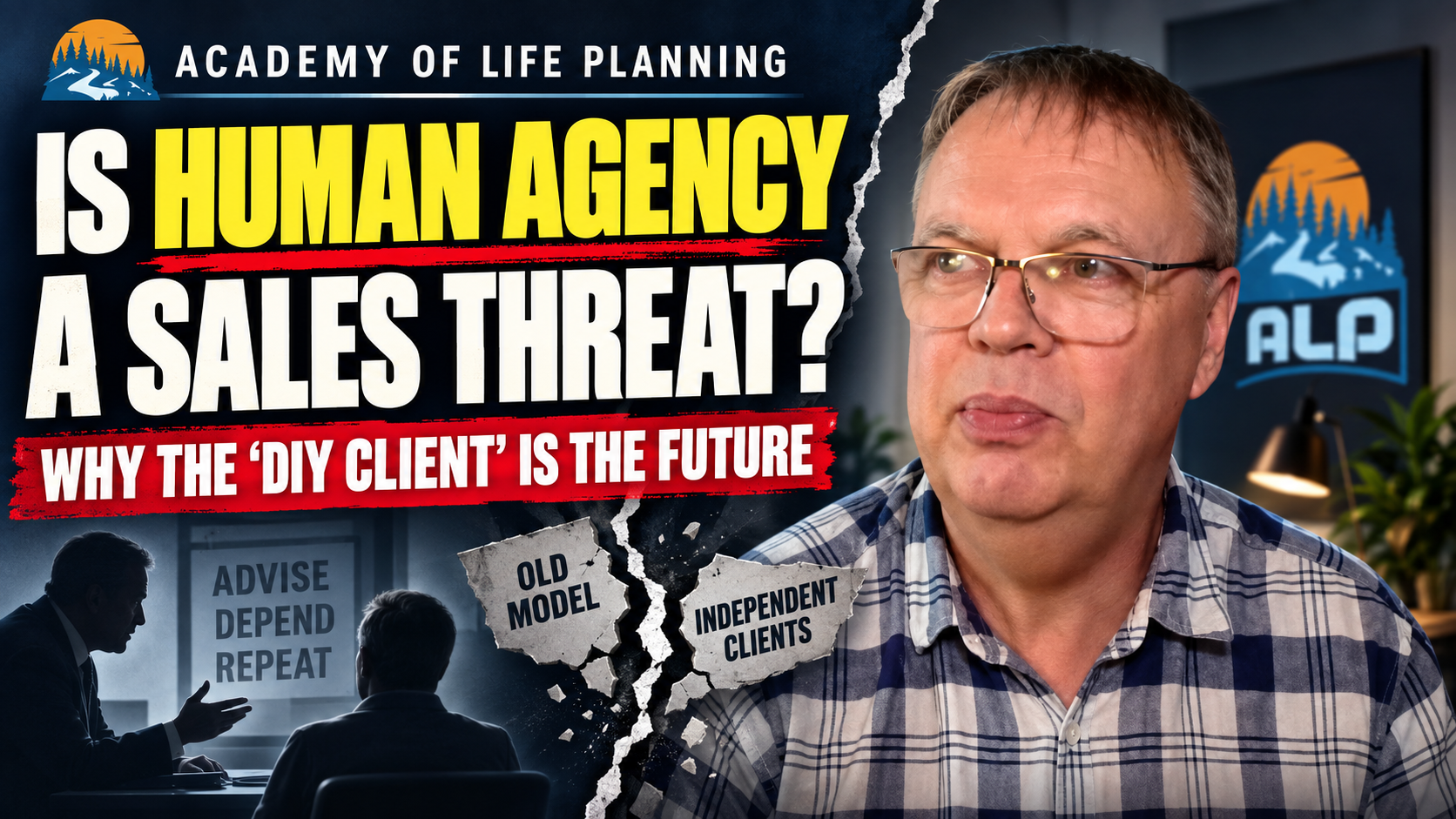
Why the “DIY client” may be the future of financial planning, not a prospect to defeat
I recently read a sales article about how advisers should handle people who prefer to manage their own finances.
It described the “DIY prospect” as a battle. Advisers were told to weed such people out before they wasted time, to question them with the focus of a SWAT team, and never to reveal too much of the proposed solution. Doing so, it suggested, would be like “feeding the piranha”.
The objective was to keep questioning until the person recognised their own failings and understood why they should pay the adviser.
The article was unusually direct, but the underlying mindset is not unusual.
It reveals something important about the old advice model: when a business depends upon client dependency, restored human agency can look like sales resistance.
That is worth discussing inside the Academy—not to mock traditional advisers working within the established model, but because our planners are trying to build successful businesses around a fundamentally different relationship.
Our starting belief is that 90% of people, 90% of the time, can manage their own finances with the right support.
The final words matter. The right support is not the absence of a service, and it need not be free. It is the Independent Financial Lifeguard: an affordable, continuing relationship that gives self-directed people access to reassurance, education, early warning and experienced judgment—without taking control away from them.
What was actually being said?
Beneath the dramatic language was a legitimate commercial problem.
Some prospective clients do attend meetings hoping to obtain useful ideas without paying. Some are overconfident. Some underestimate complexity, tax, risk or the burden their financial arrangements could place on a partner if they became incapacitated. Advisers have every right to protect their time, define the limits of an exploratory conversation and decide whom they are equipped to serve.
Those are real issues.
But the proposed response turned a question of fit into a contest for control.
The prospect was classified as an adversary. Curiosity became interrogation. Professional expertise became ammunition that must not be given away. The purpose of questioning was not simply to understand the person, but to lead them towards a recognition of inadequacy.
This is more than colourful sales language. Language reveals the mental model beneath the process.
If the meeting is a battle, someone must win and someone must lose.
If information is food for a piranha, knowledge must be withheld to preserve leverage.
If confidence is an obstacle, the sales process must first create or amplify doubt.
And if a capable person is a poor prospect, the commercial proposition may depend upon people believing they cannot safely act without the adviser.
Imagine discovering how you had been classified
Now view the same meeting from the client’s side.
Imagine that you have spent ten years learning about money, managing your investments and taking responsibility for your decisions. You know you do not understand everything. That is why you have approached a professional. You may want your assumptions challenged, a second opinion on a difficult decision, help organising the wider picture or reassurance that you have not overlooked something important.
Then imagine discovering that, before the conversation had properly begun, you had been classified as a “DIYer” who might waste the adviser’s time.
You learn that the meeting was treated as a battle, that questions were designed to expose your failings, and that useful detail was deliberately withheld because giving it to you would weaken the adviser’s chance of securing the sale.
How would you feel?
Probably not understood. Not respected. Not safer.
You might feel managed.
The irony is that the client’s reluctance to commit may then be treated as proof that DIY clients are difficult. But their resistance may not be resistance to expertise at all. It may be a rational response to a proposition that asks them to surrender too much control.
The self-directed client is not necessarily anti-adviser. They may simply be anti-dependency.
Agency is not the absence of expertise
This distinction matters.
Human agency does not mean knowing everything, doing everything alone or refusing professional help. It means retaining the ability to understand, choose and act.
A person with restored agency may still need:
- specialist knowledge;
- an experienced second brain;
- challenge when confidence has become overconfidence;
- support when complexity becomes overwhelming;
- regulated advice where a regulated recommendation is genuinely needed; or
- someone who can help the family create continuity if the usual decision-maker becomes unable to act.
The difference is that expertise strengthens the client’s capability rather than replacing it.
An agency-first planner does not need to prove that the client is incapable. The planner needs to identify where professional involvement would improve the quality, confidence or resilience of decisions the client remains responsible for making.
The conversation changes from:
“How do I make this person recognise why they need me?”
to:
“Where can my experience add value without taking away their ownership?”
That is not a softer sales technique. It is a different professional purpose.
The rise of the AI-enabled client
This matters even more in the age of AI.
Information asymmetry once gave professionals a powerful advantage. Advisers had access to knowledge, research, analytical tools and technical language that ordinary people struggled to obtain or interpret.
That advantage is eroding.
AI does not make everyone a financial expert. It can be wrong, superficial or dangerously confident. But it can help people ask better questions, understand unfamiliar concepts, organise records, compare alternatives and prepare for professional conversations.
The result will not simply be more DIY investing. It will be more AI-enabled agency: people arriving better informed, more questioning and less willing to outsource every decision indefinitely.
The old model may interpret this as a growing population of difficult prospects.
We should recognise it as a growing population of potentially excellent clients.
They may not want an adviser to take over. They may want a planner who can help them think.
They may not value a permanent percentage charge attached to their assets. But that does not mean they will only buy one-off work. Many will value an affordable continuing relationship that keeps help within reach, supplemented by paid in-depth planning when greater complexity arises.
They may not want reassurance produced by dependence. They may want confidence produced by understanding.
AI therefore creates both a threat and an opportunity. It threatens propositions whose value depends upon keeping the client outside the machinery. It strengthens propositions designed to make the client more capable of using that machinery well.
The commercial model is the Lifeguard, not the rescue
Academy planners still need to earn a living. Respecting agency does not mean offering unlimited free advice, accepting every client or undervaluing professional knowledge.
Nor does it mean building a practice entirely from isolated planning sessions and continually searching for the next person in crisis.
The Independent Financial Lifeguard is the commercial expression of our belief that 90% of people, 90% of the time, can manage their own finances with the right support.
For £24 per month, the client receives:
- an independent second opinion when something does not feel right;
- quick reassurance before an important financial decision;
- early warning when they may be heading into difficult waters;
- access to Academy OS and My Life Record;
- priority email support;
- short WhatsApp check-ins when something unexpected happens;
- community and continuing financial education; and
- access to in-depth planning sessions when needed at £200 per hour.
This is not a promise that a planner will continually manage the client’s financial life for £24 per month. It is a promise that the client will never be completely alone when life becomes more complicated.
That distinction changes the economics.
In the traditional model, an adviser often exchanges time for money or charges an asset-based fee to maintain an ongoing delegated relationship. The number of clients one adviser can serve is therefore constrained by the amount of individual attention the model promises.
A Total Wealth Planner can support thousands of Lifeguard clients because the primary exchange is not continuous adviser time. It is access to accumulated know-how, shared tools, education, systems, pattern recognition and timely human intervention.
Most clients will not need personal help most of the time. Academy OS, My Life Record, AI support and community learning provide much of the continuing infrastructure. Brief questions can be answered proportionately. When a situation requires careful research, analysis or substantial planner time, the client can purchase an in-depth session.
The service is therefore scalable without becoming impersonal. Technology carries the routine load. Community distributes learning. The planner appears when judgment is valuable.
The Lifeguard is not paid only for performing rescues. The Lifeguard is paid to remain watchful, accessible and independent—and to help people avoid needing rescue in the first place.
That is a much stronger proposition than either unlimited free support or permanent dependency.
It means designing clearer exchanges of value.
An agency-first practice can:
1. Qualify for fit without demeaning the prospect
Be explicit about whom you help and how. A self-directed person may be an excellent fit for planning, coaching, decision support or episodic expertise—and a poor fit for a service built around delegated investment management.
Neither party has failed. The propositions simply do not match.
2. Protect discovery without weaponising it
A free introductory meeting can establish needs, fit and next steps without delivering the substantive work. The boundary should be transparent: “Today we will identify the question and decide whether I am the right person to help. The analysis and recommendations form part of the paid engagement.”
That protects the planner’s time without treating knowledge as bait.
3. Sell continuing access without indefinite dependence
Offer a relationship people can understand and buy. The Lifeguard provides continuing access, reassurance and prevention. A Total Wealth Plan, Second Brain Session, retirement decision review, risk audit, family continuity plan or help organising My Life Record can be added when a defined piece of deeper work is required.
Continuity is commercially valuable, but it should be chosen because it adds continuing value—not because the client has been made afraid to leave.
4. Make capability part of the deliverable
The client should finish an engagement with clearer records, better questions, a stronger decision process and greater confidence about what they can do themselves—and when to call for help.
Success is not merely the decision made today. It is the client’s improved capacity to navigate tomorrow.
5. Charge confidently for judgment
Information is becoming abundant. Judgment, context, challenge, accountability and human understanding remain scarce.
We do not need to hide information to remain valuable. We need to become exceptionally good at helping people interpret it and act wisely.
Helping clients find the right planners
Clients also need a better way to assess fit. They might ask a prospective planner:
- Will you help me become more capable, or expect me to delegate the decisions permanently?
- Can I access continuing support or buy a defined piece of planning without transferring my investments?
- How are you paid, and what continuing value would justify any continuing fee?
- Will I leave with my own plan, records and reasoning in a form I can understand and use?
- Where do you believe I need regulated advice, and where can I make an informed decision myself?
- What happens if I decide I no longer need your ongoing support?
The answers reveal more than a brochure ever will.
The right planner for an agency-seeking client will not be threatened by these questions. They will welcome them.
Helping planners find the right clients
Planners should also stop trying to convert everyone.
An agency-first client is not simply anyone who likes doing things themselves. The best fit is someone willing to engage, learn, provide information, confront trade-offs and take responsibility for the eventual decision.
Agency is not passivity with a DIY label. Nor is it refusing every challenge while demanding free validation.
The planner can ask:
- Are you looking for someone to take control, or someone to help you exercise it well?
- What would you like to remain responsible for?
- Where would an experienced second brain be most valuable?
- What decision are you trying to make—and what has prevented you from making it confidently?
- What would you like to understand or be able to do when our work is complete?
These are still commercially purposeful questions. But their purpose is mutual selection, not psychological submission.
The market is moving towards us
Building an agency-first planning business can sometimes feel harder because the established market has trained both advisers and clients to expect a different relationship.
But the direction of travel is changing.
AI is expanding access to knowledge. Consumers are questioning recurring asset-based fees, but that does not mean they reject subscriptions that provide visible continuing value. More people want professional support without surrendering their assets, autonomy or identity as capable adults. Families need help turning information into resilient systems, not simply another product recommendation.
Our task is not to win a war against the DIY client.
It is to build a professional home for people the old model misunderstands.
That requires clear boundaries, confident pricing, scalable systems and genuine expertise. It also requires faith that making clients stronger does not make the planner commercially weaker. A planner does not need a small number of dependent clients when they can create a safe harbour for thousands of capable ones.
The enduring value of a Total Wealth Planner is not that the client cannot cope without us.
It is that, because of our work, they can cope better—with us when valuable, and without us when they are ready.

