
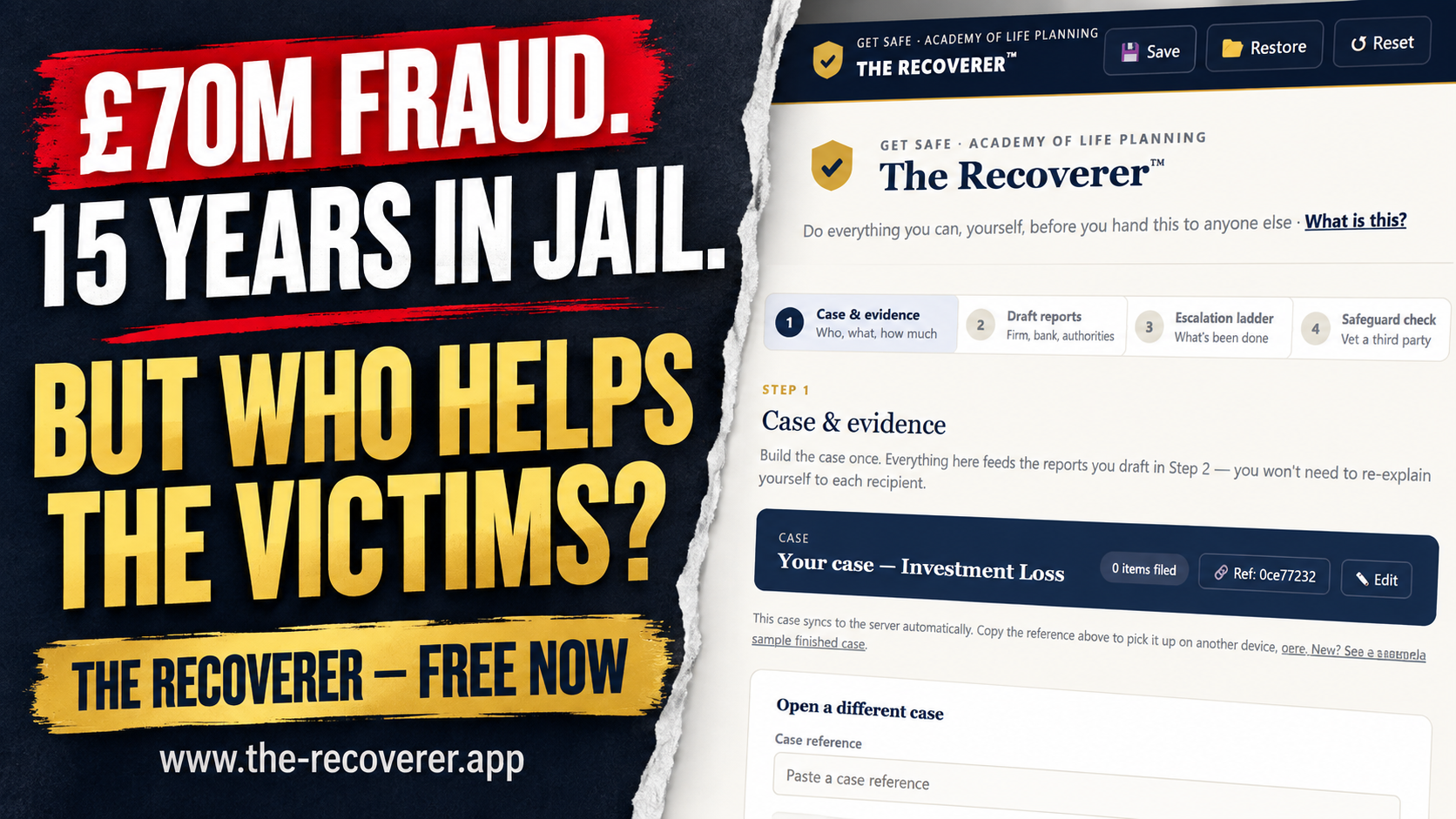
£70M FRAUD. 15 YEARS IN JAIL. BUT WHO HELPS THE VICTIMS?
The latest release of The Recoverer ™ is now available free at http://www.the-recoverer.app
A £70 million pension fraud has ended with three men in prison. But the story exposes a harder truth: justice may arrive years later, while victims need a practical way to understand their case and act now. The Recoverer helps them turn scattered evidence into an organised, realistic route forward.
By Steve Conley | Academy of Life Planning | 9 September 2026
A fraudster does not only take money. They take clarity.
They leave behind a confused trail of bank transfers, platform screenshots, emails, WhatsApp messages, contracts, invented company names and promises that no longer make sense. The victim is then expected to explain the whole affair—accurately, chronologically and persuasively—at the moment they are least equipped to do so.
That is the second injury of fraud: first the loss, then the burden of proving the loss.
Today, the Academy of Life Planning is releasing the latest version of The Recoverer™, a free citizen-investigator tool designed to reduce that burden. It helps people understand their case, organise their evidence and take every realistic step available to them before professional cost becomes necessary.
The sentence is not the same as the recovery
On 4 September 2026, Financial Planning Today reported that three former directors of Ethical Forestry Limited had been jailed for a combined 15 years and nine months after a seven-year, £70 million investment fraud affecting more than 3,000 people, many of them pensioners.
The scheme was sold through a Bournemouth call centre. Members of the public were reportedly cold-called and offered a “free pension review”, then persuaded to move pension money through SIPPs into a tree-planting operation in Costa Rica. Trees were planted, but the Serious Fraud Office found that nothing had been set aside to maintain or harvest the saplings. The promised returns could not be generated.
The directors, according to the report, spent millions on luxury homes, holidays and high-end cars. Their guilty pleas and prison sentences are an important act of public justice.
But a conviction does not rewind the clock. It does not restore the years of uncertainty, rebuild a pension automatically or remove the practical burden from every affected family. The institutional story ends with a sentence. The victim’s story may continue for years.
That gap—between public enforcement and personal recovery—is where agency matters.
The evidence gap
Institutions process cases. Victims experience events. The two do not naturally arrive in the same format.
A bank needs confirmable payment flows. An ombudsman needs a clear complaint within its jurisdiction. Action Fraud needs an intelligible account. A regulator may need intelligence about conduct, even where it cannot recover the victim’s money. A solicitor needs a usable bundle, not a carrier bag—physical or digital—full of disconnected material.
The system rewards organised evidence, but fraud produces disorganisation. That is not a personal failing. It is a structural asymmetry, and fraudsters benefit from it.
The Recoverer ™ is designed to narrow that asymmetry.
What the latest release does
The Recoverer ™ guides a user through case and evidence intake, including an early check on the regulatory position. That matters because the honest route forward depends on whether a firm was regulated, what role each organisation played and how the individual was classified.
From the information and documents supplied, the tool can help the user:
- build a structured evidence dossier from uploaded images, PDFs and DOCX files;
- separate what the evidence actually shows from what it may indicate;
- distinguish self-reported losses, bank-confirmable transfers and balances merely displayed on a platform;
- identify aliases while maintaining one consistent name for each firm or entity;
- tag evidence as externally verifiable or controlled by the suspected platform;
- see a transparent case-strength assessment based on named factors and bands;
- follow an escalation ladder weighted towards the routes that may realistically help;
- prepare AI-drafted reports for the firm, bank or electronic money institution, Financial Ombudsman Service, Action Fraud and FCA; and
- check an approaching recovery firm against common “recovery room” scam patterns.
The latest release also adds duplicate-file detection, masking of sensitive bank and card identifiers in the working view, a document-readiness checklist, a persistent map of every stage and a fictional demonstration case that people can explore before entering their own information.
Honest escalation not automated optimism
The Recoverer ™ does not pretend that every complaint route leads to compensation. It adjusts the prominence and wording of the escalation ladder according to the regulatory position established at intake. A report to the FCA may create a valuable intelligence record without resolving an individual loss. The Financial Ombudsman may be relevant to the conduct of a regulated bank or firm, but it is not a universal route against every unregulated perpetrator.
That distinction is deliberate. People harmed by fraud are especially vulnerable to anyone selling certainty. False hope is not support.
The tool therefore uses qualified language, separates facts from interpretations and shows how its case-strength assessment has been formed. It is there to help a person participate intelligently in the process—not to pronounce guilt, determine legal merits or manufacture confidence that the evidence cannot support.
Professional help should be an escalation not an entry ticket
There are cases where a solicitor, forensic investigator or specialist recovery professional is necessary. The question is whether the victim must begin by surrendering both control and money simply to make their own case intelligible.
Our answer is no.
The Recoverer ™ follows a simple principle: do what you can yourself, understand what remains, then buy expertise for the part that genuinely requires it. Professional engagement becomes the last rung of an honest escalation ladder, not the first response to fear.
This is not “do it yourself” as abandonment. It is supported self-reliance: agency first, expertise when needed.
Try The Recoverer free
The latest release is now available free. You can begin with the fictional demonstration case, see how the stages work and then decide whether the tool is appropriate for you.
Visit www.the-recoverer.app to start.
If you have been affected by investment fraud, act promptly. Contact your bank or payment provider, preserve all evidence, report the matter to the appropriate authorities and seek regulated legal or financial advice where your circumstances require it.
Fraud tries to turn a person into a case number. Recovery begins by turning the case back into something the person can understand, organise and act upon.
Important information
The Recoverer ™ does not provide legal or financial advice, determine the merits of a case, submit reports on a user’s behalf or guarantee recovery. Its outputs depend on the information supplied and should be checked before use. AI-drafted complaint templates, including those concerning the CRM Code and Financial Ombudsman Service, have not yet received independent legal review. Users should obtain qualified advice where necessary and should never pay an unverified recovery firm merely because it promises to retrieve lost money.
Your information is not public or visible to other users. It is disclosed only to the technology providers needed to store your case and perform the analysis you request.
How your information is handled: Your case information is cached locally in your browser and securely synchronised to the Recoverer’s dedicated Supabase database. The browser does not connect directly to that database; requests pass through the Recoverer’s protected server-side service. When you ask the tool to analyse evidence or draft a report, the relevant information is sent securely to Anthropic’s Claude API for processing. It is not published or made visible to other Recoverer users. Access to your case depends on possession of its unique case reference, so keep that reference private and use particular care when uploading sensitive information. Bank and card identifiers are masked in the everyday dossier view, although full details may appear in formal PDF exports.

