
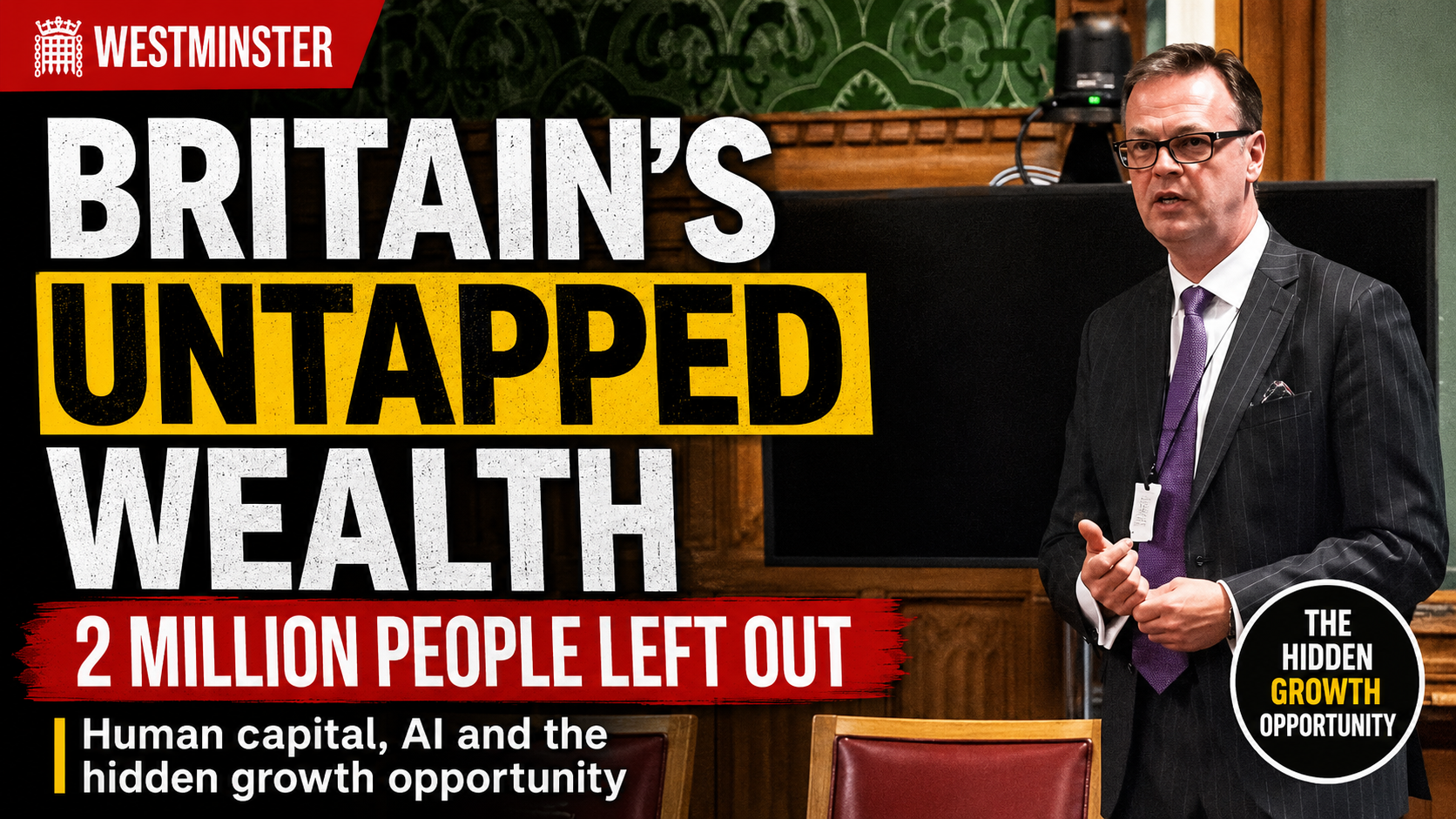
How AI could convert dormant human capital into sustainable livelihoods, economic growth and higher tax revenues
Abstract
The United Kingdom faces an unusual labour-market problem at both ends of the working-age spectrum. In early 2026, approximately 1.012 million people aged 16–24 were not in education, employment or training (NEET), equivalent to 13.5% of the age group. At the other end of working life, government analysis estimates that around 876,000 people aged 50–64 are either actively seeking work or economically inactive but willing or wanting to work.
These groups are normally understood through the language of unemployment, employability, welfare dependency, retirement or labour-market participation.
This paper proposes a different interpretation.
Britain may possess substantial stocks of human capital that are not being effectively converted into economic output.
Human-capital theory has traditionally focused on education, skills, health and experience as assets capable of increasing individual productivity and national economic performance. However, the literature also demonstrates that merely possessing human capital is insufficient. Economic value depends upon the institutional, technological and economic conditions that allow that capital to be deployed.
Generative artificial intelligence potentially changes this conversion mechanism. Emerging empirical evidence finds substantial productivity improvements from AI assistance, particularly among less experienced workers, while OECD research suggests that generative AI may reduce barriers to entrepreneurship by making capabilities that previously required specialised labour, organisational infrastructure or technical expertise more accessible.
This paper therefore advances a Human Capital Activation hypothesis:
Human Capital → Recognition → Renewal → AI Leverage → Opportunity → Enterprise or Employment → Sustainable Livelihood → Economic Output → Tax Revenue
The policy implication is not that every economically inactive person should become an entrepreneur. Rather, employment policy should cease treating employment as the only legitimate mechanism through which human capital can become economically productive.
The objective should be broader: enabling people to convert their human capital into sustainable livelihoods.
1. Britain has an employment problem at both ends of the age spectrum
Two numbers illustrate the problem.
The Office for National Statistics estimated that 1,012,000 people aged 16–24 were NEET during January to March 2026. That represented 13.5% of young people and was 89,000 higher than a year earlier.
At the other end of the age distribution, the Department for Work and Pensions reports that approximately 876,000 people aged 50–64 are either unemployed and seeking work or economically inactive but willing or wanting to work. Of these, around 572,000 are economically inactive but would like to work.
The symmetry is striking.
At the younger end:
“You do not have enough experience.”
At the older end:
“You are overqualified.”
Both responses are usually treated as separate labour-market phenomena.
They may instead be manifestations of the same systems failure.
People possess capabilities that the conventional labour market does not currently know how, or choose, to use.
The conventional response is therefore:
education → employability → job application → employer selection → employment.
But what if the failure occurs not principally in the development of human capital, but in its conversion?
That distinction matters.
Britain may not simply have an employment problem.
It may have a Human Capital Conversion Gap.
2. What economists mean by human capital
Human capital is an old idea.
Adam Smith recognised the “acquired and useful abilities” embodied in people as something analogous to capital. Modern human-capital theory was subsequently formalised through the work of Theodore Schultz, Gary Becker, Jacob Mincer and others.
The OECD gradually broadened the concept beyond formal educational qualifications. Human capital came to include knowledge, skills, competencies and attributes embodied in individuals that facilitate personal, social and economic well-being. The broader literature incorporates formal education, experience, training, tacit knowledge, interpersonal capabilities, health and aspects of motivation.
This matters because popular discussion frequently confuses human capital with credentials.
They are not the same.
A university degree may provide evidence of human capital.
But thirty years of solving engineering problems may also constitute human capital.
So may:
commercial judgement;
relationships;
occupational knowledge;
pattern recognition;
negotiation ability;
craft skills;
communication;
leadership;
problem-solving;
community knowledge;
creativity;
technical proficiency;
or accumulated experience of a particular industry.
Schultz conceptualised human capital as knowledge, skills, experience, health, motivation and energy capable of being used in the production of goods and services and generating future income.
The distinction we therefore need is:
credential capital is not identical to productive human capital.
This is particularly important when considering older workers.
Someone losing a corporate role at 58 does not suddenly lose the accumulated knowledge, judgement and relationships developed over thirty years.
The employment relationship has disappeared.
The human capital has not.
3. Human capital is an asset — but an unusual one
Economic approaches have attempted to value human capital in several ways.
One is the lifetime-income approach, which estimates the discounted value of future labour income that an individual’s skills and capabilities may generate.
This provides an important conceptual insight.
Financial wealth represents accumulated claims upon future resources.
Human capital represents potential future productive capacity.
But the two differ profoundly.
Financial capital can normally be transferred between owners.
Human capital remains embodied in the person.
A person therefore does not merely own human capital.
In an important sense, the person is the location of the asset.
That asset can also depreciate.
Research reviewed in the supplied literature identifies technological change, organisational change, displacement and sectoral change as mechanisms through which existing human capital can become economically obsolete. At the same time, learning, training, experimentation and experience can maintain or increase its value.
Leka and Pojani describe human capital explicitly as earning power and argue that it must be acquired, protected and maintained. Maintenance does not have to mean returning to formal education: it can involve self-study, experimentation, research, practical experience and lifelong learning.
This creates another important distinction:
employment loss is not necessarily human-capital loss.
It may instead represent a failure to reconvert one form of human capital into another productive context.
4. Human capital and economic growth: what the evidence actually says
Human-capital theory occupies an important place in endogenous growth economics.
The theoretical argument is straightforward.
Human capital can increase output directly by improving productivity.
It can also increase output indirectly by supporting innovation, technological adoption and improvements in total factor productivity.
The literature describes these as a level effect and a rate effect.
Empirical research generally supports a positive relationship between human capital and individual productivity.
Cross-country studies reviewed in the supplied literature find positive associations between education and labour productivity across large samples, although results vary according to methodology, measurement and time period.
Purmiyati’s panel study of 32 Indonesian provinces between 2013 and 2017 similarly found statistically significant positive relationships between regional GDP per capita and education expenditure, domestic investment and technological literacy.
However, academic caution is necessary.
Hyun Son’s review for the Asian Development Review notes that macroeconomic studies have sometimes produced inconsistent results, while microeconomic studies more consistently show positive relationships between education, earnings and productivity.
Reverse causality is another problem.
Greater education may encourage economic growth.
But economic growth itself can increase the returns to education, thereby encouraging greater educational investment.
Some apparent relationships between schooling and GDP may therefore reflect both directions of causality.
This does not invalidate human-capital theory.
It tells us something more interesting.
Accumulating human capital is not sufficient.
It must actually be used.
5. The missing variable: utilisation
One of the most important findings within the literature reviewed for this paper comes from Son.
Human capital only affects economic growth if the acquired capabilities are actually utilised.
Workers can acquire substantial education yet end up in low-productivity work because the labour market does not demand or correctly match those skills.
This changes the policy question.
The conventional question is:
How much human capital does Britain possess?
The more useful question is:
How much of Britain’s human capital is actually being converted into productive activity?
The World Economic Forum-style Human Capital Index reviewed by Moyo recognises precisely this problem.
It includes not only education, health, workforce experience and training, but an enabling environment: the legal, economic and infrastructural conditions allowing human capital to produce a return.
The report states that barriers in the surrounding environment can prevent effective deployment of human capital, effectively negating investment previously made in its development.
This gives us a useful equation:
Economic value of human capital ≠ human capital stock alone.
A simplified formulation might be:
Human Capital × Utilisation × Leverage = Productive Output
Human capital without utilisation is latent capacity.
Human capital without leverage may remain low-productivity capacity.
The public-policy opportunity therefore lies not merely in accumulating more skills.
It lies in improving the conversion process.
6. The young and old have different human-capital problems
The two age groups should not be treated identically.
The younger population may possess what we might call emergent human capital.
They may have:
new technical capabilities;
creativity;
cultural knowledge;
digital fluency;
energy;
nascent networks;
unconventional skills;
or specialised interests.
But they frequently lack occupational experience, credentials, networks, capital and employer validation.
The older population possesses a different asset.
They may have accumulated:
judgement;
industry knowledge;
professional networks;
technical expertise;
leadership experience;
institutional memory;
client knowledge;
commercial credibility;
and pattern recognition.
But some of this capital may have become stranded inside a particular occupation or organisational context.
Younger people may therefore face a human-capital recognition problem.
Older people may face a human-capital redeployment problem.
Both result in economic underutilisation.
7. Aspiration alone is not enough
One study in the supplied literature provides an important warning against motivational policymaking.
Research into the UK’s Widening Participation programme found that interventions aimed at increasing young people’s aspirations did increase motivation and the probability of remaining in education after age 16.
The estimated increases in staying in education were approximately 3.2 and 4.5 percentage points in two datasets, and the modelling suggested that a ten-percentage-point increase in aspirations corresponded to approximately a 7.2-percentage-point increase in staying in full-time education.
But increased aspirations alone did not substantially increase university attendance among poorer pupils.
Financial constraints remained binding.
The policy lesson is important.
Telling somebody to:
“believe in yourself”;
“be entrepreneurial”;
“work harder”;
or “learn AI”
is not a serious economic strategy.
Capability must be connected to opportunity.
Hence the model must contain at least three stages:
identify human capital → create accessible opportunity → convert it into sustainable livelihood.
8. AI may change the conversion economics
This is where the current technological transition becomes important.
The proposition is not that AI magically creates human capital.
Rather:
AI may reduce the cost of activating human capital that already exists.
There is now credible empirical evidence that generative AI can raise productivity in certain knowledge-intensive tasks.
Brynjolfsson, Li and Raymond studied the introduction of a generative-AI assistant among more than 5,000 customer-support workers. The peer-reviewed version reports an average productivity improvement of approximately 15%.
More importantly, the gains were highly unequal.
Less experienced and lower-skilled workers experienced much larger improvements, while experienced high-performing workers saw comparatively small gains. The researchers also found evidence that AI accelerated learning, effectively transferring some of the practices of high-performing workers to less experienced colleagues.
This is relevant to younger people.
AI may partially compress the experience curve.
It does not eliminate the value of human expertise.
It can make elements of accumulated expertise more accessible.
That could allow an inexperienced individual to become productively useful more quickly.
9. AI may also give experienced human capital greater leverage
The implication for older workers is different.
An experienced person may already possess considerable domain knowledge.
Historically, scaling that expertise required complementary organisational resources.
A consultant might require:
research assistants;
administration;
graphic design;
marketing;
data analysis;
software;
copywriting;
sales support;
or technical development.
Many of those complementary functions imposed minimum economic scale.
Artificial intelligence can reduce some of those costs.
A single person can increasingly use AI to:
research markets;
analyse documents;
draft proposals;
prototype services;
create marketing materials;
analyse data;
produce educational content;
manage customer communication;
write software;
build simple applications;
and develop intellectual property.
The OECD’s 2025 review of generative AI, productivity, innovation and entrepreneurship explicitly identifies this possibility.
It concludes that emerging evidence suggests generative AI can lower entry barriers, help entrepreneurs with limited technical knowledge, improve operational efficiency, support idea generation, improve business models and make entrepreneurial capabilities more accessible.
Experimental evidence remains limited, which should temper strong causal claims.
But the mechanism is economically important.
AI potentially changes the production function around an individual.
Previously:
Human Capital + Organisation + Employees + Financial Capital → Output
Increasingly, some activities may follow:
Human Capital + AI + Small Amount of Capital → Output
That represents a potentially profound reduction in the minimum efficient scale of enterprise.
10. From job creation to livelihood creation
This leads to the central policy distinction.
British employment policy is still largely organised around:
How do we get this person into a job?
But a job is only one institutional mechanism through which productive human capital can generate income.
Other mechanisms include:
self-employment;
consulting;
portfolio careers;
co-operatives;
micro-enterprises;
digital services;
craft businesses;
teaching;
community enterprises;
mentoring;
freelance work;
licensing intellectual property;
or combinations of paid activities.
The better policy objective is therefore:
sustainable livelihood creation.
Employment may form part of that livelihood.
It need not constitute all of it.
This moves the conversation away from labour-market dependency.
Instead of asking:
“Which employer will select me?”
an individual may increasingly ask:
“What problems can my human capital solve?”
That is not merely entrepreneurship.
It is economic agency.
11. A Human Capital Activation Model
A national programme designed around this principle might follow eight stages.
1. Recognition
Identify what human capital already exists.
Not merely qualifications.
Include:
knowledge;
skills;
experience;
relationships;
interests;
values;
reputation;
judgement;
creativity;
and tacit expertise.
2. Renewal
Identify what has become obsolete or incomplete.
Determine the minimum learning required to restore relevance.
3. AI leverage
Identify tasks where AI can increase productivity, accelerate learning or provide complementary capability.
4. Opportunity discovery
Start not with “what job should I apply for?” but:
Who has a problem I understand?
5. Value proposition
Convert capability into something another person, business or community values.
6. Experimentation
Test the opportunity cheaply before committing substantial financial capital.
7. Sustainable livelihood
Combine appropriate sources of income until expenditure and resilience requirements can be supported.
8. Continuous adaptation
Maintain human capital through lifelong learning, experimentation and technology.
I would describe this as the Human Capital Activation Model:
Human Capital
→ Recognition
→ Renewal
→ AI Leverage
→ Opportunity
→ Enterprise / Employment / Portfolio Work
→ Sustainable Livelihood
→ Economic Contribution
12. This is not simply a productivity policy
There is a danger in treating human beings merely as units of national production.
The human-capital literature itself has increasingly moved beyond that interpretation.
OECD definitions have expanded from capabilities relevant to economic activity towards capabilities facilitating personal, social and economic well-being.
This connects human-capital theory with Amartya Sen’s capabilities approach.
Economic development is not valuable merely because GDP rises.
It matters because people’s real freedoms and choices expand.
One of the supplied reviews describes this shift as moving beyond per-capita income toward people’s capabilities and their freedom to sustain livelihoods and live meaningful lives.
This is why sustainable livelihood is a better objective than maximising income.
The objective is not:
extract as much GDP as possible from economically inactive citizens.
It is:
enable people to build lives in which their capabilities can support greater economic independence, security and agency.
Economic output is a consequence.
Not the sole purpose.
13. The potential macroeconomic scale
The numerical scale deserves attention.
Britain currently has approximately:
- 1.012 million 16–24-year-olds classified as NEET; and
- around 876,000 50–64-year-olds either seeking work or inactive while indicating that they would like to work.
These categories are not perfectly comparable and should not simply be added together without qualification.
They nevertheless identify approximately 1.9 million people whose productive potential is not being fully utilised through conventional employment.
For policy discussion, two million is therefore a reasonable order-of-magnitude thought experiment—not an estimate of how many people could immediately become entrepreneurs.
Consider illustrative scenarios.
If two million people produced additional economic income averaging only:
£10,000 each, the gross amount would be approximately £20 billion per year.
At £20,000 each, approximately £40 billion.
At £30,000 each, approximately £60 billion.
At £50,000 each, approximately £100 billion.
These figures are arithmetic scenarios, not GDP forecasts.
They illustrate the scale of the latent asset.
Even modest productive activation across a population of this size becomes macroeconomically material.
14. The Exchequer has an interest in activation
The fiscal consequences operate through several channels.
Successful activation can potentially create:
income-tax receipts;
National Insurance receipts where applicable;
corporation-tax receipts;
VAT and other consumption taxes;
business-rate and local-tax receipts;
additional household spending;
reduced welfare expenditure;
and reduced fiscal pressure associated with long-term economic inactivity.
The economic effect also compounds.
Income earned by one individual becomes spending received by another.
Business expenditure becomes somebody else’s revenue.
Knowledge acquired in one business may diffuse across others.
Human-capital investment therefore creates both private and social returns.
The supplied literature notes precisely these spillovers: education and knowledge can generate benefits beyond the person receiving them, including innovation and community benefit.
15. Before taxing accumulated wealth, should Britain activate latent wealth?
This leads to an uncomfortable fiscal question.
There is increasing advocacy for new taxes on accumulated financial wealth.
For example, Tax Justice UK and Patriotic Millionaires UK have proposed an annual 2% levy on net wealth above £10 million, estimating that such a tax could raise approximately £24 billion annually.
Other academic modelling produces different numbers depending upon threshold, rate, behavioural response and tax design. An Institute for Fiscal Studies-published study, for example, modelled an annual tax of 0.17% above £500,000 as potentially raising around £10 billion before administrative costs, while substantially larger sums could theoretically be generated by a one-off wealth tax.
The purpose here is not to settle the normative case for wealth taxation.
That involves arguments about:
inequality;
ability to pay;
economic rents;
inheritance;
fairness;
public-service provision;
and the appropriate distribution of tax burdens.
There is, however, another question policymakers should ask first:
How much revenue could Britain generate by activating wealth it already possesses in people?
A country can address a fiscal deficit in two fundamentally different ways.
It can extract more from existing economic activity.
Or it can create more economic activity.
These are not mutually exclusive.
But public debate disproportionately focuses on the first.
16. Taxing stocks versus activating flows
This suggests a useful conceptual distinction.
A wealth tax seeks revenue from an accumulated stock of financial capital.
Human-capital activation seeks to create new economic flows.
The latter potentially generates recurring:
production;
income;
consumption;
enterprise;
investment;
and taxation.
This does not make wealth taxation inherently undesirable.
But it changes the policy sequence.
Perhaps the first question should be:
What productive capacity is currently lying idle?
Only after understanding that should we conclude how much additional extraction from accumulated capital is necessary.
This is the difference between:
redistributing the existing pie
and
enabling more people to bake.
Both may have legitimate roles.
But they are different economic strategies.
17. The wealth tax comparison needs proper modelling
Academic credibility requires restraint here.
It would be wrong to claim that activating two million people automatically produces £24 billion of additional tax revenue.
It does not.
Gross livelihood income is not equivalent to GDP.
GDP is not equivalent to taxable income.
Taxable income is not equivalent to tax receipts.
People have allowances.
Businesses have costs.
Some activity would substitute for existing activity.
Some ventures would fail.
Some participants would work part-time.
Some would remain entitled to benefits.
Some income would fall below tax thresholds.
Others might eventually produce substantial tax receipts.
There are also deadweight, behavioural and displacement effects.
Therefore the proposition requiring empirical testing is:
Could the fiscal dividend from large-scale human-capital activation materially reduce Britain’s structural revenue requirement and consequently reduce pressure for new taxes on accumulated wealth?
That is a legitimate research question.
It is not yet an established answer.
18. Nor can everybody simply become an entrepreneur
The same caution applies to the older population.
Of the 572,000 economically inactive 50–64-year-olds who say they would like to work, 66.1% report sickness, injury or disability as the main reason they are not currently seeking employment.
A policy based upon telling all of them to launch businesses would be unserious.
Some people require:
medical support;
workplace accommodation;
care flexibility;
income security;
rehabilitation;
part-time work;
or conventional employment.
Entrepreneurship is an additional pathway, not a universal prescription.
Likewise, some young people classified as NEET face:
poor health;
disability;
care responsibilities;
housing instability;
low confidence;
financial constraints;
or severe disadvantage.
Human-capital activation therefore requires support appropriate to the individual.
Agency is not the same thing as abandonment.
19. Why AI makes the present moment different
Human-capital theory is not new.
Entrepreneurship is not new.
Self-employment is not new.
What may be new is the cost structure surrounding an individual.
The knowledge economy previously rewarded human capital partly because organisations assembled complementary resources around skilled people.
AI may allow some of those complementary resources to be available directly to individuals.
OECD evidence already indicates that SMEs using generative AI commonly report improved employee performance, cost savings and the ability to perform new tasks. Among surveyed SMEs experiencing skill gaps, 39% of generative-AI users reported that the technology helped compensate for those gaps.
That is potentially significant.
Economic agency may increasingly depend not on owning vast physical capital but on combining:
human capital + digital capital + networks.
The barrier between individual capability and commercially viable enterprise may therefore be falling.
That does not guarantee successful enterprise.
But it changes the option set.
20. Britain may be measuring the wrong asset
Public policy measures employment intensively.
It measures:
unemployment;
economic inactivity;
vacancies;
wages;
hours;
qualifications;
and participation.
But these measures tell us surprisingly little about the productive capabilities sitting inside economically inactive populations.
Moyo’s methodological review highlights the difficulty of measuring human capital directly. Years of schooling, literacy rates and enrolment measures are all imperfect proxies.
The Workforce and Employment component of human-capital measurement consequently attempts to incorporate experience, talent, knowledge and training—but internationally comparable measures remain weak.
The result is a major information problem.
We know whether somebody has a job.
We often do not know what they could productively do.
That is the missing dataset.
21. From a labour-force survey to a human-capital map
Imagine if policy moved beyond asking unemployed or inactive people:
“What job are you looking for?”
and instead asked:
What do you know?
What have you done?
What problems have you solved?
What do people ask your help with?
What communities do you understand?
What relationships do you possess?
What tools can you use?
What would you like to learn?
What productive activity could fit your health and circumstances?
What could AI enable you to do that you could not economically do before?
That would create something different from a labour-force database.
It would create a human-capital map.
From there, AI could help identify:
market opportunities;
complementary capabilities;
training requirements;
potential collaborators;
micro-enterprise ideas;
local unmet needs;
and possible routes to revenue.
That is a different conception of employment policy.
22. A GAME Plan for human capital
At the individual level, the practical intervention can be expressed simply.
First:
identify human capital.
Second:
identify where that capital can create value.
Third:
use AI and other tools to increase its leverage.
Fourth:
construct a sustainable livelihood around it.
The objective is not necessarily to create the next technology unicorn.
A £15,000 or £25,000 microenterprise may completely change one household’s economic resilience.
A portfolio consisting of:
two days consulting;
one day teaching;
some freelance work;
and a small digital service
may be economically more sustainable for a 62-year-old than trying to secure another full-time corporate appointment.
For a 22-year-old, a similar pathway may build the experience that employers claim is missing.
Enterprise itself can become human-capital formation.
The individual learns by doing.
23. The two million-person experiment
The policy opportunity is therefore unusually symmetrical.
At one end:
approximately one million young people whose human capital is still emerging.
At the other:
nearly one million older people whose human capital has accumulated but may be stranded.
Between them sits a new class of technology capable of supplying complementary cognitive capacity at exceptionally low marginal cost.
This creates the possibility of a national experiment:
Can Britain help two million people discover, develop and deploy their human capital to create sustainable livelihoods?
Not:
“Can we force two million people off benefits?”
Not:
“Can we train them all for the jobs employers currently advertise?”
Not:
“Can we persuade businesses to employ them?”
Those may all play a role.
The more interesting question is:
What would these people create if the economic system helped them recognise and leverage the capital already inside them?
24. From human-capital formation to human-capital activation
Traditional policy has concentrated heavily on human-capital formation.
Education.
University.
Vocational qualifications.
Training.
Skills programmes.
These remain important.
But Britain may have entered a period in which the limiting factor is increasingly activation.
The distinction is simple:
Human-capital formation asks: what can we put into people?
Human-capital activation asks: what can people do with what is already inside them?
That may be particularly important in an AI economy.
When knowledge is becoming increasingly accessible, the scarce resource may cease to be information itself.
The scarce resource becomes:
judgement;
context;
purpose;
trust;
experience;
creativity;
relationships;
problem selection;
and the ability to act.
Those are profoundly human forms of capital.
25. Conclusion: Britain’s largest untapped asset may be its people
The public debate around economic inactivity tends to begin with a deficit.
People lack jobs.
People lack qualifications.
People lack experience.
People lack motivation.
People lack employability.
Human-capital theory suggests another starting point.
Ask what they already possess.
Britain has spent decades accumulating knowledge, experience and productive capability inside its population.
Some of that capital is visible in businesses and institutions.
Some sits outside them.
Among young people, capabilities may not yet have been recognised.
Among older people, capabilities that once commanded substantial economic value may no longer fit conventional employment structures.
AI creates an opportunity to change this.
Not because machines replace human capital.
But because they can give human capital leverage.
The policy sequence therefore becomes:
identify it;
renew it where necessary;
connect it with problems;
leverage it with AI;
and help people convert it into sustainable livelihoods.
If that process succeeds at scale, the consequences extend far beyond employment statistics.
It means:
higher household incomes;
more enterprise;
greater productivity;
higher economic output;
more resilient communities;
higher tax receipts;
lower dependency;
and potentially less pressure to raise additional revenue by taxing accumulated wealth.
Britain may therefore be looking at the fiscal problem from the wrong end.
Before asking:
“Where can government find more wealth to tax?”
perhaps we should ask:
“How much wealth are we currently failing to create because millions of people’s human capital is sitting unused?”
That is the Human Capital Conversion Gap.
And in the age of AI, closing it may be one of the largest economic opportunities Britain possesses.
References
Ahmed, A. M. (2024). What Is the Major Relationship Between Human Capital and Economic Growth? Oda Bultum University. The paper reviews relationships among education, health, productivity, participation and economic growth and emphasises the multidirectional relationship between income and human-capital investment.
Akinyemi, G. M. & Abiddin, N. Z. (2013). “Human Capital Developments: An Interdisciplinary Approach for Individual, Organization Advancement and Economic Improvement.” Asian Social Science, 9(4).
Becker, G. S. (1964). Human Capital: A Theoretical and Empirical Analysis, with Special Reference to Education. National Bureau of Economic Research.
Brynjolfsson, E., Li, D. & Raymond, L. R. (2025). “Generative AI at Work.” Quarterly Journal of Economics, 140(2), 889–942. The study finds an average productivity increase of approximately 15% among customer-support workers using generative AI, with particularly large gains among less experienced workers.
Castelló-Climent, A. & Doménech, R. (2008). “Human Capital Inequality, Life Expectancy and Economic Growth.” Economic Journal, 118, 653–677. Their analysis of 92 countries finds significant relationships among human-capital inequality, life expectancy and subsequent human-capital accumulation.
Daru, M. U. (2015). “Human Capital: The Tool for Economic Growth and Development.” International Journal in Commerce, IT & Social Sciences, 2(8).
Kang, S. Human Capital Theory: A Review and Critique. School of Education and Social Work, University of Sussex. The review discusses human-capital theory alongside important problems of measurement, causality and valuation.
Kaur, S. “Role of Human Capital Formation in Economic and Human Development.” The paper draws on the capabilities tradition associated with Amartya Sen and distinguishes human development from income growth alone.
Leka, B. & Pojani, E. “Human Capital — Theoretical and Statistical Study Focused Mainly on Education.” The study discusses human capital as earning power requiring acquisition, protection and lifelong maintenance.
Mincer, J. (1974). Schooling, Experience and Earnings. National Bureau of Economic Research.
Moyo, N. Measuring Human Capital: A Review of Methodologies. Peking University, Institute of Population Research. The review examines cost-based, lifetime-income and indicator approaches to human-capital measurement and highlights the importance of context and enabling environments.
OECD (2025). The Effects of Generative AI on Productivity, Innovation and Entrepreneurship. OECD. The report reviews evidence that generative AI may lower entrepreneurial entry barriers, make tools more accessible, improve operational efficiency and support business-model development.
OECD (2025). AI Adoption by Small and Medium-Sized Enterprises. OECD. Survey evidence indicates that SMEs commonly report improved employee performance and cost savings from generative AI; among users facing skills shortages, 39% reported that generative AI helped compensate for the gap.
Office for National Statistics (2026). Young people not in education, employment or training (NEET), UK: May 2026. ONS. Approximately 1.012 million 16–24-year-olds were classified as NEET in January–March 2026.
Purmiyati, A. (2019). “The Impact of Human Capital on Economic Growth: An Education Approach.” Advances in Economics, Business and Management Research, 101. Panel regression across 32 Indonesian provinces found statistically significant positive associations between GDP per capita and education spending, domestic investment and technological literacy.
Schultz, T. W. (1961). “Investment in Human Capital.” American Economic Review, 51(1), 1–17.
Son, H. H. (2010). “Human Capital Development.” Asian Development Review, 27(2). Son distinguishes relatively consistent micro-level relationships between education, productivity and earnings from more contested macroeconomic relationships and stresses the importance of human-capital utilisation.
UK Department for Work and Pensions (2025). Economic labour market status of individuals aged 50 and over: trends over time. Approximately 876,000 people aged 50–64 were either seeking employment or inactive but willing or wanting to work.
Voichuk, M. (2021). “Scientific Approaches to the Understanding of Human Capital Concept.” National Interest, No. 4. The paper traces human-capital theory historically and examines human capital across personal, organisational, national and global levels.
Wealth Tax Commission / Advani, A., Hughson, H. & Tarrant, H. (2021). “Revenue and Distributional Modelling for a UK Wealth Tax.” Fiscal Studies, 42(3–4), 699–736.
Tax Justice UK & Patriotic Millionaires UK (2025). Proposed annual 2% tax on net wealth above £10 million, estimated by the proponents to raise up to £24 billion annually.
I think the strongest conceptual contribution here is no longer simply “human capital matters”. Economics has established that for decades.
It is this:
Human Capital Formation → Human Capital Activation → Human Capital Leverage.
And the genuinely contemporary proposition is:
AI may substantially reduce the cost of converting dormant human capital into economically productive agency.

