
AI Literacy Before AI Leadership: Why Britain Needs an AI-Confident Population
By Graham Francis, Academy of Life Planning Member
The conversation around Artificial Intelligence is accelerating.
Governments are investing billions. Technology companies are competing to build ever more capable systems. Businesses are exploring how AI can improve productivity, reduce costs, and create new opportunities.
Yet amid all the discussion about infrastructure, regulation, innovation, and economic growth, one question receives surprisingly little attention:
Who is helping ordinary people understand AI?
At the Academy of Life Planning, we believe this may be one of the most important public-interest questions of the decade.
The future of AI will not be determined solely by the quality of our technology. It will also be shaped by the confidence, understanding, and agency of the people who use it.
The UK’s greatest AI asset may not be its computers.
It may be its citizens.
We Already Live Alongside AI
Many people still think of AI as something futuristic.
In reality, AI is already embedded in everyday life.
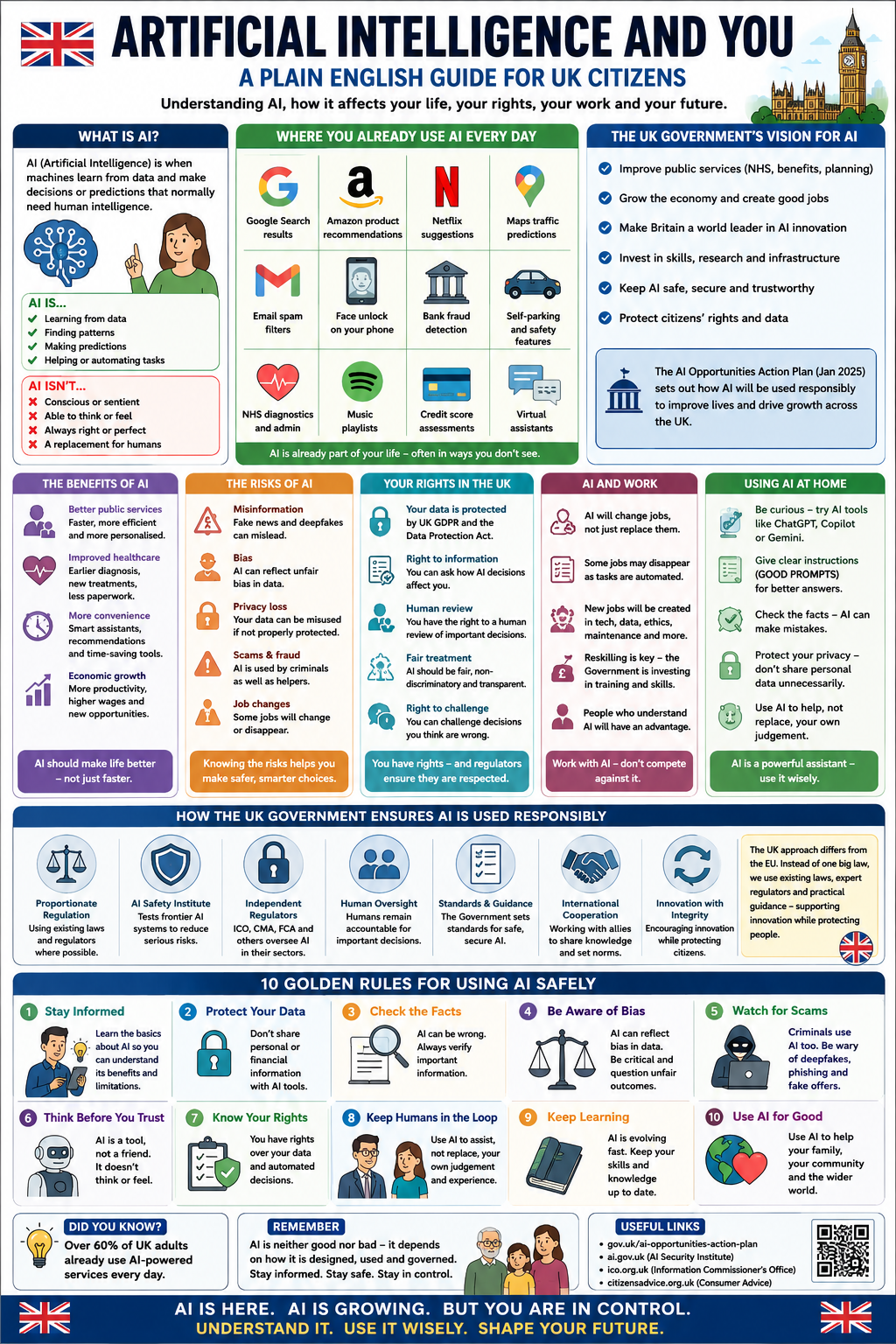
It recommends what we watch on streaming services. It filters spam emails. It helps detect fraud. It powers online search, navigation apps, voice assistants, facial recognition, and increasingly the services we use at work.
Most people use AI every day without necessarily recognising it.
That creates an unusual challenge.
We are becoming increasingly dependent on technologies that many people do not fully understand.
The issue is not whether citizens need to become AI engineers.
They do not.
The issue is whether citizens understand enough to make informed decisions in a world increasingly shaped by AI.
The Missing Layer in the AI Strategy
The UK has ambitious plans for AI leadership.
Government policy focuses on investment, innovation, research, skills development, public service transformation, and maintaining public trust.
These are all important.
But there is a difference between creating AI and creating an AI-capable society.
Most national AI strategies focus on:
- Technology
- Infrastructure
- Regulation
- Research
- Commercial adoption
Far fewer focus on helping ordinary people develop practical AI literacy.
In many ways, this mirrors earlier phases of digital transformation.
Building the internet was only part of the challenge.
People also needed to learn how to use it safely, effectively, and critically.
The same principle now applies to AI.
AI Literacy Is Not Just About Technology
When people hear the term “AI literacy,” they often think about technical skills.
But the challenge is broader than that.
AI literacy includes understanding:
- What AI can and cannot do
- How AI systems make recommendations
- Where AI can be useful
- Where human judgement remains essential
- How to identify misinformation and synthetic content
- How personal data is used
- How to question and verify AI-generated outputs
- How AI affects work, education, finances, healthcare, and everyday decisions
This is less about coding and more about citizenship.
An AI-literate population is better equipped to participate in society, navigate risk, and benefit from emerging opportunities.
Why This Matters for Financial Planning
For advisers and planners, the implications are particularly significant.
Consumers are already asking AI questions about:
- Mortgages
- Debt
- Investments
- Retirement
- Taxation
- Insurance
- Estate planning
That trend will accelerate.
The response should not be to discourage people from using AI.
Nor should it be to assume AI can replace human expertise.
The opportunity lies somewhere between those extremes.
People need the confidence to use AI as a thinking aid while understanding its limitations.
The most valuable professionals of the future may not be those who possess information that AI can access.
They may be those who help people interpret, contextualise, challenge, and apply information wisely.
In other words, the future may require less dependence and more agency.
The Agency Question
At the Academy of Life Planning, we often return to a simple distinction.
Technology can either increase human agency or reduce it.
Agency means the ability to think, choose, decide, and act intentionally.
Used well, AI can strengthen agency by helping people:
- Understand complex issues
- Explore options
- Learn new skills
- Access knowledge
- Improve decision-making
Used poorly, AI can encourage passivity, over-reliance, and blind acceptance.
The difference often comes down to literacy.
People who understand a tool tend to use it.
People who do not understand a tool risk being used by it.
Advisers Have a Role to Play
This is not solely a government challenge.
Professional communities have an important role.
Financial planners, coaches, educators, community leaders, employers, and advisers are often the trusted intermediaries who help people adapt to change.
The question is no longer whether AI will become part of everyday life.
It already has.
The question is whether we equip people to engage with it confidently and critically.
Advisers who help clients understand AI may ultimately create more value than advisers who simply shield clients from it.
A Public Conversation Worth Having
Graham Francis has developed a practical plain-English guide to AI for UK citizens, designed to help people understand what AI is, where it already appears in daily life, the opportunities it presents, the risks it creates, and the rights citizens retain in an increasingly digital world.
The guide is deliberately accessible.
Because if AI is going to affect everyone, understanding AI cannot remain the preserve of specialists.
The UK has an opportunity to lead not only in building AI technologies, but in helping people use them wisely.
That would be a different kind of leadership.
Not technological leadership alone.
Human leadership.
And perhaps that is the form of leadership that will matter most.
The Academy of Life Planning thanks AoLP member Graham Francis for developing and sharing this important contribution to the conversation around AI literacy, human agency, and public understanding. We believe the future of AI should not simply be about what machines can do, but about what people can become when they are equipped to use these tools thoughtfully, safely, and confidently.

