
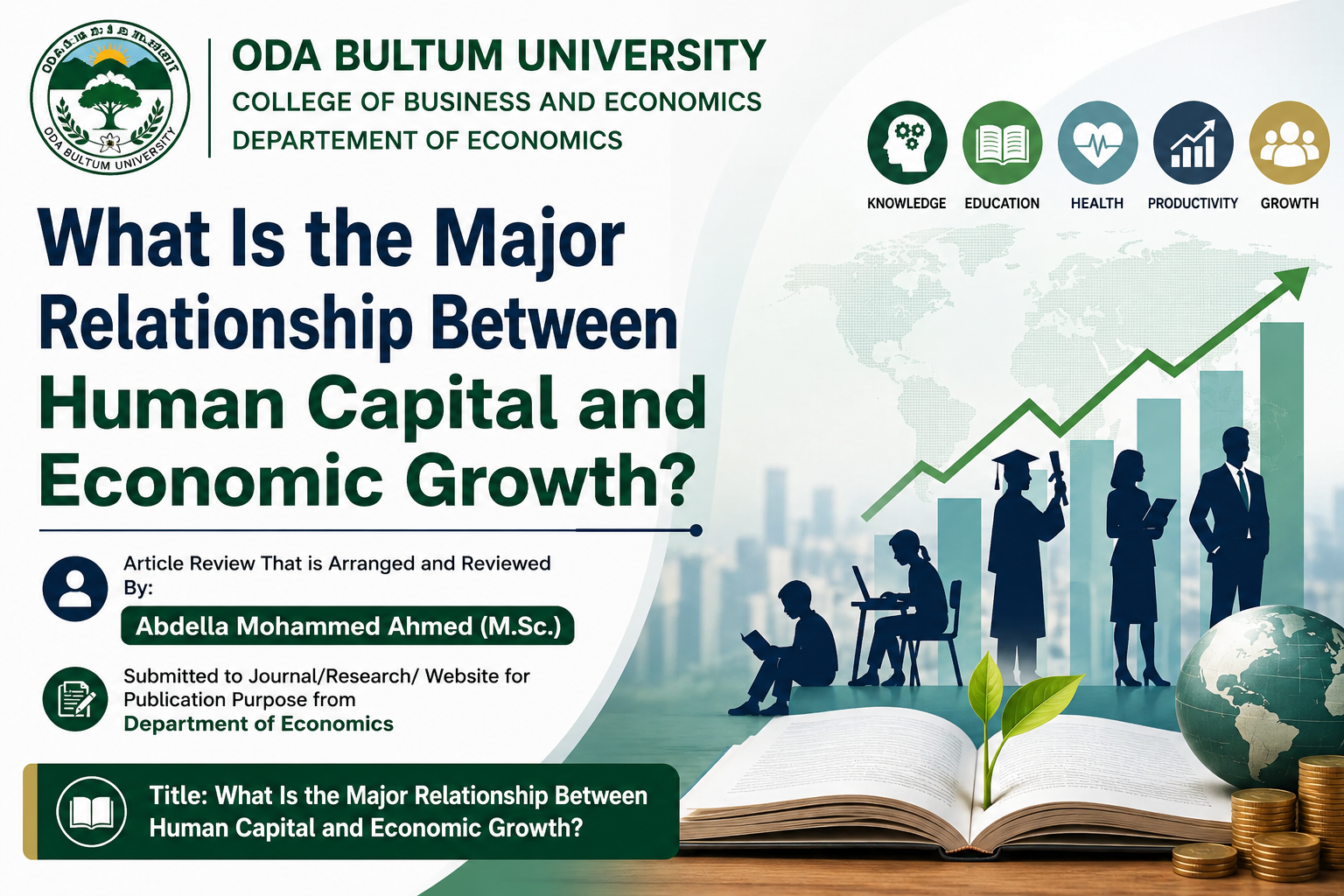
Introducing the Paper
What Is the Major Relationship Between Human Capital and Economic Growth? is an article review prepared by Abdella Mohammed Ahmed (M.Sc.) of the Department of Economics at Oda Bultum University’s College of Business and Economics.
The paper examines a question that is often obscured by conventional discussions of investment and growth: does prosperity begin with financial capital, or with the capabilities of people?
Its central proposition is that human capital—the knowledge, skills, experience, health, judgement and productive capacity of a population—is strongly connected to economic growth. Investment in education, healthcare and workforce development can increase productivity, innovation, employment, participation and earnings. Economic growth can then provide further resources for investment in people, creating what the paper describes as a positive, strong and bi-directional relationship.
The review considers how education and health interact with income, employment, consumer spending and business investment. It also highlights an important limitation: higher income alone does not guarantee that families, firms or governments will invest sufficiently in human development. Capability must be deliberately cultivated; it cannot be assumed to emerge automatically from financial growth.
Although presented as a study, the document is more accurately described as a synthesis of established economic arguments and supporting evidence, including OECD education and employment data. Its value lies less in offering a new econometric model than in drawing together a powerful conclusion:
Economies do not become prosperous merely because they accumulate money. They become prosperous when people become more capable of learning, creating, working, adapting and participating.
For Total Wealth Planners and Citizen Investigators, that conclusion carries particular significance. It suggests that financial resources, professional expertise and technology should not be assessed only by the transactions they facilitate or the outputs they produce. They should also be judged by the human capability they leave behind.
The paper therefore provides a useful foundation for a broader Academy of Life Planning principle:
Financial capital may finance growth. Human capital creates it.
Human Capital Funds Growth. Financial Capital Only Finances It.
Most discussions about economic growth begin with money.
How much is being invested?
How much credit is available?
How can businesses raise more capital?
How can consumers be encouraged to spend?
These are reasonable questions. But they begin halfway through the story.
The paper What Is the Major Relationship Between Human Capital and Economic Growth? reaches a more fundamental conclusion: economies grow when people become healthier, better educated, more skilled, more creative and more capable of participating productively.
Financial capital may finance economic activity.
Human capital creates it.
What the paper actually shows
The document describes human capital as the knowledge, skills, experience, intelligence, judgement, health and capabilities held by individuals and collectively across a population. It argues that increasing these capabilities improves productivity, innovation, employment, participation, earnings and ultimately economic growth.
Its central causal sequence is straightforward:
Investment in people → greater capability → higher productivity and earnings → increased spending and enterprise investment → economic growth.
This is not a one-way relationship. Economic growth can also increase the resources available for education, healthcare and training.
The relationship is therefore described as positive, strong and bi-directional.
Growth helps build human capital.
Human capital helps produce growth.
That feedback loop matters because it challenges the assumption that economic policy can concentrate on money, markets and business investment while treating human development as a secondary social concern.
Education and health are not merely things a prosperous society purchases after growth has occurred.
They are part of the productive infrastructure from which prosperity emerges.
A necessary qualification
Although the document is presented as an empirical study, it is more accurately understood as an article review or synthesis. It draws on established economic reasoning and cites evidence including OECD education and employment data, rather than reporting a new original econometric investigation.
For example, it notes that among 25- to 34-year-olds in 2021, employment rates were higher for people with college or graduate education than for those whose education ended at school level. The difference was particularly substantial for women: 82% employment among those with tertiary education, compared with 67% among those with school-level education.
This supports an association between education, employability and economic participation. It does not, by itself, prove that every additional qualification produces growth or that education operates independently of labour-market conditions, geography, discrimination or institutional quality.
Indeed, the paper acknowledges an important limitation: educating people does not automatically create suitable jobs. Skills may be developed in one place while opportunities exist elsewhere. People may be qualified but unable or unwilling to relocate. Economic structures still determine whether human capability can be expressed productively.
That distinction is crucial.
Human capital is productive potential. Agency and opportunity determine whether that potential becomes productive reality.
The growth system is wider than GDP
The paper defines economic growth conventionally as an increase in the production of goods and services, measured through GDP.
But its own conclusions point towards a broader understanding of prosperity.
Investment in human capital is associated not only with increased output, but with:
- improved health and longevity;
- greater participation;
- increased innovation;
- better employment conditions;
- reduced poverty;
- greater equality;
- enhanced problem-solving capacity;
- stronger democratic and social participation;
- improved individual and collective well-being.
This exposes one of the limitations of the traditional growth narrative.
GDP records the value of economic production. It does not fully record the capability of the people producing it.
An economy may increase output while depleting health, confidence, community, attention or personal agency. It may appear richer on the financial balance sheet while becoming poorer in the human assets upon which future prosperity depends.
The deeper question is therefore not simply:
How fast is the economy growing?
It is:
What is happening to the capability of the people from whom future growth must come?
The lesson for Total Wealth Planners
Traditional financial planning tends to treat human capital as an input to a financial calculation.
A person has earnings. Those earnings are projected forward. A present value may be calculated. The planner then concentrates on how the resulting financial capital should be accumulated, invested and protected.
The study suggests that this ordering should be reversed.
A client’s future financial position is not produced primarily by an investment portfolio. It is produced first by the person’s continuing ability to learn, work, adapt, decide, cooperate, create and recover from setbacks.
The portfolio is downstream of the person.
For Total Wealth Planners, human capital therefore includes much more than expected salary. It includes:
- health and functional capacity;
- knowledge and transferable skills;
- judgement and decision-making ability;
- professional relationships and social trust;
- adaptability in the face of technological change;
- confidence and self-efficacy;
- creativity and entrepreneurial capacity;
- the ability to recognise risk and seek appropriate help;
- the capability to turn financial resources into a life that is actually valued.
A conventional adviser might ask:
How much capital does this person need?
A Total Wealth Planner should also ask:
What capability must this person retain, strengthen or rebuild to create the future they want?
This leads to a different form of planning.
Career development is no longer separate from financial planning. Health is not merely an insurance risk. Education is not only a cost. Time away from work is not automatically lost production. A sabbatical, retraining programme, caring period or transition into self-employment may reduce short-term income while increasing the person’s long-term adaptive capacity.
The paper’s diagram on the decision to remain in education illustrates precisely this trade-off. Education involves direct costs and foregone earnings in the present, while potentially producing higher income over a much longer future period. Those later benefits must be considered over the whole life course rather than judged against the immediate cost alone.
That is recognisably a life-planning problem.
The same reasoning applies to investing in health, developing digital competence, changing career, starting an enterprise, building a professional network or learning to manage money independently.
These are not simply expenses.
They are investments in future capability.
The lesson for Citizen Investigators
Human capital also matters when people are trying to understand misconduct, exploitation or institutional failure.
A citizen confronting a complex financial dispute may possess legal rights but lack the practical capability to exercise them.
They may need to:
- reconstruct a chronology;
- distinguish evidence from allegation;
- understand unfamiliar financial structures;
- identify inconsistencies;
- assess competing explanations;
- locate relevant rules and records;
- communicate clearly with institutions;
- resist intimidation and information overload;
- decide when professional expertise is genuinely necessary.
These are forms of investigative human capital.
The underlying injustice is often described as a shortage of money: the citizen cannot afford lawyers, forensic accountants or specialist investigators.
But the problem is also a shortage of accessible capability infrastructure.
Knowledge is fragmented. Procedures are opaque. Institutions understand their own systems while the citizen encounters them for the first time. The professional side possesses accumulated organisational memory; the individual is expected to learn under pressure.
This creates what we might call the capability asymmetry.
The formal rights of both parties may appear equal. Their practical ability to understand, evidence and pursue those rights is not.
Citizen investigation tools can reduce that asymmetry. They can help people organise documents, test claims, identify gaps, build timelines and ask better questions. But their purpose should not be to replace one dependency with another.
A good investigative tool should leave the citizen more capable than it found them.
The proper measure is not simply whether the software produced a report.
It is whether the person gained enough understanding to exercise informed judgement over what happens next.
Income alone is not enough
One of the paper’s most important conclusions is that increasing income does not automatically produce adequate investment in health and education.
Households may spend additional income elsewhere. Food spending may rise through greater variety without significantly improving nutrition. Resources may not reach the family members who need them most. Structural inequalities may continue even when average income increases.
This offers a wider lesson for financial planning.
More money does not automatically create more agency.
A larger pension, inheritance, compensation payment or investment portfolio may improve someone’s options. But money without knowledge, confidence, health, supportive relationships and decision-making capacity can remain underused, misdirected or vulnerable to exploitation.
That is why financial capital cannot be treated as a substitute for human capital.
It can buy access to education, healthcare, time and support. But the conversion is not automatic.
The planner’s role is partly to help the person make that conversion consciously:
money into capability, capability into choice, and choice into a life the person has reason to value.
Human capital creates spillover value
The paper also observes that human-capital investment benefits more than the individual receiving it.
An educated person may help others understand information, solve problems or develop innovations. A healthy person may support family and community and reduce the transmission of illness. The benefits spill beyond the original investor.
This creates a problem for markets.
Because some of the value is shared socially rather than captured privately, individuals and firms may invest less in human capital than would be beneficial for society as a whole. The paper consequently argues that governments retain an important responsibility for the performance of health and education systems.
The same principle applies to financial capability.
When a person becomes more financially capable, the benefit is not confined to their own bank account.
They may help relatives avoid scams.
They may challenge harmful practices.
They may make better decisions as trustees, carers, employers or community members.
They may reduce avoidable dependence on public services.
They may pass knowledge and confidence to the next generation.
Financial capability is therefore not merely a private consumer benefit.
It is civic infrastructure.
The danger of extractive expertise
The paper presents education as an investment that leaves knowledge, skill and capability inside the person.
Much of the financial-services model works differently.
The client pays repeatedly for an expert to retain knowledge and exercise judgement on their behalf. The service may solve the immediate problem while leaving the underlying capability gap largely unchanged.
This creates a distinction between two forms of economic activity.
Capability-building activity increases the productive capacity of the person.
Dependency-maintaining activity monetises the continuing absence of that capacity.
Both may contribute to measured GDP. But they do not create the same kind of prosperity.
A system can grow financially by increasing the number of intermediaries, procedures and recurring charges required to help citizens navigate complexity. Yet that growth may be generated by institutionalising dependence rather than increasing human capability.
From an agency perspective, this is not genuine development.
It is the commercialisation of the capability gap.
From assets under management to capability under ownership
The investment industry commonly measures success through assets under management, recurring revenue, retention and product flows.
The human-capital perspective suggests a different scorecard.
For Total Wealth Planners, the relevant questions include:
- Is the person healthier, more secure and more adaptable?
- Do they understand their financial position better?
- Can they evaluate options more independently?
- Have they developed skills that improve future earning or coping capacity?
- Are they less vulnerable to manipulation and exploitation?
- Do they know when they can act alone and when specialist support adds value?
- Has the planning relationship increased or diminished their confidence?
- What capability remains with them after the planner steps away?
For Citizen Investigators, the parallel questions are:
- Can the person explain what happened in their own words?
- Can they distinguish verified facts from suspicions?
- Is the evidence organised and accessible?
- Can they identify the unanswered questions?
- Do they understand the principal routes for escalation?
- Are they better able to make the next decision without surrendering control?
This gives us a more meaningful measure than assets under management:
Capability under ownership
Assets under management belong to the client but are frequently controlled, interpreted and administered by institutions.
Capability under ownership remains within the person.
It cannot easily be withdrawn by a provider, lost through platform failure or subjected to an annual management charge.
And unlike a financial asset, capability often produces positive externalities for families, workplaces and communities.
The Academy conclusion
The paper begins with a familiar economic proposition: investment in education and health raises productivity and contributes to growth.
Its deeper implication is more challenging.
The most important productive asset in an economy is not money.
It is the developing capability of its people.
Financial capital can fund a school, a hospital, a business, an investigative tool or a planning service. But it is human capital that learns, judges, invents, cooperates and acts.
And human capital reaches its full value only when people possess sufficient agency and opportunity to use it.
That should change how we think about financial planning, citizen support and economic policy.
The purpose of planning cannot be merely to accumulate assets.
The purpose of investigation cannot be merely to produce documents.
The purpose of expertise cannot be to preserve the expert’s position in the middle.
The real task is to build capable people who can understand more, choose more freely and act with greater confidence.
Because financial capital may finance growth.
Human capability is what makes growth possible.

