
By the Academy of Life Planning | www.academyoflifeplanning.com
A Total Wealth Planner is someone who has restored their human agency—able to think clearly, act independently, and navigate life, money, and uncertainty without reliance on structurally untrustworthy systems.
The Gap We’ve Been Designing Around
For decades, financial planning has been framed as a service delivered at a point in time: advice given, recommendations made, outcomes reviewed.
It is a model built for a world where:
- information was scarce,
- institutions were trusted,
- and complexity could be managed through delegation.
That world no longer exists.
Today’s environment is defined by:
- persistent uncertainty,
- expanding complexity,
- and systems that are, at times, structurally misaligned with the interests of those they serve.
The result is not simply poor outcomes. It is something more fundamental:
a gradual erosion of human agency.
Individuals are left dependent—on advice, on interpretation, on systems they cannot fully see or challenge.
The question is no longer whether people need help.
It is whether the help they receive restores their ability to think and act for themselves—or replaces it.
A Different Starting Point
The Academy of Life Planning begins from a different premise:
All planning begins with what is already present.
Not with products.
Not with markets.
Not even with money.
But with the individual’s:
- current reality,
- lived experience,
- and latent capability.
From this foundation, the role of planning is redefined.
It is not to direct decisions.
It is to enable them.
The Full Spectrum of Agency
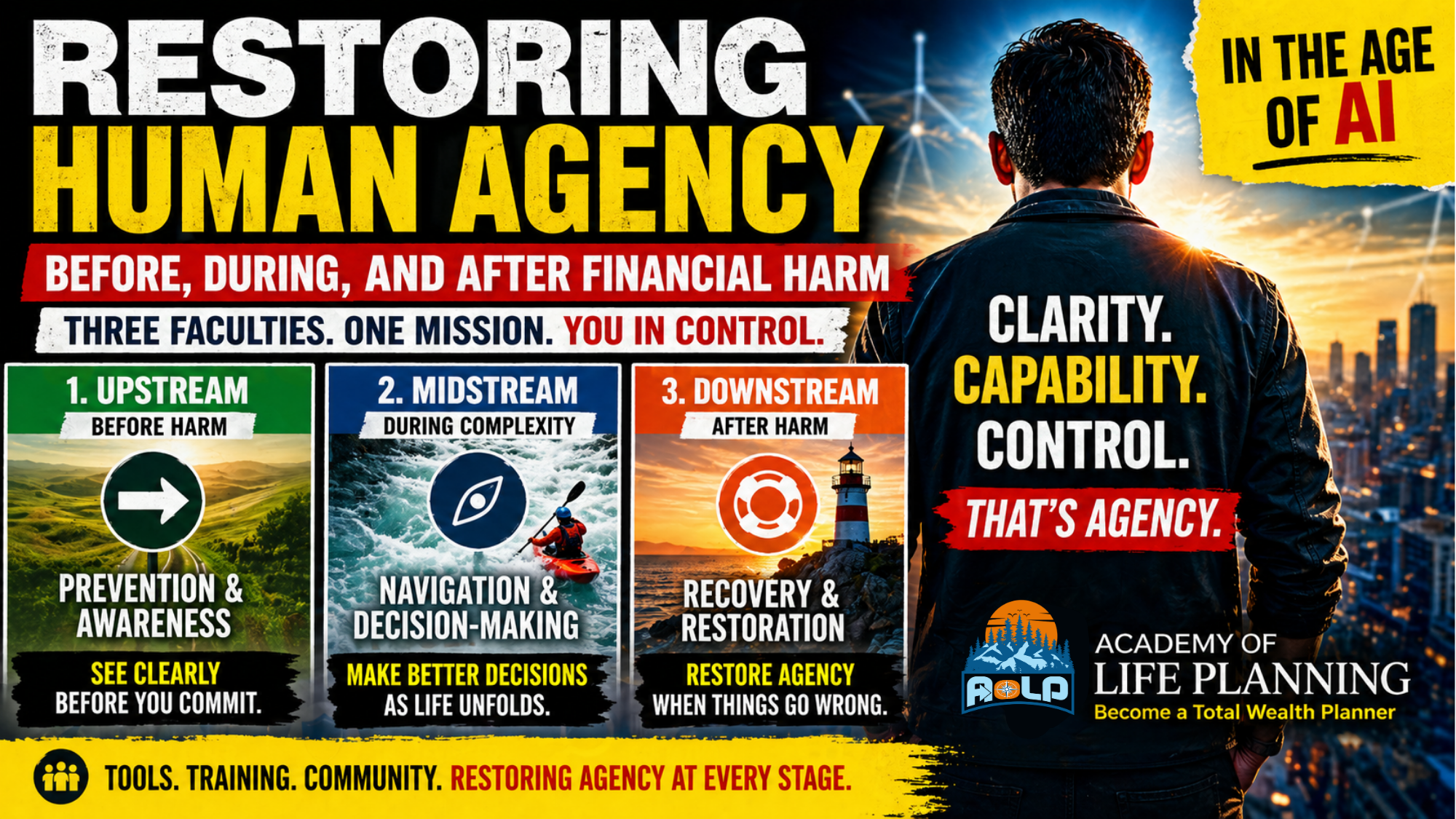
To understand this shift, it helps to move beyond isolated moments of advice and consider the full lifecycle of financial experience.
In practice, individuals encounter three distinct conditions:
- Before harm occurs
- While navigating complexity
- After harm has taken place
Traditional models tend to engage primarily in the second.
The Academy’s ecosystem is designed to support all three.
1. Upstream: Seeing Clearly Before Decisions Are Made
Most financial harm does not arise from reckless behaviour.
It arises from:
- incomplete understanding,
- hidden asymmetries,
- and decisions made without full visibility.
Contracts are signed.
Products are adopted.
Obligations are entered into.
Often without the individual having a clear view of:
- the risks,
- the trade-offs,
- or the structural imbalances embedded within them.
Upstream of harm, the objective is simple:
Clarity before commitment.
Tools such as the Leveller™ are designed to:
- surface hidden risks,
- identify power imbalances,
- and prompt the right questions at the right time.
This is not advice.
It is the restoration of informed decision-making.
2. Midstream: Navigating Complexity as Life Unfolds
Life does not present itself in neat, linear sequences.
Income changes.
Health shifts.
Opportunities emerge.
Pressures build.
Financial decisions are rarely isolated—they are interconnected with:
- family dynamics,
- career paths,
- and personal values.
Here, the central challenge is not access to information.
It is the ability to:
- interpret it,
- prioritise it,
- and act upon it coherently.
This is where Decision Capital becomes critical.
The Academy’s planning frameworks and tools—such as Navigator™ —exist to:
- model real-life trade-offs,
- visualise future scenarios,
- and support individuals in making grounded, forward-looking choices.
This is agency in motion.
3. Downstream: Restoring Agency After Harm
Despite best efforts, systems sometimes fail.
When they do, individuals can find themselves:
- overwhelmed,
- disempowered,
- and navigating processes that are adversarial, opaque, and exhausting.
At this point, traditional support models often intervene by:
- taking over the case,
- representing the individual,
- or directing the strategy.
The Academy takes a different approach.
Through Get SAFE, individuals are supported to:
- stabilise emotionally,
- organise their thinking,
- structure their evidence,
- and develop the capability to act for themselves.
They are not positioned as passive recipients of help.
They are supported to become Citizen Investigators with Goliathon™.
Not as a label of conflict—but as an expression of agency under pressure.
One Identity, Multiple Conditions
Across these stages, the individual remains the same.
Whether:
- assessing a contract,
- making a life decision,
- or responding to financial harm,
they are engaged in a single, continuous process:
restoring and exercising human agency.
A Citizen Investigator is not a different type of person.
They are a Total Wealth Planner operating in a moment of stress and complexity.
The Role of the Planner—Reconsidered
For professionals, this shift has significant implications.
The role is no longer defined by:
- providing answers,
- delivering recommendations,
- or managing outcomes.
It is defined by the ability to:
- build capability,
- create clarity,
- and support independent thinking.
From:
- adviser → to enabler
- expert → to partner in decision-making
- intermediary → to restorer of agency
This is not a reduction in value.
It is a redefinition of it.
A System Designed for a Different Outcome
The Academy ecosystem—spanning:
- Total Wealth Planning,
- Life Planner,
- the Leveller,
- Get SAFE,
- and Goliathon—
is not a collection of tools.
It is a coherent system designed to support individuals:
before, during, and after financial harm.
- Upstream: to prevent harm through clarity
- Midstream: to navigate complexity with confidence
- Downstream: to restore agency when systems fail
Each element reinforces the same objective.
Why This Matters Now
We are entering a period where:
- AI is democratising access to information,
- traditional advice models are under pressure,
- and trust in institutions is increasingly conditional.
In this environment, the most valuable asset is not:
- knowledge alone,
- or access to products,
but the capacity to:
- interpret,
- decide,
- and act.
In other words:
human agency.
The Direction of Travel
The Academy of Life Planning is not seeking to optimise the existing model.
It is building an alternative:
A system where:
- individuals retain control,
- professionals enable capability,
- and tools reduce asymmetry.
A system where planning is not something done to people.
But something they are empowered to do for themselves.
The Invitation
The future of financial planning will not be defined by who gives the best advice.
It will be defined by who is best able to:
restore agency in a world where it is increasingly under pressure.
That is the work.
And that is the opportunity.
The Three Faculties of the Academy of Life Planning: Prevention, Navigation, Recovery
Supporting human agency before, during, and after engagement with structurally untrustworthy systems in the age of AI.
Faculty 1: Upstream — Prevention & Awareness
Purpose:
To help individuals see clearly before they commit
Focus:
- Understanding decisions before they are made
- Identifying risk, bias, and asymmetry
- Building early-stage decision capability
Tools & Pathways:
- Leveller
- Foundational planning education
- Early-stage Total Wealth Planning
Core Idea:
Clarity before commitment.
Faculty 2: Midstream — Navigation & Decision-Making
Purpose:
To support individuals to act with clarity through complexity
Focus:
- Life planning
- Financial decision-making
- Trade-offs across life, money, and time
Tools & Pathways:
- Life Planner
- GAME Plan
- Total Wealth Planning frameworks
Core Idea:
Better decisions as life unfolds.
Faculty 3: Downstream — Recovery & Restoration
Purpose:
To help individuals restore agency when things go wrong
Focus:
- Emotional stabilisation
- Evidence organisation
- Self-directed case capability
Tools & Pathways:
- Get SAFE
- Goliathon
- Citizen Investigator pathway
Core Idea:
Rebuild capability under pressure.
The Academy of Life Planning is structured around three core faculties—supporting individuals before decisions are made, through life’s complexity, and when things go wrong.
Together, they form a complete system for restoring and protecting human agency in a world where trust can no longer be assumed.
A lifecycle model of human agency in the age of AI.

