
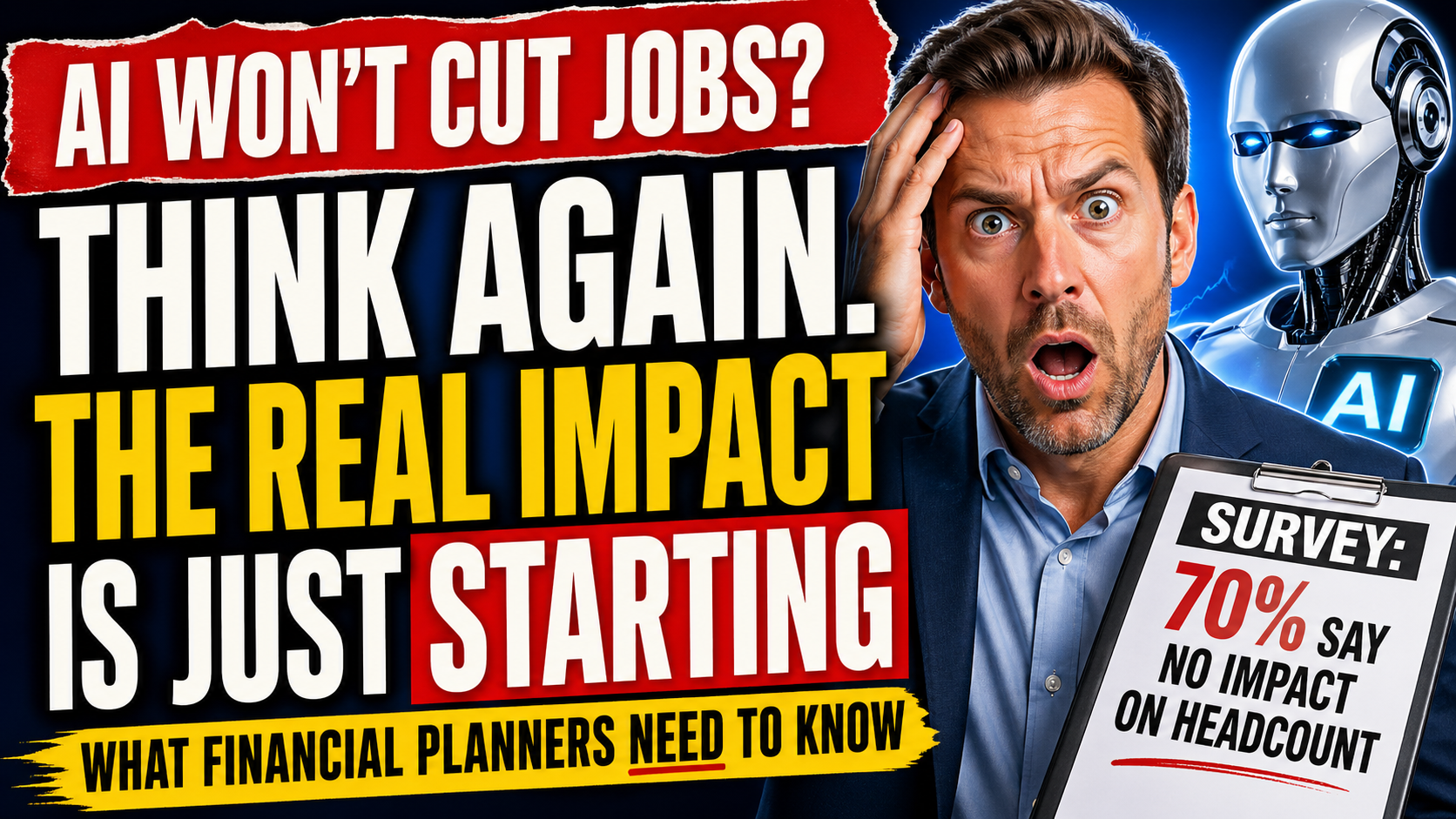
A recent industry survey suggests that nearly 70% of financial planning firms do not expect artificial intelligence to reduce headcount this year.
At first glance, that sounds reassuring. Stable. Even optimistic.
But look a little closer, and a different picture begins to emerge—not one of stability, but of transition.
What the Industry Is Saying
The research, conducted by L.E.K. Consulting in partnership with Saltus Partnership Programme, highlights three key themes:
- AI is being deployed primarily to improve administrative efficiency
- Firms see opportunities in planning support and operational processes
- Very few expect immediate job losses
The conclusion offered is simple:
AI is here to empower people, not replace them.
And in the short term, that may well be true.
A Familiar Pattern
Every major technological shift follows a recognisable path:
- Assist – Technology supports existing roles
- Augment – Productivity increases within the same structure
- Reshape – Roles begin to evolve
- Redefine – The profession itself changes
Most financial planning firms are currently operating between stages one and two.
That’s not a criticism. It’s a natural phase.
But it does mean the current narrative is based on where we are, not where we’re heading.
The Signal Beneath the Headline
Two data points in the report deserve more attention than the headline:
- Over half of firms are targeting administrative efficiencies
- A growing number expect AI to reduce future hiring
That second point is subtle—but significant.
Disruption rarely begins with redundancies.
It begins with roles that are simply… not replaced.
The shape of a profession can change quietly, long before it changes visibly.
The Deeper Shift Isn’t Inside the Firm
Much of the current focus is on how AI can improve:
- Back-office processes
- Report writing
- Portfolio analysis
- Planning workflows
All valuable. All worthwhile.
But all focused on making the existing model more efficient.
The more profound shift is happening elsewhere.
AI is not only enhancing advisers.
It is empowering individuals.
For the first time, people have access to tools that can:
- Model lifetime financial scenarios
- Analyse options in real time
- Translate complexity into plain language
- Support decision-making without intermediation
This changes the dynamic entirely.
From Advice to Agency
For decades, financial planning has largely been built on a simple premise:
The professional knows, the client follows.
AI begins to rebalance that relationship.
Not by removing the need for expertise—but by changing where value sits.
The emerging question is no longer:
- “Who gives the best advice?”
But:
- “Who best supports human decision-making in a complex world?”
That is a fundamentally different role.
A Profession at an Inflection Point
The survey also notes that a growing proportion of firms expect technology to have a significant impact over the next three to five years.
That timeframe matters.
Because it reflects a shift from:
- Incremental efficiency gains today
- To structural change tomorrow
As AI continues to evolve, several forces will converge:
- Information asymmetry will diminish
- Technical modelling will become commoditised
- Client expectations will rise
- Fee models will come under pressure
None of this necessarily eliminates planners.
But it does redefine what it means to be one.
The Opportunity Ahead
This is not a story about job losses.
It is a story about role evolution.
The financial planner of the future is unlikely to be valued primarily for:
- Producing reports
- Running calculations
- Selecting products
Instead, their value will increasingly lie in their ability to:
- Help individuals clarify what matters
- Navigate trade-offs and uncertainty
- Apply judgement where no model can decide
- Act as a trusted second brain during complexity, stress, or change
A Different Way to Frame the Future
At the Academy of Life Planning, we see this shift not as a threat—but as a necessary evolution.
A Total Wealth Planner is not defined by control over information or products.
They are defined by something more enduring:
The ability to restore and support human agency.
In a world where systems are becoming more complex, and trust is increasingly fragile, that capability matters more than ever.
Final Thought
AI may not reduce headcount this year.
But it is already reshaping expectations.
And over time, expectations reshape professions.
The question isn’t whether financial planning will change.
It’s whether we choose to evolve with it—
or optimise a model that is quietly being outgrown.

