
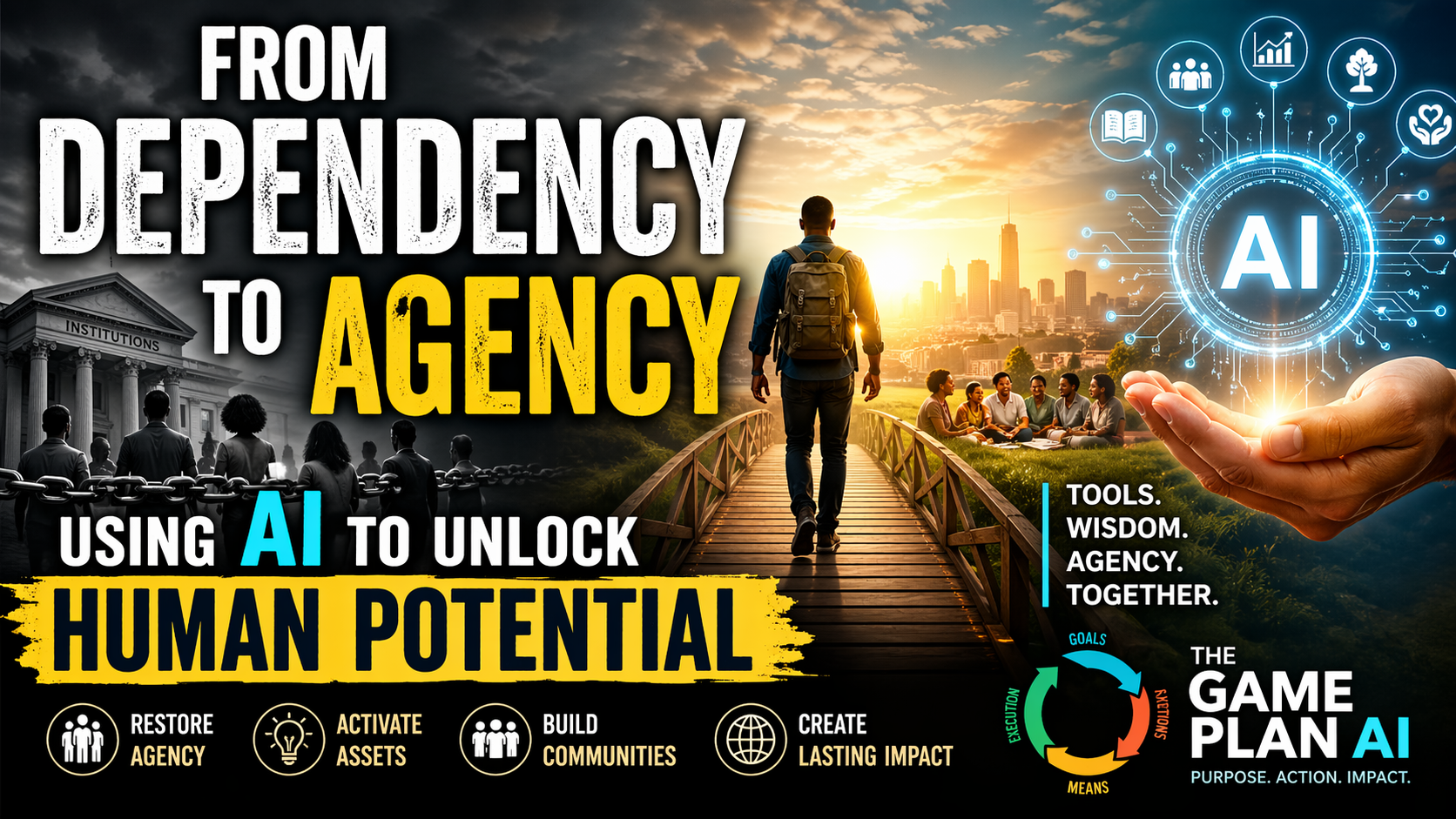
There was a time—not long ago—when access to knowledge was the preserve of institutions.
If you wanted expertise, you went to the expert.
If you wanted guidance, you deferred to authority.
If you wanted to make a major life decision, you were expected to rely on someone else to interpret complexity on your behalf.
That model shaped entire systems—education, finance, governance, even faith.
And for a time, it worked.
But it came at a cost.
Over time, something subtle began to erode:
not intelligence, not capability—but agency.
The Quiet Drift into Dependency
Across sectors and societies, we now see the consequences.
People are more informed than ever, yet less certain what to do.
Communities are rich in talent and experience, yet struggle to mobilise it.
Institutions are more sophisticated, yet increasingly disconnected from the lived reality of those they serve.
This is not a failure of individuals.
It is the natural outcome of a system that gradually shifted decision-making away from people and into structures.
Even well-intentioned systems—those designed to help—can, over time, create dependency if they do not actively cultivate self-direction.
That is the tension now being recognised in many domains, including within global faith communities.
A Convergence of Movements
Within the Anglican Communion, conversations around decolonisation and the Beloved Community reflect a growing awareness:
True development does not come from external provision alone—it emerges when people are able to recognise, organise, and deploy what they already have.
This is the essence of asset-based development.
It is also the foundation of the GAME Plan.
And now, with the emergence of AI, these ideas are no longer theoretical.
They are actionable.
AI Changes the Starting Point
Artificial Intelligence does not simply make processes faster.
It changes who can participate.
For the first time in history:
- Individuals can interrogate complex ideas in real time
- Communities can map their own capabilities without external gatekeepers
- People can explore purpose, strategy, and action without waiting for permission
This is not about replacing expertise.
It is about redistributing access to it.
The implication is profound:
The constraint is no longer access to knowledge.
The constraint is the ability to use it meaningfully.
And that is where structure becomes essential.
From Information to Transformation
Information alone does not create change.
Without a coherent framework, more information can simply lead to more confusion.
This is where the GAME Plan provides clarity.
At its core, it reflects a universal cycle:
- Goals – What truly matters
- Actions – What needs to change
- Means – What is already available
- Execution – What will be done
This is not a financial model.
It is not a technical system.
It is a human development framework—one that mirrors how intention becomes reality.
Crucially, it begins with a principle often overlooked:
All planning begins with what is already present.
A Life of Significance, Not Just Success
This perspective aligns closely with a deeper philosophy emerging across disciplines—what might be described as a Life of Significance and Collective Wellbeing.
As articulated in recent work on integrated life planning:
“A Life of Significance and Collective Wellbeing is a life oriented toward purposeful contribution that measurably enhances the flourishing of others and the systems we are part of.”
This reframes the objective entirely.
The goal is no longer optimisation of isolated outcomes—income, status, accumulation.
Instead, it becomes:
- Alignment of purpose
- Stewardship of resources
- Contribution to something larger than oneself
AI, used well, can accelerate this shift.
Not by directing people—but by helping them see more clearly.
The Role of the Church—and Institutions More Broadly
This raises an important question for institutions, particularly faith-based ones.
If individuals now have direct access to knowledge, insight, and interpretation:
What is the role of the institution?
The answer is not control.
It is stewardship.
- Stewardship of wisdom
- Stewardship of values
- Stewardship of discernment
The opportunity is to move:
From authority → to guidance
From instruction → to activation
From dependency → to agency
This is not a loss of relevance.
It is an evolution of it.
From Passive Recipients to Active Participants
Across the world, there are vast reserves of untapped human capital:
- Retirees with decades of experience
- Young people disconnected from opportunity
- Communities rich in relationships but lacking structure
These are not deficits.
They are dormant assets.
What is missing is a system that helps people:
- recognise their value
- organise their thinking
- act with confidence
This is precisely where the combination of AI and the GAME Plan becomes transformative.
A Practical Shift
Imagine:
- A retired professional rediscovering purpose and contributing to their community
- A young person mapping their capabilities and building a pathway forward
- A local faith group identifying its collective assets and mobilising them
Not through instruction.
Not through dependency.
But through structured self-direction.
This is not hypothetical.
It is already beginning.
The Real Question
The debate around AI often centres on risk.
And those risks are real.
But they are not the whole picture.
The deeper question is this:
Will AI deepen dependency…
or will it be used to restore agency?
The answer will not be determined by the technology itself.
It will be determined by the frameworks we build around it.
Closing Reflection
We are entering a period of profound transition.
Technology will continue to evolve.
Institutions will continue to adapt.
But the human need for purpose, meaning, and contribution remains constant.
If we can bring together:
- The accessibility of AI
- The structure of the GAME Plan
- The values of stewardship and collective wellbeing
Then we have the foundation for something genuinely transformative.
Not a new system of control.
But a new era of human agency.
Final Line
“This is not financial advice. This is not artificial intelligence.
This is the restoration of human agency—supported by both.”

