
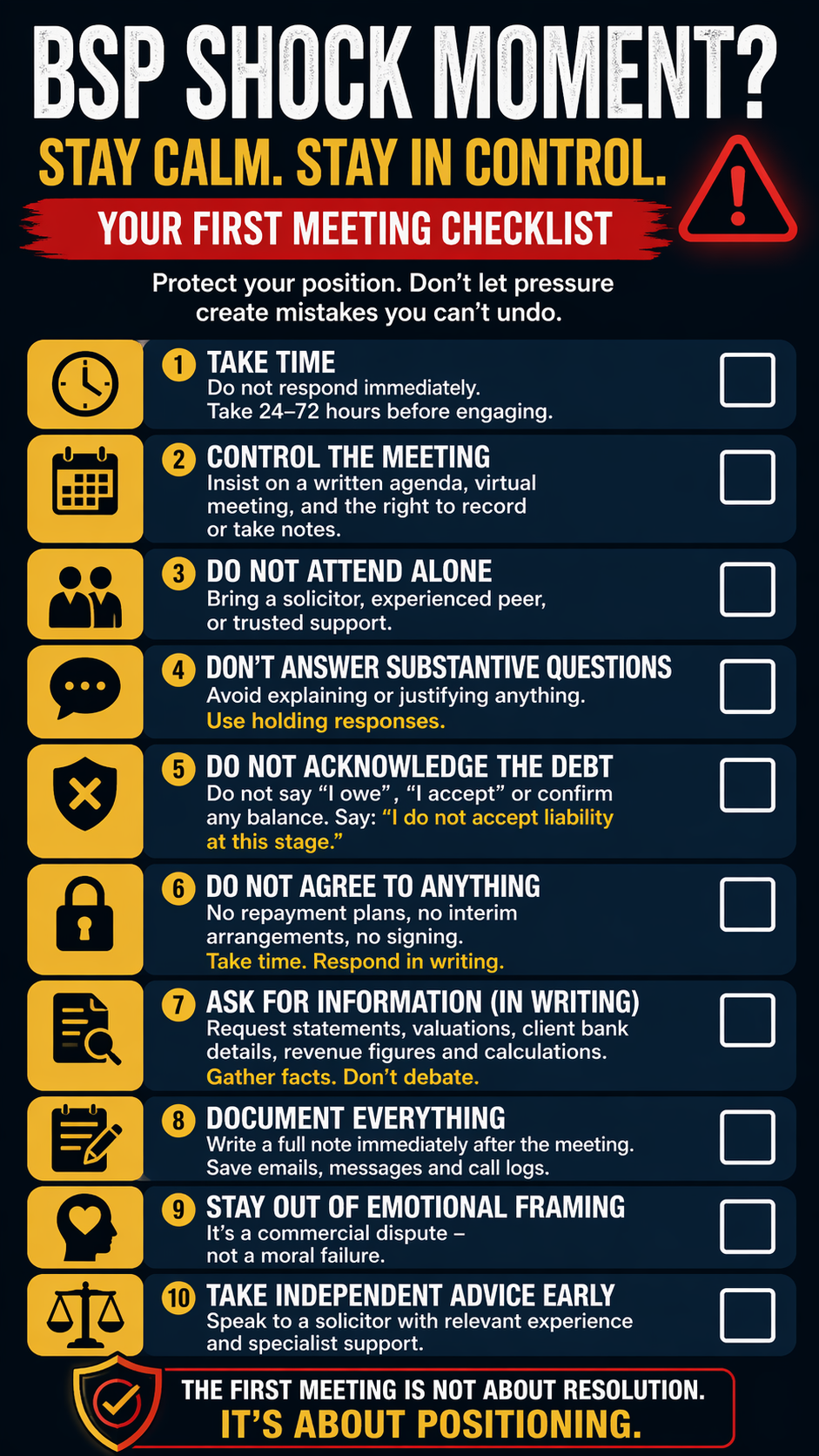
For advisers facing first “debt recovery” contact
Before You Attend That First Meeting — Read This
In many cases, the initial “debt recovery” meeting is not a neutral conversation.
You may find yourself facing two individuals:
- A regional manager (familiar, measured, supportive tone)
- A collections or recovery specialist (more direct, procedural, outcome-focused)
This pairing can create a subtle pressure dynamic:
- One builds rapport
- The other reinforces urgency and consequence
The effect is deliberate: to move the conversation forward quickly, often before you’ve had time to fully understand your position.
You may feel:
- Rushed to respond
- Encouraged to “just clarify a few things”
- Nudged toward informal agreement or acknowledgement
This is not unusual. It’s a well-established approach in high-stakes commercial discussions.
The Risk
In that environment, it’s easy to:
- Say more than you intended
- Agree to something prematurely
- Frame your position in a way that limits your options later
And once said, it’s very difficult to unwind.
The Principle
This meeting is not about resolving anything on the day.
It is about protecting your position.
10 Critical Steps Before and During Your First Debt Recovery Meeting
1. Immediate Grounding (Before Any Meeting)
Objective: Do not react. Stabilise.
- Do not respond immediately to calls or emails
- Do not agree to an urgent meeting “today” or “tomorrow”
- Acknowledge receipt only:
“I’ve received your message. I will review and revert in due course.”
- Take 24–72 hours minimum before engaging
Why it matters:
Urgency is part of the leverage. Time restores your thinking.
2. Control the Meeting Format
Objective: Remove pressure tactics before they start
- Insist on:
- Written agenda in advance
- Virtual meeting (not in-person office setting)
- Ability to record or take full notes
- Right to have a third party present
- If refused:
“I’m not in a position to proceed without those conditions.”
Why it matters:
Environment shapes behaviour. Their office = their psychological advantage.
3. Never Attend Alone
Objective: Avoid isolation
Bring one of:
- Solicitor
- Experienced peer
- AoLP/Adviser Bridge support
- Trusted witness (even if silent)
Why it matters:
Two people changes the entire dynamic. It disrupts “good cop / bad cop”.
4. Do Not Answer Substantive Questions
Objective: Avoid accidental admissions
In the meeting:
- Do not explain:
- Why you left
- Your understanding of the agreement
- Your financial position
- Client relationships
Use holding responses:
“I’m not in a position to comment on that today.”
“I’ll respond in writing once I’ve taken advice.”
Why it matters:
These meetings are often information-gathering exercises disguised as discussions.
5. Do Not Acknowledge the Debt
Objective: Preserve legal position
Avoid phrases like:
- “I owe…”
- “The balance is…”
- “I accept…”
Instead:
“I acknowledge receipt of your claim. I do not accept liability at this stage.”
Why it matters:
Language matters. One sentence can shift the entire case.
6. Do Not Agree to Anything On the Day
Objective: Prevent rushed commitments
- Do not:
- Agree repayment terms
- Sign documents
- Accept “interim arrangements”
- Enter “without prejudice” discussions prematurely
Response:
“I will review any proposals and respond in writing.”
Why it matters:
Pressure is highest in the room. Decisions made there are rarely optimal.
7. Ask for Key Information (But Don’t Debate It)
Objective: Shift from defence to information gathering
Request:
- Full loan/account statement
- Basis of valuation of the “client bank”
- Post-departure revenue generated from those clients
- Details of client reassignment
- Calculation of alleged loss
Say:
“Please provide that in writing so I can review properly.”
Why it matters:
You move from reacting → building your own position
8. Document Everything Immediately After
Objective: Preserve evidence
- Write a full note within 1 hour:
- Who attended
- What was said
- Tone and pressure used
- Save all emails, messages, call logs
Why it matters:
Memory fades. Evidence wins.
9. Do Not Be Drawn Into Emotional Framing
Objective: Stay out of guilt/shame dynamics
Expect:
- “You signed this”
- “You knew what you were doing”
- “We’re trying to help you”
- “This will escalate quickly if you don’t cooperate”
Internal reframe:
This is a commercial dispute — not a moral failure.
10. Take Independent Advice Early
Objective: Regain control of strategy
- Speak to:
- SRA-regulated solicitor with relevant experience
- Specialist support network (e.g. Adviser Bridge / Get SAFE style support)
Avoid:
- Relying on the other side’s interpretation
- Generalist advisers unfamiliar with these structures
Core Principle to Anchor This
The first meeting is not about resolution.
It is about positioning.
If they leave that meeting:
- Without admissions
- Without agreements
- Without losing composure
…they’ve already done well.
Pause. Regain Control. Choose Your Next Move—Deliberately.
You don’t need to rush.
You don’t need to guess.
And you don’t need to face this alone.
What you need right now is clarity before action.
Adviser Exit Support™ gives you a structured, independent space to:
- Understand your position
- Protect your options
- Decide your next step with confidence
Before anything is said that can’t be unsaid.
Before anything is signed that can’t be undone.
Start with a confidential, no-obligation conversation
We’ll help you slow this down, make sense of it, and move forward on your terms.

