
By Steve Conley
What if the problem was never access… but activation?
For decades, financial services has framed its central challenge as an “advice gap.”
Not enough advisers.
Not enough access.
Not enough affordability.
But the NHS—facing far greater scale, complexity, and pressure—took a different view.
They asked a more fundamental question:
What if most people don’t need more intervention…
but better support to manage things themselves?
The NHS Insight That Changed Everything
Within the NHS, a concept emerged that quietly reshaped how care is delivered:
The Patient Activation Measure (PAM)
PAM is a simple but powerful tool.
It assesses a person’s:
- Knowledge
- Skills
- Confidence
…to manage their own health and wellbeing.
Rather than assuming everyone needs the same level of care, PAM recognises something critical:
People are at different levels of readiness.
The Four Levels of Activation
The NHS identified a clear progression:
- Level 1: Passive, overwhelmed
- Level 2: Lacking knowledge and confidence
- Level 3: Taking action
- Level 4: Maintaining behaviours and progressing further
This wasn’t just theory.
It transformed how care is delivered.
A Radical Shift: From Treatment to Activation
The NHS began to move away from a “one-size-fits-all” model.
Instead, they used PAM to:
- Tailor support to the individual
- Avoid over-servicing those who are capable
- Focus resources on those who truly need help
Because without this:
The capable are over-supported
The vulnerable are under-supported
The Hidden Truth: Most People Can Self-Manage
At the heart of this approach is a simple but powerful belief:
With the right support, most people can manage their own health most of the time.
And the evidence backs this up.
More activated individuals:
- Make better decisions
- Adopt healthier behaviours
- Require fewer interventions
- Experience better outcomes
Activation isn’t fixed.
It can be developed.
So Why Has Financial Planning Not Followed?
Now consider the financial world.
We have:
- More tools than ever
- Instant access to information
- AI capable of modelling almost anything
And yet:
- People still feel overwhelmed
- Decisions are delayed or outsourced
- Dependency remains the default
The industry response?
More advice.
More complexity.
More intermediation.
But what if the NHS is right?
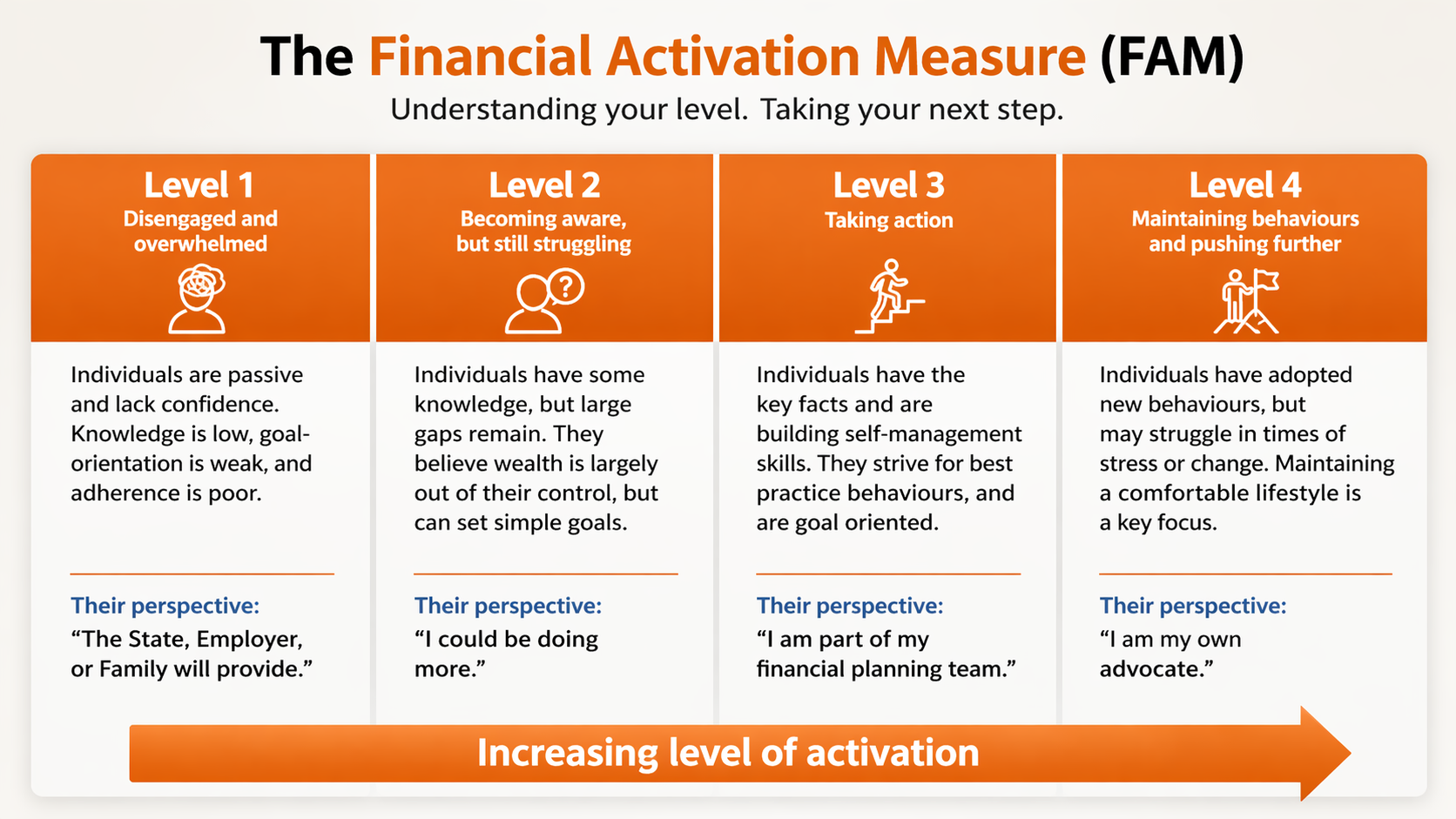
Introducing the Financial Activation Measure (FAM™)
At the Academy of Life Planning, we asked:
What if financial planning has the same problem healthcare had?
Not a lack of expertise.
But a lack of activation.
FAM™ is the financial equivalent of PAM
It measures a person’s:
- Ability to earn, save, invest and protect
- Confidence to make decisions
- Readiness to take control
Not their wealth.
Not their portfolio.
But:
Their capacity to manage their financial life.
From Advice Gap to Activation Gap
The traditional model assumes:
People need experts to take control.
The activation model recognises:
People need support to take control.
That’s a fundamental shift.
Why This Matters in the Age of AI
In 2026, the landscape has changed.
AI can:
- Analyse portfolios
- Model outcomes
- Explain financial concepts
So the constraint is no longer:
Access to information
It is:
The ability to decide and act
The Role of FAM™
FAM™ does three critical things:
1. It identifies where someone is
Not financially—but behaviourally.
2. It prevents premature advice
Not everyone is ready for complex planning.
3. It enables tailored support
Just like PAM, it allows support to be:
- Proportionate
- Personalised
- Effective
The 90/10 Reality
The NHS operates on a simple truth:
Most people can manage most of their health most of the time.
Financial planning is no different.
At AoLP, we believe:
- Most people can manage their finances
- With the right structure
- And the right support at the right time
Some will need one-to-one help.
But not all.
And not always.
From Dependency to Agency
This is not about removing support.
It’s about placing it where it belongs:
- After activation, not before
- In support of decisions, not in place of them
What Comes Next
Understanding your level of financial activation is the starting point.
From there:
- You build your Total Wealth Plan
- You develop your decision-making capability
- You move from passenger → pilot
Final Thought
The NHS didn’t scale by treating everyone.
It scaled by activating people.
Financial planning now faces the same choice.
The future of financial wellbeing will not be built on advice alone.
It will be built on activation.
Ready to begin?
Discover your Financial Activation Level—and take the first step towards building your Total Wealth Plan.

