
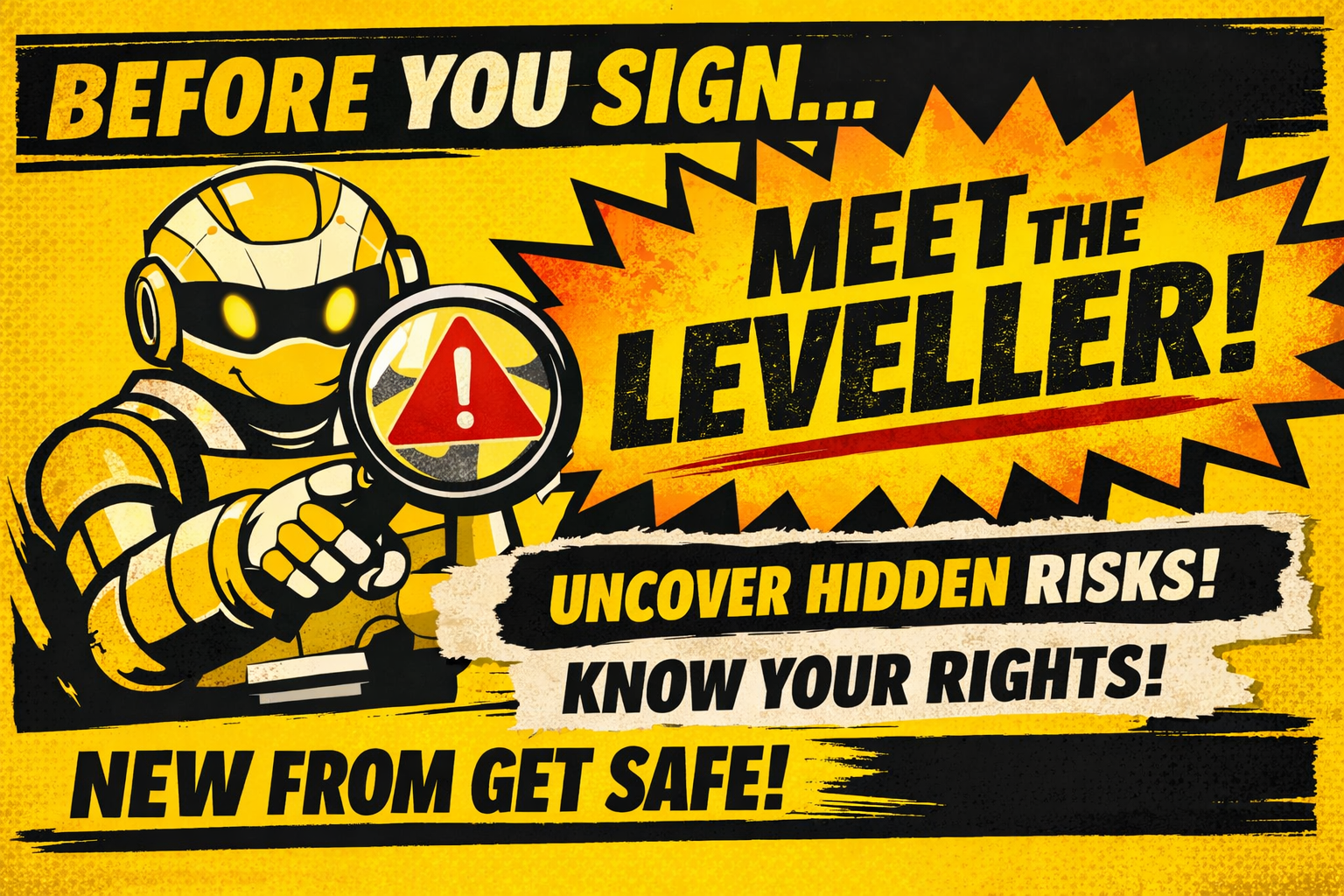
By Steve Conley, Founder of Get SAFE (Support After Financial Exploitation)
For years, we have sat with people after the damage was done.
People who trusted.
People who signed.
People who didn’t realise what they had agreed to until it was too late.
The consequences are rarely just financial.
They affect confidence, relationships, health—and sometimes a person’s entire sense of safety in the world.
And almost every story begins the same way:
“I didn’t understand what I was signing.”
The problem was never carelessness. It was imbalance.
The contracts were not written for them.
They were written by experienced legal teams.
Designed to protect institutions.
Structured in a way that assumed the individual would not challenge them.
Small print.
Complex clauses.
Hidden conditions.
One side knew exactly what the contract meant.
The other was expected to sign in good faith.
That is not informed consent.
That is imbalance.
We’ve helped people recover. But that was never enough.
At Get SAFE, we built Goliathon to support people after harm.
It helps individuals:
- organise their evidence
- understand what happened
- regain clarity and confidence
- take safe, structured next steps
For many, it has been the first moment they felt back in control.
But one question kept coming back:
What if we could help people before they signed?
That question led to The Leveller
The Leveller is a free AI-powered contract intelligence tool.
Its purpose is simple:
To help you understand what you are agreeing to—before you agree to it.
You can use it in real situations:
- At a car dealership
- In a bank meeting
- Reviewing a mortgage or loan
- Considering a pension transfer
- Signing a tenancy agreement
You upload a document, paste text, or take a photo.
Within seconds, The Leveller gives you clear, plain-English insight.
What The Leveller shows you
Instead of pages of legal language, you see what matters:
- Red flags
Clauses that may give the other side disproportionate control - Hidden costs
Fees, penalties, or charges that are not clearly presented - Power imbalances
Terms that limit your rights or shift risk onto you - Questions to ask
Specific, practical questions based on the contract itself - Your position
A calm, structured view of whether to proceed, pause, or reconsider
You also receive a fairness score and a downloadable report you can keep, share, or review later.
Why this matters now
Many of the largest financial scandals in recent decades followed the same pattern:
- Motor finance agreements
- Pension transfer schemes
- Mortgage mis-selling
- Payment protection insurance (PPI)
These were not isolated failures.
They were the result of a system where:
- one side held the information
- the other carried the risk
The Leveller exists to restore that balance—at the moment it matters most.
Part of a wider system of support
The Leveller is not a standalone tool.
It sits within a simple, human-centred flow:
- Before you sign → The Leveller
Helps you understand and decide safely - After harm → Goliathon
Helps you stabilise, organise, and move forward
This is not about fighting institutions.
It is about restoring clarity, agency, and informed choice.
A clear boundary
The Leveller is not a lawyer.
It does not provide legal advice.
What it does is something most people have never had:
Real-time understanding at the point of decision.
It stands beside you—quietly, clearly—when it matters most.
Try The Leveller
The Leveller is free to use at:
get-safe.org.uk
https://www.get-safe.org.uk/the-leveller
Mobile or PC.
You can:
- upload a PDF
- paste contract text
- photograph pages from your phone
The analysis takes seconds.
If someone you know is about to sign an agreement, share it with them.
Because the most important moment is not after something goes wrong.
It is the moment just before you say yes.
About the author
Steve Conley is the Founder of Get SAFE (Support After Financial Exploitation), Founder of the Academy of Life Planning, Global Ambassador for the Transparency Task Force, and a Chartered Financial Planner with over three decades of experience in financial services.
He was awarded the Transparency Trophy in 2017 for his leadership in financial consumer protection.
Appendix: A Real Example — When “Simple Funding” Isn’t Simple
To illustrate why The Leveller exists, here is a real example from my own experience.
I was offered what appeared to be a straightforward funding arrangement through a well-known payment platform. It was presented as quick, convenient, and aligned with my business cashflow.
On the surface, the offer looked manageable:
- Borrow: £2,510
- Repay: £2,961
- Structure: a fixed fee, repaid through a percentage of card takings
Nothing about this immediately suggested high risk.
What The Leveller revealed
When the agreement was analysed using The Leveller, the picture changed completely:
- Fairness score: 2/100 — Very Poor
- Effective cost: approximately 72% APR
- Automatic deduction: 24% of all card revenue
- Operational control: lender access to and control over payment flows
- Default risk: triggered by relatively minor operational changes
- Personal exposure: unlimited personal guarantee
Why this matters
Individually, each of these elements might be understood.
Together, they create a very different reality:
- Cashflow becomes constrained at the source
- Business flexibility is reduced
- Personal financial risk is introduced at a high level
- The true cost is significantly higher than it first appears
Most importantly, these characteristics were not presented in a way that made their combined impact immediately clear at the point of decision.
A structural observation
This type of arrangement sits in a space that can feel familiar—particularly when accessed through trusted platforms—but may not carry the same expectations of protection or transparency that individuals associate with regulated lending.
That is where confusion arises.
Not because people are careless, but because the form of the offer suggests safety, while the structure of the contract introduces risk.
What would have changed
If this agreement had been reviewed through The Leveller before signing, the decision would likely have been different.
Not necessarily because the offer is invalid—but because the full picture would have been visible:
- the real cost
- the loss of control
- the scale of personal exposure
That is the purpose of The Leveller.
To make the invisible visible—
before a decision is made.
A simple takeaway
If something is presented as:
- fast
- simple
- aligned to your cashflow
Pause.
Those features are not, in themselves, a problem.
But they can sometimes sit alongside terms that deserve closer attention.
Clarity changes decisions.
And better decisions prevent harm.

