
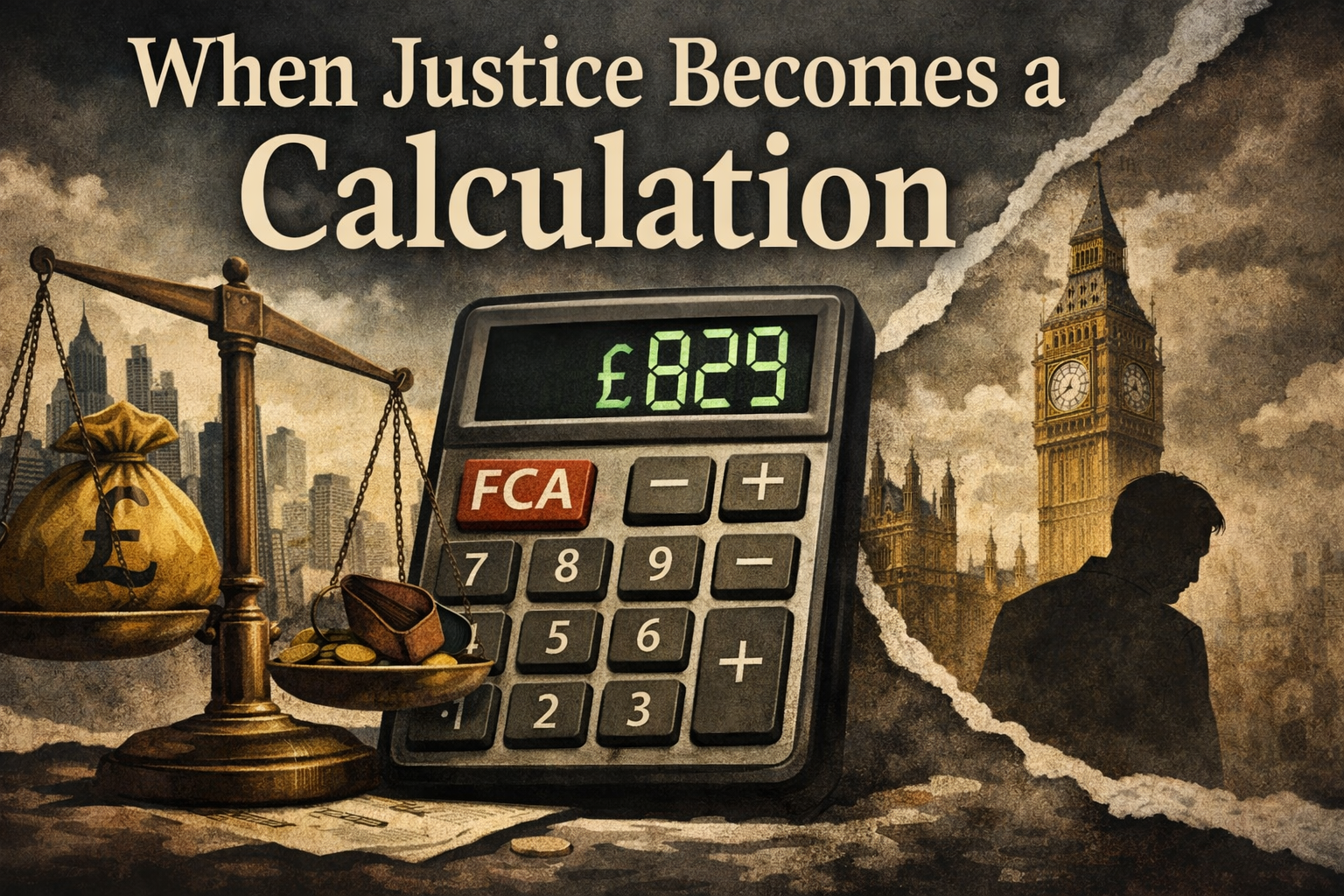
The UK’s financial watchdog has drawn a clear line in the sand.
Consumers who pursue car finance claims through the courts may be excluded from the Financial Conduct Authority’s £9.1bn redress scheme. The message is unmistakable: accept the scheme, or take your chances elsewhere.
[Source: Financial Times | Go to court and lose out on £9bn car finance redress scheme, says FCA boss | 4th April 2026]
At first glance, this appears pragmatic. A vast, complex scandal involving millions of agreements demands an orderly solution. But beneath the surface lies a deeper and more troubling question:
When did justice become negotiable?
A Discount on Harm
The numbers tell their own story.
The FCA estimates an average payout of £829 per claim. Legal firms suggest outcomes closer to £1,500 may be achievable through the courts.
If that gap reflects reality, then something important has happened.
Not just a difference in valuation — but a shift in principle.
Traditionally, the aim of redress is clear:
Restore the individual to the position they would have been in had the wrongdoing not occurred.
This is not an abstract ideal. It is a cornerstone of natural justice.
Yet what we are now seeing is something different:
A system that standardises harm — and discounts it.
From Justice to Manageability
To understand why, we must step back.
The FCA is not operating in a vacuum. It is balancing competing pressures:
- Millions of affected consumers
- Billions in potential liabilities
- A financial system still central to economic stability
Faced with this, the regulator has made a choice — not explicitly stated, but clearly embedded in the structure of the scheme:
Deliver partial justice at scale, rather than full justice in principle.
This is not incompetence. It is design.
A redress scheme of this nature is engineered to:
- Cap systemic exposure
- Provide speed and certainty
- Avoid the legal gridlock of mass litigation
But in doing so, it inevitably introduces compromise.
The Quiet Redistribution
The consequences of that compromise are rarely stated openly.
If consumers receive less than full restitution, the shortfall does not disappear. It remains within the system.
And that raises uncomfortable questions.
- Who ultimately retains the benefit of the original misconduct?
- How are profits, bonuses, and shareholder returns affected?
- Where, in this equation, is the consumer made whole?
What emerges is not neutrality, but redistribution.
Loss is not eliminated — it is allocated.
And too often, it is allocated away from institutions and towards individuals.
The Erosion of Deterrence
There is a further, more subtle consequence.
If firms know that, in the event of misconduct:
- Redress will be capped
- Liability will be managed
- Outcomes will be negotiated at system level
Then the signal changes.
Misconduct is no longer existential.
It becomes:
A risk to be provisioned, not a behaviour to be eliminated.
This is how structural problems persist — not through intent, but through incentives.
A System Under Strain
It would be easy to frame this as regulatory failure.
That would be too simplistic.
The FCA is attempting to avoid a repeat of the Payment Protection Insurance scandal, which ultimately cost the industry nearly £50bn and took over a decade to unwind.
No regulator wishes to recreate that.
But in avoiding one extreme, there is a risk of drifting too far toward the other:
A system where fairness is subordinated to feasibility.
The Deeper Failure
The truth is that by the time redress is required, the real failure has already occurred.
It occurred:
- When commission structures distorted incentives
- When disclosures were insufficient or unclear
- When consumers entered agreements without full understanding
Redress is not a solution. It is a remedy applied after the damage is done.
And remedies, by their nature, are imperfect.
Structural Untrustworthiness
This is where the issue moves beyond this single scheme.
What we are witnessing is a pattern.
A system that:
- Allows harm to occur at scale
- Manages the consequences centrally
- Limits the cost of accountability
- Presents the outcome as fair
This is not about individuals.
It is about structure.
And when structure consistently produces these outcomes, trust is not eroded by accident — it is eroded by design.
A Different Starting Point
At the Academy of Life Planning, we approach this from a different direction.
Not downstream, where harm is negotiated.
But upstream, where harm can be prevented.
That begins with a simple but often overlooked shift:
Plan the person before the money.
When individuals are equipped with:
- Clarity of purpose
- Understanding of trade-offs
- The ability to interrogate financial decisions
They are far less likely to enter into arrangements that later require redress.
This is the essence of Total Wealth Planning.
Not as a product.
But as a safeguard.
The Question That Remains
The FCA’s scheme may deliver speed.
It may deliver consistency.
It may even deliver a degree of fairness.
But it also raises a question that cannot be ignored:
If justice is adjusted to fit the system, rather than the system adjusted to deliver justice — what, exactly, are we protecting?
Closing Reflection
There is a place for pragmatism.
But there must also be a line.
Because once harm is routinely discounted, and accountability routinely managed, the risk is not just financial.
It is foundational.
When justice becomes a calculation, trust becomes the cost.
And in financial services, trust is the one asset that cannot be provisioned, capped, or quietly written down.
The future of financial planning will not be built on better redress schemes.
It will be built on systems that make them unnecessary.
That is the work ahead.
Appendix: Who Really Pays — and Who Is Held to Account?
These are the questions many people are asking — and they deserve clear, grounded answers.
1. Will the £9.1bn simply be passed back to consumers?
In practice, some of it likely will be.
Not as a visible charge, but through:
- Higher interest rates on future finance agreements
- Tighter lending criteria
- Reduced incentives or less favourable terms
Financial institutions don’t operate in isolation. When large, unexpected costs arise, they are often absorbed across the system over time.
That said, it is not always a direct pass-through. The cost is typically shared between:
- Shareholders (through reduced profits)
- Firms (through provisions and capital impact)
- Future customers (through pricing adjustments)
So the more accurate answer is:
The cost doesn’t disappear — it is redistributed.
2. What happens to the people who caused the harm?
This is where expectations and reality often diverge.
In most large-scale financial scandals:
- Responsibility is institutional rather than individual
- Firms pay compensation and, occasionally, fines
- Individuals rarely face direct financial liability
Why?
Because decisions are:
- Distributed across teams
- Embedded in systems and processes
- Often technically compliant at the time, but later judged inadequate
This makes individual accountability difficult to prove, even when outcomes are clearly harmful.
3. Do executives get prosecuted?
In the vast majority of cases:
No — not unless there is clear evidence of fraud or deliberate criminal intent.
Regulatory action tends to focus on:
- Firms
- Systems
- Governance failures
Rather than:
- Individual prosecution
There have been frameworks introduced (such as senior manager accountability regimes), but in practice, criminal prosecutions remain rare.
4. Is this effectively a “£9.1bn heist”?
It can feel that way — particularly to those directly affected.
But the reality is more nuanced.
This is not typically a case of:
- Individuals deliberately extracting money with clear intent to defraud
It is more often:
- Incentive structures that reward certain behaviours
- Sales models that evolve faster than oversight
- Disclosure practices that fall short of true understanding
In other words:
Harm emerges from the system — even when no single actor is clearly “the villain.”
5. Why this still matters
Even if there is no single perpetrator, the outcome remains the same:
- Consumers experienced financial harm
- Redress may not fully restore losses
- Accountability appears diluted
And this leads to a deeper issue:
If no one is clearly responsible, then who ensures it doesn’t happen again?
6. The structural lens
This is why focusing only on compensation misses the bigger point.
The more important questions are:
- How are incentives designed?
- Who benefits when products are sold?
- What does the consumer actually understand at the point of decision?
Because if those conditions remain unchanged, the cycle repeats.
7. A different way forward
Rather than relying on:
- After-the-fact compensation
- Regulatory intervention
- Legal remedies
There is a growing case for strengthening the position of the individual before decisions are made.
That means:
- Better access to clear, unbiased guidance
- Tools that help people understand trade-offs
- A shift from product-driven to person-led planning
Closing reflection
These questions — about cost, accountability, and fairness — are not just reactions to one scheme.
They point to something more fundamental:
A system that can absorb large-scale harm without clear individual consequence will always struggle to build lasting trust.
Which brings us back to the central challenge:
Not just how we compensate for mistakes…
But how we design a system where fewer people need compensating in the first place.

