
Last week, analysts on a St. James’s Place investor call asked the same question again and again:
Will AI replace financial planners?
The short answer?
No.
The more important answer?
It doesn’t have to replace you to fundamentally change your business.
And that shift has already started.
The Real Question Isn’t Replacement — It’s Compression
Recent market nerves were triggered by AI-powered tax tools emerging from US platforms like Altruist. Investors reacted as if advice firms could disappear overnight.
That’s unlikely.
When someone loses a spouse…
When a client is paralysed by fear about retirement…
When family dynamics become complex…
They don’t want a bot.
They want a steady human.
But here’s what will happen:
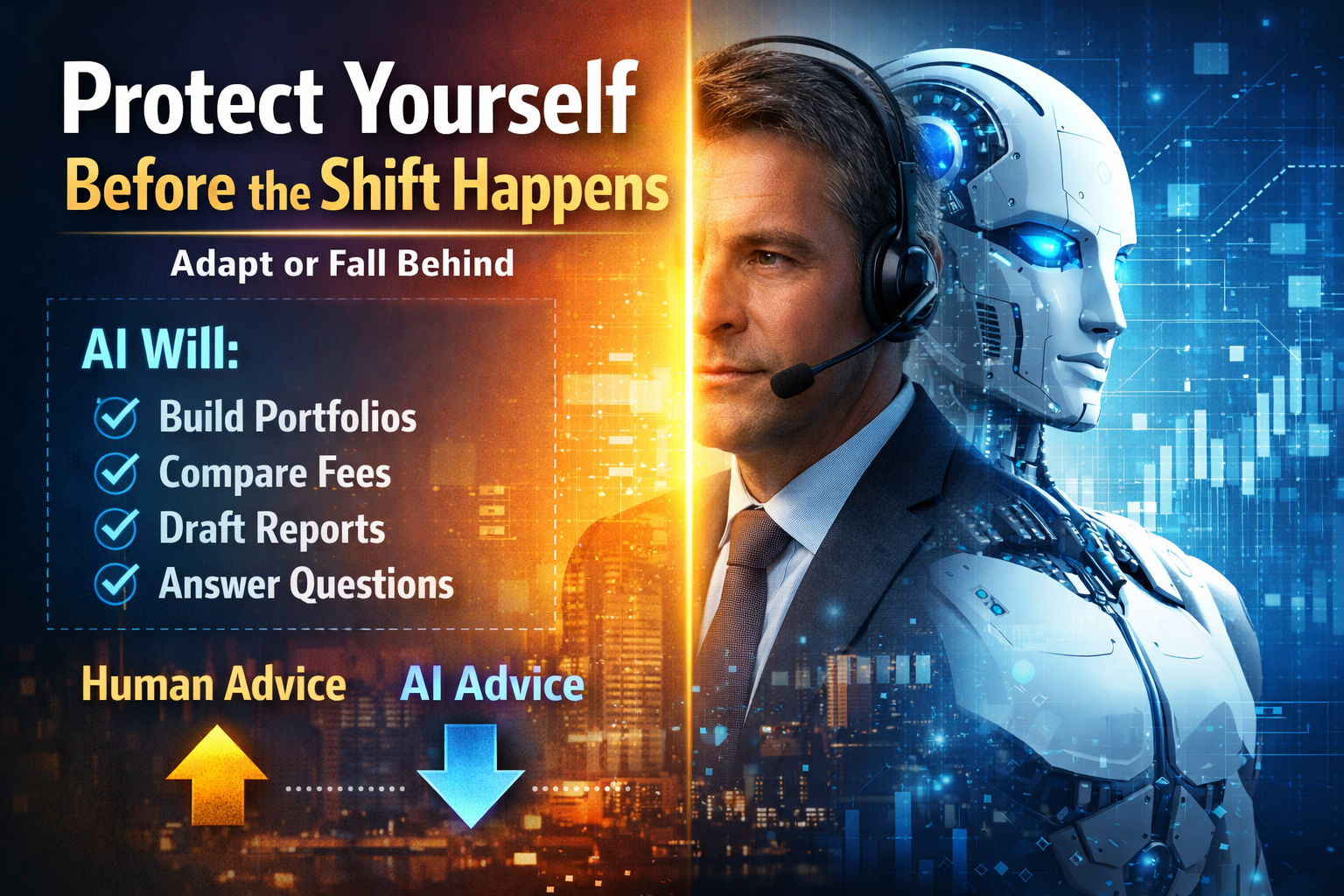
- AI will handle portfolio construction.
- AI will compare fees.
- AI will draft suitability letters.
- AI will answer technical tax questions.
- AI will be embedded inside D2C platforms.
And it will do it at scale.
The D2C Threat Is Real
Imagine a platform like:
- AJ Bell
- Hargreaves Lansdown
Launching an AI tool that says:
“Tell me your age, ISA balance, goals — and here’s your recommended portfolio.”
At 0.1% fee.
Or bundled inside platform charges.
That doesn’t replace holistic planning.
But it absolutely competes with money-only advisers.
If your proposition is:
- Asset allocation
- Fund selection
- Rebalancing
- Annual review meeting
You are already in the compression zone.
AI Won’t Replace Advisers.
It Will Replace Certain Advisers.
The ones who:
- Plan the money, not the person
- Focus on financial capital, not human capital
- Ignore values, purpose, meaning
- Just manage assets
AI can already build portfolios competently.
The Financial Times’ Stuart Kirk recently demonstrated AI constructing investment portfolios with reasonable logic. That genie is not going back in the bottle.
The question is not whether AI can do this.
It’s how cheaply it can do it.
Fee Compression Is Inevitable
If clients can ask:
“Am I overpaying my adviser?”
And receive a structured comparison in seconds…
Pressure builds.
If D2C platforms offer “guided AI advice” at 0.1%…
Pressure builds.
If advisers themselves use AI to cut internal costs…
Margins shift.
This is not a 12-month extinction event.
It is a multi-year repricing event.
So What Should You Do?
Protect yourself before the shift happens.
Not after.
Here’s how:
1. Move Up the Value Chain
Become indispensable in areas AI cannot replicate:
- Identity transitions
- Grief and life shocks
- Family conflict
- Behavioural coaching
- Purpose alignment
- Human capital strategy
2. Stop Being a Portfolio Manager
Start being a:
- Life architect
- Human capital strategist
- Decision partner
- Accountability guide
3. Build an AI-Integrated Practice
Don’t fight AI.
Use it.
Let AI:
- Model scenarios
- Draft documents
- Stress-test plans
- Compare options
You focus on meaning, context, judgement.
The Real Divide
The divide won’t be:
AI vs Advisers.
It will be:
Old-model advisers vs AI-integrated holistic planners.
Those who cling to product distribution and percentage fees will feel the squeeze.
Those who evolve into whole-person planners will find themselves in higher demand than ever.
The Strategic Question
If AI can handle 70% of the technical workload…
Why are you still charging as if it can’t?
And more importantly:
What is the 30% that only you can do?
That’s your future.
A Quiet Truth
The shift is not coming.
It’s underway.
You can either:
- Defend a shrinking perimeter
Or - Redesign your value around the irreplaceable human elements of planning.
At the Academy of Life Planning, we believe the future belongs to planners who integrate:
- Human capital
- Financial capital
- Values
- Purpose
- AI tools
In that order.
Because when you plan the person first,
technology becomes an ally — not a threat.
If you’re an adviser sensing the ground moving beneath your feet…
Now is the time to adapt.
Not when the fees have already halved.
Curious how others see this.

