

When AI makes deception cheaper, we must make verification cheaper too.
By Steve Conley, Founder, Academy of Life Planning
The Financial Conduct Authority (FCA) has warned that artificial intelligence is making investment scams easier to create and harder to identify.
It is right to be concerned.
But there is another side to this story that deserves considerably more attention.
The same technology that enables criminals to manufacture credibility enables ordinary citizens to interrogate credibility.
The same technology that can exploit human vulnerability can help people recognise when their vulnerability is being exploited.
And the same technology that threatens to widen the information asymmetry between financial institutions and consumers has the potential to close it.
Perhaps we should be asking a different question.
Rather than simply warning people about increasingly sophisticated financial predators, shouldn’t we be helping people become increasingly sophisticated financial citizens?
The confidence–competence gap
On 26 November 2026, the FCA published new research highlighting the growing threat of AI-enabled investment scams.
Reports of investment fraud mentioning suspected use of AI increased from 193 in 2024/25 to 956 in 2025/26 — a rise of nearly 400%.
The average loss suffered by investment fraud victims in 2025/26 was £28,188.
The consumer research revealed something particularly interesting:
- 62% of adults believed they could recognise an AI investment scam.
- 49% felt capable of recognising an artificially generated or manipulated celebrity recording.
- 74% of younger investors believed they could identify an AI investment scam.
- 38% of younger investors would check a firm’s regulatory authorisation before investing.
The research, conducted by Kantar on behalf of the FCA, involved 2,558 UK adults. FCA
There appears to be a gap between how capable people believe themselves to be and the protective behaviours they adopt.
We might call this the confidence–competence gap.
Confidence without competence creates vulnerability. Competence without confidence creates dependency.
What we should be developing is informed confidence: the ability to understand, investigate, evaluate and act in our own interests.
That is human agency.
The declining value of apparent credibility
For generations, we have relied on familiar signals to determine whom we should trust.
A professional qualification. An impressive website. A recognisable brand. A celebrity endorsement. A confident presentation. A sophisticated financial report.
Artificial intelligence is reducing the cost of reproducing almost all of these signals.
The problem is not simply that AI can create convincing fake videos. It is that the traditional relationship between the appearance of credibility and actual credibility is weakening.
A polished presentation once required considerable resources. Today, it may require little more than a subscription and a prompt.
We are entering an age in which looking trustworthy is becoming considerably easier than being trustworthy.
We must move from an economy of apparent credibility to an economy of verifiable credibility.
That requires a different set of consumer capabilities.
Authorisation is not the same as trustworthiness
The FCA recommends that consumers use its Firm Checker before engaging with businesses offering regulated financial services.
This is sensible and important guidance. We should encourage people to use it.
However, regulatory authorisation is one component of due diligence, not a substitute for it.
There are at least four questions a consumer should consider.
| Question | What we are establishing |
|---|---|
| Does this firm have the required regulatory permissions? | Authorisation |
| Am I communicating with the genuine organisation? | Authenticity |
| Are the claims supported by independent evidence? | Credibility |
| Does the proposition serve my interests? | Alignment |
These are different questions requiring different answers.
An authorised firm can be impersonated. An authentic business can make misleading claims. A legitimate financial product can be unsuitable for a particular individual.
Equally, a professional providing legitimate services outside the regulatory perimeter does not become untrustworthy simply because their activities do not require FCA authorisation.
The FCA acknowledges that dealing with an appropriately authorised firm reduces risk but does not eliminate it. It also warns consumers about clone firms impersonating genuine businesses. FCA+1
Regulatory status matters. But so do evidence, incentives, accountability and the nature of the service being provided.
Trustworthiness is a broader question than regulatory permission.
The other side of artificial intelligence
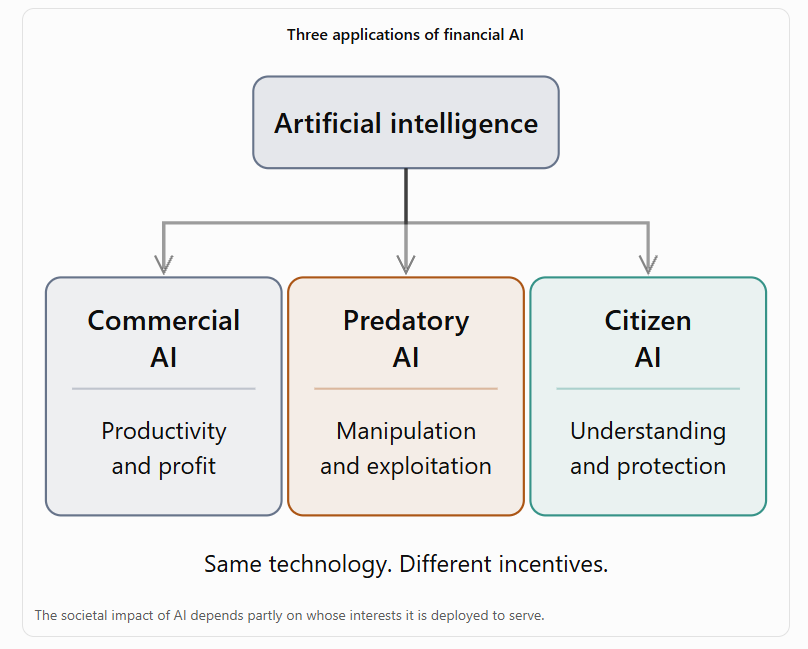
Much of the discussion surrounding AI and financial services focuses on two applications.
How financial businesses can use AI to improve their productivity and profitability.
And how criminals can use AI to exploit consumers.
But there is a third application.
How consumers can use AI to protect and advance their own interests.
Three applications of financial AI
The societal impact of AI depends partly on whose interests it is deployed to serve.
Imagine receiving an investment promotion promising attractive returns.
Instead of relying entirely on your ability to spot a suspicious advertisement, you could use AI to examine the proposition.
You could ask it to explain the underlying investment, identify inconsistencies, examine commercial incentives, highlight missing information, locate official sources and formulate questions that need answering before you proceed.
You could ask it to explain who is being paid, how they are being paid, and what happens if things go wrong.
You could ask it to distinguish between an established fact, a marketing assertion and an unsupported promise.
These are investigative capabilities that were previously much less accessible to ordinary citizens.
We now have an opportunity to democratise them.
Five questions to ask before parting with your money
At the Academy of Life Planning, we believe financial capability should extend beyond understanding financial products.
It should include understanding the systems, relationships and incentives surrounding them.
Here are five questions you could explore with the help of an independent AI assistant before making a significant financial commitment.
- Identity: Who exactly am I dealing with, and how can I independently verify their identity and permissions?
- Evidence: Which claims are independently supported, and which remain unsubstantiated?
- Incentives: Who benefits financially if I proceed, and how might that influence what I am being told?
- Consequences: What could happen if the investment fails, the provider becomes insolvent or I need my money back?
- Alternatives: What other options exist, including doing nothing, and what information do I need before deciding?
These questions are useful whether you are dealing with an unfamiliar online promoter or an established financial institution.
They are not a substitute for appropriate professional advice or independent verification.
AI can make mistakes, invent sources, misunderstand documents and provide false reassurance. Consumers should independently check material findings, protect sensitive personal information and avoid treating an AI-generated assessment as a certificate of safety.
The purpose is not to outsource judgement to a machine.
It is to develop better human judgement with the assistance of a machine.
From protective regulation to protective agency
For decades, our principal response to financial exploitation has been protective regulation.
We establish rules, supervise businesses, investigate misconduct and provide mechanisms for compensation and redress where applicable.
These are essential functions.
But there is another dimension to consumer protection that deserves greater investment: protective agency.
Protective agency is the capability of an individual to recognise risks, understand their options, challenge assertions, make informed decisions and access appropriate support.
| Protective regulation | Protective agency |
|---|---|
| Establishes rules for providers | Develops capabilities in citizens |
| Supervises market participants | Strengthens independent judgement |
| Investigates misconduct | Helps recognise warning signs |
| Provides mechanisms for redress | Helps prevent avoidable harm |
| Holds institutions accountable | Helps citizens exercise their rights |
We need both.
Developing consumer capability must never become an excuse for weakening regulatory oversight, shifting responsibility onto victims or allowing businesses to escape accountability.
Rather, it adds another layer of protection.
One operates around the individual. The other operates through the individual.
What we are building at the Academy of Life Planning
At the Academy, we are working towards an ecosystem in which ordinary people have access to tools that help them understand, investigate and navigate financial decisions independently.
Our work includes:
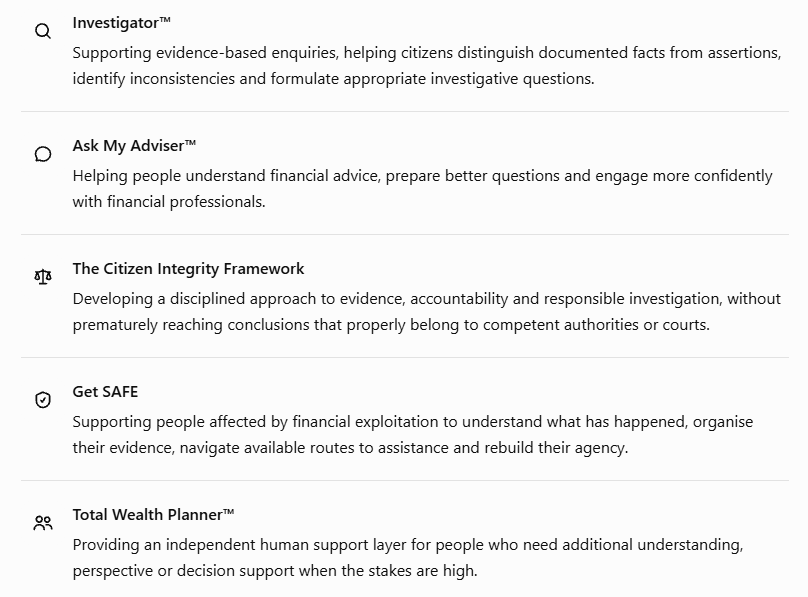
The objective is not to create another authority that consumers must unquestioningly trust.
It is to help consumers become less dependent on unquestioned authority.
Self-directed by default. Supported when it matters.
Safeguarding by design
Financial exploitation is not always a consequence of insufficient intelligence or education.
People can become vulnerable through bereavement, illness, loneliness, financial distress, cognitive impairment or significant life transitions.
Even highly educated and financially experienced people can be manipulated when circumstances change.
That is why consumer capability must be accompanied by accessible human support.
Our approach at the Academy is Safeguarding by Design.
Rather than waiting until someone has suffered harm, we should build protective capabilities into the systems they use every day.
That means designing technology and services that encourage independent verification, recognise uncertainty, support informed consent and make it easier to involve trusted people when needed.
AI should help people recognise when they need human assistance, not persuade them that they no longer need it.
The measure of success is not how much of their decision-making we can automate.
It is how much of their decision-making capability we can preserve and strengthen.
A new opportunity for consumer protection
The FCA’s warning should prompt a much broader conversation about the future of financial consumer protection.
Regulators should continue to tackle financial crime. Technology companies should improve the safety of their platforms. Financial businesses should be held accountable for their conduct.
Alongside these responsibilities, we should invest in:
- Accessible AI literacy and financial capability education.
- Public-interest AI tools designed to serve consumers rather than sell to them.
- Independent verification and evidence-checking capabilities.
- Transparent commercial incentives and conflicts of interest.
- Affordable, independent human support at critical decision points.
Consumer protection should not be something that happens exclusively behind the scenes, undertaken by institutions on behalf of largely passive citizens.
It should also be something that citizens are equipped to participate in themselves.
We have an opportunity to move from protecting consumers alone to empowering and protecting financial citizens.
The answer to smarter scams is smarter safeguarding
Artificial intelligence is neither inherently exploitative nor inherently empowering.
Its effects depend on the intentions, incentives and structures surrounding its use.
If sophisticated technology is concentrated in the hands of those seeking to extract wealth, existing power imbalances could become more pronounced.
If those capabilities are also made accessible to ordinary citizens, we have an opportunity to reduce those imbalances.
The response to artificial intelligence in the hands of financial predators should not be to discourage artificial intelligence in the hands of citizens.
It should be to equip citizens with the knowledge, tools and independent support to defend their own interests.
When deception becomes cheaper, verification must become cheaper too.
When manipulation becomes more sophisticated, safeguarding must become more sophisticated too.
And when technology increases the power of those who would exploit us, we must ensure it also increases the power of those who might otherwise be exploited.
The future of financial consumer protection is not simply better regulation. It is better regulation combined with greater human agency.
That is the future we are working to build at the Academy of Life Planning.
Understand more. Question better. Decide for yourself.
Explore the Academy ecosystem:
- Academy of Life Planning — the movement for restoring human agency through financial and life planning.
- Academy OS — AI-enabled tools for understanding, investigating and planning your life and money.
- Total Wealth Planner — independent human support when it matters.

