
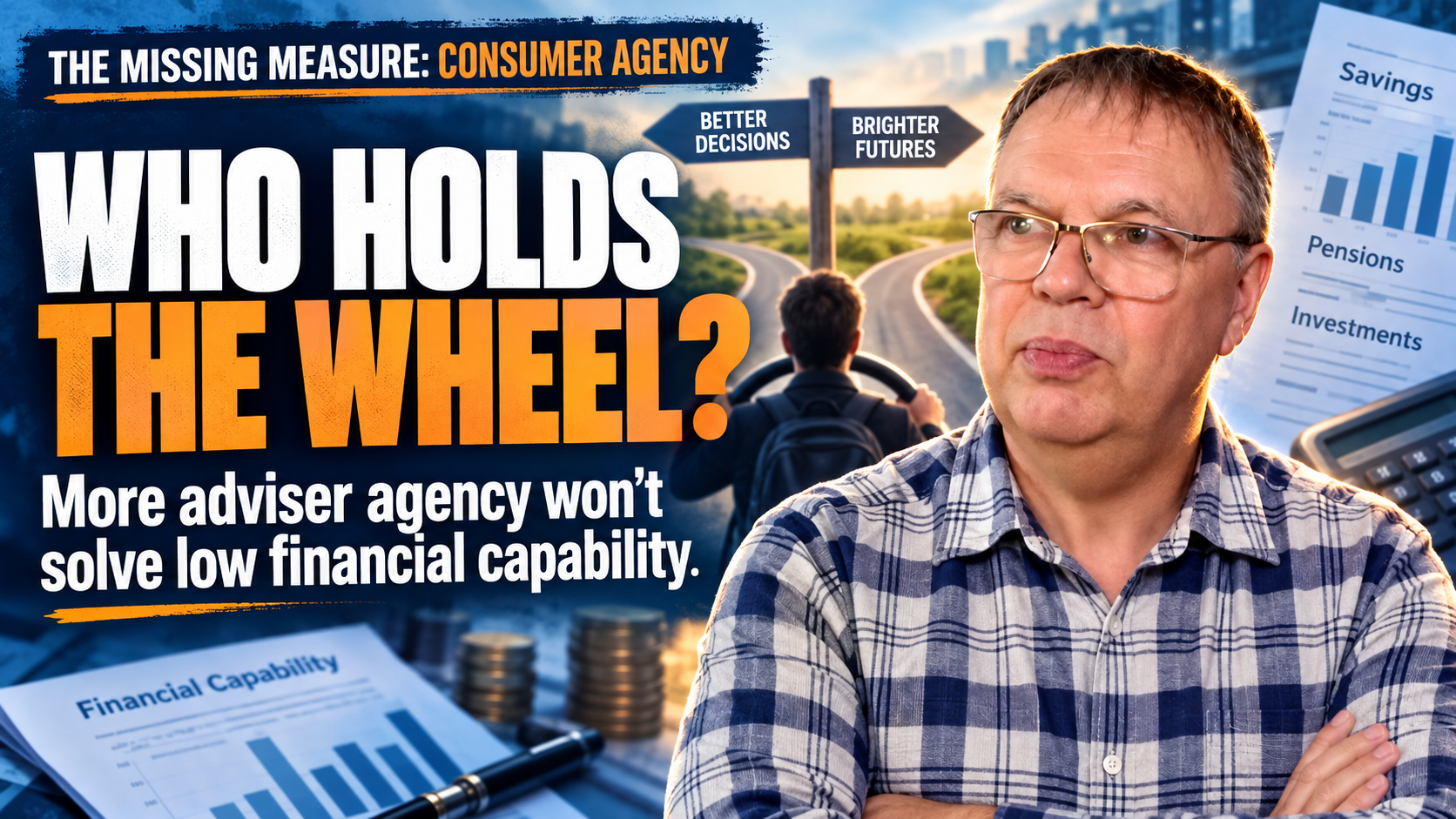
The FCA wants people to navigate their financial lives. What would it take to put the person, rather than the adviser, at the wheel?
Someone sits down with a folder of pension statements, an insurance renewal and a list of questions about work. They have been told to seek financial advice. Yet their first question is more basic: “What do I have, what does it mean, and what am I trying to do?”
They may eventually need a regulated adviser. They may also need a solicitor, an accountant, a benefits specialist or a conversation with their family. But before any of that, they need somewhere to start. They need to be able to see their own life clearly enough to take the next step.
That is the moment I kept returning to while reading the Financial Conduct Authority’s Our Strategy 2025 to 2030.
The FCA has named the problem
The FCA says that low financial capability holds people back from accessing services that could help them manage their financial lives. It recognises that financial and personal shocks can knock people off course. It also says that regulation will not have all the answers, and that it will work with others on financial capability and inclusion.
These are significant admissions. People do not experience their lives as a sequence of regulated product decisions. They experience a job change, an illness, a caring responsibility, a relationship ending, a pension letter they cannot understand, or a frightening message that may be a scam. The money question arrives inside a life question.
The strategy proposes more timely and affordable help. It discusses targeted support for people who do not currently access financial advice and a review of the boundary between advice and guidance. It also anticipates Open Finance making data easier to use for personalised support.
All of those developments could help. But they invite a further question: whose capability grows as a result?
More adviser agency is not the same as more consumer agency
An adviser can have more data, more sophisticated AI, better permissions to approach customers and more efficient ways to recommend a course of action. Those changes may improve access and outcomes. They may also leave the individual in much the same position: waiting for someone else to interpret their life and tell them what to do next.
The issue is structural. If success means getting more people into suitable products, it is rational to equip providers to find and serve them. The FCA’s proposed 2030 measures include greater ownership of key products and more mainstream investment holdings among consumers with at least £10,000 in investible assets. Those measures have a purpose. But they do not tell us whether people can understand their own circumstances, recognise when something has changed, weigh options, or know when to seek expertise.
A person can own the right product and still feel lost. Another can have no investible assets and urgently need help navigating debt, housing, work, benefits or family responsibilities.
Financial capability is not simply access to a better answer. It is the growing ability to ask a better question, understand the options and act with confidence.
That is what I mean by consumer agency.
What an agency model looks like in practice
At the Academy of Life Planning, we are building support around the person’s continuing ability to navigate. The person keeps their own record, works through their own goals and decisions, and can bring in human expertise when a situation calls for it.
Academy OS and My Life Record give people a place to organise the information scattered across accounts, documents and areas of life. An understandable record makes a conversation with any specialist more useful. It also means the person does not have to start from scratch each time circumstances change.
The GAME Plan and Total Wealth Plan connect money with the rest of life: health, relationships, work, meaning and the future someone hopes to build. A plan becomes a living basis for choices, rather than a document produced for one transaction.
Academy tools help people examine a specific question, test a claim, prepare for a pension conversation, or organise evidence in a dispute. Their purpose is to make the next decision more intelligible. An AI output still needs scrutiny; the person remains responsible for deciding what matters, and for seeking qualified help where needed.
All of that is free.
Academy Membership adds practical frameworks, community and a human support layer through WhatsApp and email alongside Academy OS. A question need not wait until it is large enough to justify a formal advice engagement.
Total Wealth Planners provide episodic human support: helping a person frame a problem, see what is missing, explore options and recognise the limits of the planner’s expertise. When a regulated recommendation or other specialist service is needed, the planner helps the person prepare for that handover. The expertise serves the person’s agency; it does not replace it.
This is the distinction behind our model: continuous agency, with episodic expertise.
Open Finance needs an owner
The FCA sees promise in sharing financial data so people can get more accessible, personalised support. I do too. But collecting more data is not the same as making sense of it.
Imagine a system that can see a pension, a bank account and a mortgage. It may still know nothing about a parent’s care needs, the health condition changing someone’s capacity to work, or why they want a simpler life. Data can help a person see the financial picture. The person supplies the meaning.
That is why client control matters. The useful question is not merely whether an adviser or platform can see more. It is whether the individual can use their information to understand their choices, decide what to share, and carry that understanding from one conversation to the next.
A different test of progress
I would like to see financial capability judged partly by what people can do after support ends.
Can they explain the decision in their own words? Can they identify the assumptions it rests on? Can they spot a suspicious story before they part with money? Do they know what would cause them to revisit the plan, and whom to call when a question crosses into specialist territory?
Those are not substitutes for suitable products, sound regulation or professional advice. They are measures of whether support has left the person stronger.
The FCA is right to want people to navigate their financial lives. The Academy’s contribution is to take that verb seriously. Navigation is something the person does. Our job is to give them the tools, understanding and support to keep doing it.
If our help ends and the person still cannot move without us, whose capability did we build?
Source: Financial Conduct Authority, Our Strategy 2025 to 2030, especially pp. 9 and 15–19. References to the Academy describe our approach; they are not FCA endorsements. The strategy sets out aims and proposals, rather than establishing a new permission for unregulated providers to make personal recommendations.

