
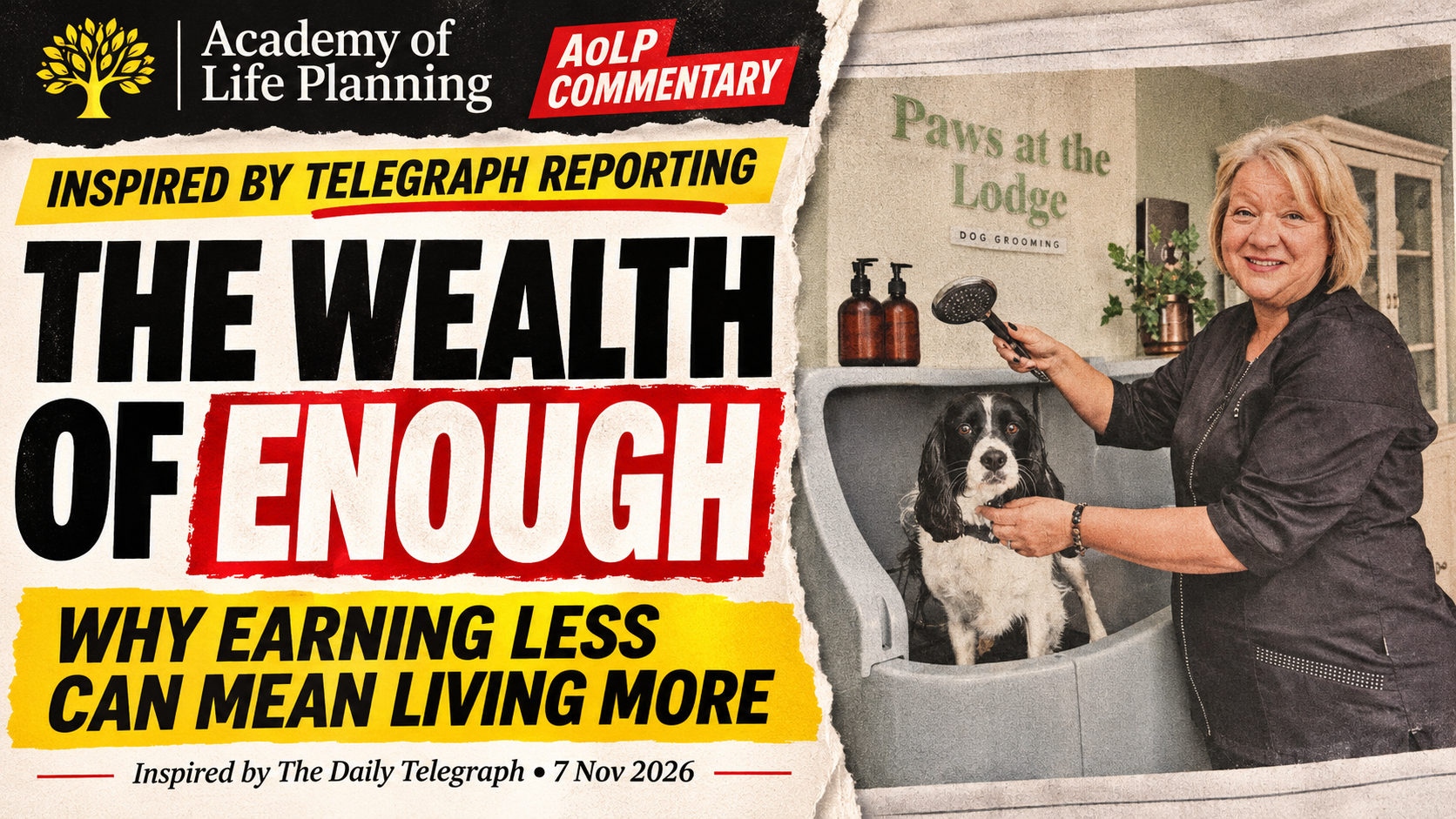
When people voluntarily exchange higher earnings for greater freedom and fulfilment, are they becoming poorer—or are they redefining what it means to be wealthy?
By Steve Conley | Academy of Life Planning | 8 November 2026
The people choosing less money and a better life
Something interesting is happening in Britain’s working lives.
People who have spent decades climbing the career ladder are discovering that they may have been climbing the wrong ladder.
They are walking away from substantial salaries, prestigious positions and apparently successful careers. Not necessarily because they have failed, but because they have begun to question what success actually means.
In The Daily Telegraph on Saturday 7 November 2026, Peter Crush reported on this phenomenon in an article headed “Job downshifters trade stress and cash for ‘just enough’.”
The article tells the stories of three women who have exchanged financial earning power for greater control over their lives.
Their experiences raise a fundamental question for the financial planning profession.
If someone voluntarily reduces their income but substantially improves their quality of life, has their financial plan succeeded or failed?
The answer depends entirely on what we believe financial planning is for.
Three women, three different definitions of success
The Telegraph introduces us to Gillian Wilson, Kate Tompsett and Jodie Robertson.
Their circumstances differ, but their decisions share a common feature: they have challenged the assumption that maximising earnings is the same as maximising personal welfare.
Gillian Wilson: From six figures to dog grooming
At 60, Gillian Wilson left a six-figure engineering career after years of stress and high blood pressure.
She invested approximately £20,000 converting her garage and opened a dog-grooming business, Paws at the Lodge.
Her working life changed dramatically.
Instead of managing the pressures of a demanding corporate career, she now works with animals in surroundings she enjoys.
Her income has fallen substantially. But so have some of the pressures that previously dominated her life.
She has discovered that the amount of money she needs is not necessarily the amount she is capable of earning.
That is a profound distinction.
Kate Tompsett: From corporate communications to meaningful work
Kate Tompsett, 37, had spent 19 years progressing through a career in public relations, eventually reaching senior management.
Yet professional advancement did not provide the fulfilment she wanted.
She opened a gift shop in Canterbury, Happy & Glorious, following several years of developing the business alongside employment.
The transition involved uncertainty and lower earnings. It also created opportunities for creativity, community involvement and personal satisfaction.
Her career change illustrates something conventional financial models struggle to capture.
The value of work cannot always be measured by its remuneration.
Jodie Robertson: Reclaiming control after burnout
Jodie Robertson, 44, left a career in financial services after work-related illness.
Previously, she had earned approximately £75,000 annually, with the potential for substantial bonuses.
With the help of a career coach, she reconsidered what she wanted from her working life and eventually became an independent travel agent.
Her earnings initially fell to around a third of her previous income.
Nevertheless, she rebuilt her career around an activity she enjoyed and a working pattern she could control.
Her financial circumstances helped make that transition possible. A relatively modest mortgage and reduced childcare commitments provided room to manoeuvre.
That detail matters.
Downshifting is not simply about finding the courage to pursue a dream. It is also about understanding the financial conditions that make a different life sustainable.
Source: Peter Crush, The Daily Telegraph, Money, 7 November 2026. Case studies summarised and discussed with acknowledgement to the original reporting.
What conventional financial planning gets wrong
Imagine Gillian visiting a conventional financial adviser before leaving her engineering career.
The adviser might calculate her projected earnings until retirement, pension contributions, future investment returns and expected retirement income.
Reducing her earnings would produce a less favourable financial projection.
Her capacity to save would fall. Her future pension fund might be smaller. Her investment portfolio might accumulate more slowly.
On those measures, the decision could look financially irrational.
But what if the model is measuring the wrong things?
What value should we place on lower stress?
What is the economic value of better health?
How much is control over one’s working day worth?
What about the satisfaction of meaningful work?
And what is the value of being able to enjoy the years before retirement, rather than merely accumulating resources for the years afterwards?
These are not peripheral lifestyle considerations.
They are central to the purpose of financial planning.
The problem is not that conventional financial projections are necessarily wrong. It is that they are incomplete.
They measure what is relatively easy to quantify while overlooking much of what makes life worth living.
Human capital is more than earning power
In traditional financial economics, human capital is frequently understood through the lens of future earnings.
A person’s education, skills, experience and productive capacity generate an expected stream of income.
That has considerable analytical value.
But it also creates a problem.
If we define human capital principally through earnings, reducing income can appear to mean destroying human capital.
Yet the experience of these three women suggests something different.
Gillian has not lost her engineering knowledge, experience or transferable skills. She has chosen to deploy her capabilities differently.
Kate has not abandoned the skills acquired during her career in communications. She has redirected them towards entrepreneurship and community-based work.
Jodie has converted professional experience, commercial understanding and personal interests into a different form of economic activity.
They have not necessarily depleted their human capital.
They have changed how their human capital is used—and what they want it to produce.
This connects with the work of economists Paula England and Nancy Folbre, whose reconceptualisation of human capital challenges approaches that concentrate too narrowly on market productivity and earnings.
Their wider perspective draws attention to human capabilities, caring relationships and contributions that conventional economic measurement can overlook.
For independent financial planning, that creates an important opportunity.
We can begin to examine human capital not simply as an asset that produces income, but as a collection of capabilities through which people create lives they value.
Income is one potential output.
It is not the only output.
The economics of enough
There is a concept at the heart of these stories that deserves more attention.
Enough.
For much of the financial services industry, the implicit objective is more.
More earnings. More contributions. More assets under management. More accumulated wealth.
But more is not an objective in itself.
More only has value when it helps someone achieve something that matters to them.
Suppose a person earns £100,000 annually but experiences chronic stress, declining health and little control over their time.
Suppose that person could earn £40,000 doing work they enjoy, with greater flexibility, better health and sufficient resources to meet their obligations.
Which person is wealthier?
The answer cannot be established by comparing their salaries alone.
We need to understand the whole person.
This is where the concept of Total Wealth becomes useful.
At the Academy of Life Planning, we begin with a broader framework:
Total Wealth = Financial Capital + Human Capital − Liabilities
Financial capital includes savings, investments, pensions, property and other financial resources.
Human capital encompasses the capabilities, knowledge, health, relationships, creativity and personal agency through which people generate value and experience well-being.
Liabilities include financial obligations, but a comprehensive life plan must also recognise non-financial constraints and vulnerabilities.
This is a conceptual framework rather than a claim that every dimension can be converted into a single monetary figure.
It encourages us to examine the relationship between different forms of wealth instead of treating financial accumulation as the only objective.
A reduction in financial income may be accompanied by improvements in autonomy, health, relationships or life satisfaction.
Whether the overall exchange is worthwhile depends on the individual’s values, circumstances and priorities.
That is the economics of enough.
Downshifting is a planning problem, not simply a lifestyle choice
There is an important danger in romanticising these stories.
Not everyone can afford to reduce their income.
People have mortgages, dependants, debts, caring responsibilities and retirement obligations.
A person struggling to meet essential expenditure cannot simply declare that money no longer matters.
Financial security is not the enemy of freedom.
Financial security is often what makes freedom possible.
This is precisely why independent financial planning matters.
A good planner should help someone considering downshifting answer practical questions.
- What does our household actually need to spend to live comfortably?
- How much of our current expenditure reflects genuine needs, and how much reflects habits formed around our existing income?
- What financial commitments must we continue to meet?
- Could our existing assets support a period of lower earnings?
- How would reduced income affect pensions, insurance, housing and future care needs?
- What happens if the new business earns less than expected?
- Could we return to our previous career if necessary?
- What would happen to our well-being if we stayed where we are?
These questions combine financial forecasting with life planning.
A lifetime cash-flow model can help quantify the financial consequences of different choices.
But the model cannot decide which life is worth living.
That decision belongs to the person.
The planner’s role is to improve the quality of the decision.
Independent of the assets, independent of the outcome
This also raises a question about the independence of financial advice.
In the UK, an independent financial adviser is conventionally understood as someone able to make suitable recommendations across the relevant retail investment product market, rather than being restricted to a narrower range.
That is an important regulatory distinction.
But it is not the same as the independence I mean when I describe an Independent Financial Planner.
I mean a planner whose commercial proposition does not depend on persuading the client to place assets under management.
Consider two possible recommendations.
One is to continue working at a high salary, save more and accumulate a larger investment portfolio.
The other is to reduce earnings, perhaps use some accumulated capital to finance a career transition, and achieve a better balance between work and life.
A planner remunerated through assets under management may face a commercial incentive favouring asset retention and growth.
That does not mean every such adviser will act against the client’s interests. Many provide conscientious advice and manage conflicts professionally.
But the incentive exists.
An independent financial planner whose remuneration is based on the planning work itself can assess the alternatives without making asset placement a condition of the relationship.
The distinction matters because the client’s best outcome may involve accumulating assets, spending assets, leaving assets untouched or having no investable portfolio at all.
The client should not have to make their money attractive to a financial business before their life becomes worthy of planning.
Bring me the problem, not the portfolio.
AI makes a different model possible
There is another reason these Telegraph case studies are timely.
Artificial intelligence is beginning to change the economics of financial planning.
Historically, comprehensive lifetime financial modelling was relatively expensive to produce and maintain.
The profession developed business models that frequently recovered those costs through investment management and ongoing asset-based charges.
AI and increasingly accessible digital tools create the possibility of separating the work of planning from the distribution and management of financial products.
At the Academy, our Total Wealth Plans ecosystem is designed around that possibility.
A person considering a career downshift can use digital tools to explore alternative futures.
For example:
- Continue working for five years before changing careers.
- Move immediately to a lower-paid occupation.
- Transition gradually through part-time employment.
- Establish a business while retaining some employment income.
- Take a planned career break to retrain or recover from burnout.
Each scenario has financial consequences.
Lifetime cash-flow forecasting can explore those consequences, including uncertainty and adverse outcomes.
Human support can then help the individual understand the trade-offs, challenge assumptions and make decisions.
The person remains in control.
Self-directed by default. Supported when it matters.
AI does not remove the need for judgment.
It creates an opportunity to make useful planning analysis more accessible, while reserving human expertise for the decisions and circumstances where it adds genuine value.
What should we measure?
There is also a research opportunity.
If independent financial planning is concerned with improving people’s lives rather than merely accumulating financial assets, how should we evaluate its effectiveness?
The Telegraph’s case studies suggest several possibilities.
We could measure changes in:
- Financial resilience: Can the household continue meeting its obligations and withstand foreseeable shocks?
- Personal autonomy: How much control does the individual have over their time, work and important decisions?
- Health and well-being: How does the chosen path affect stress, physical health and psychological welfare?
- Capability utilisation: Is the individual able to develop and use their skills in ways they value?
- Purpose and relationships: Does the change create more opportunity for meaningful activity, caring and social connection?
- Future optionality: Does the decision preserve reasonable opportunities to adapt if circumstances change?
These are proposed research dimensions, not a validated measurement instrument.
They could, however, form the beginnings of a testable framework for evaluating independent financial planning outcomes.
Such a framework would move beyond the traditional question of whether the investment portfolio performed well.
It would ask whether the planning process improved the person’s ability to understand, choose and act.
That is human agency.
And restoring human agency should be one of the central objectives of independent financial planning.
A successful plan might mean earning less
The Telegraph deserves credit for drawing attention to people who are questioning conventional definitions of career success.
Gillian, Kate and Jodie are not necessarily rejecting money.
They are questioning its proper place in their lives.
Their stories demonstrate that financial resources are a means to an end.
The end is not necessarily a bigger pension pot, a larger investment portfolio or a higher salary.
It may be the ability to work with animals, run a small business, spend time with family, recover one’s health or rediscover enjoyment in everyday life.
We should not assume that every downshift is successful. Some transitions create financial hardship, and some people later regret their choices.
That is why planning, evidence and honest consideration of risks matter.
But neither should we assume that a reduction in earnings represents failure.
At the Academy of Life Planning, we believe financial planning should begin with the person, not the money.
The purpose is to help people develop sufficient clarity, control and confidence to make choices consistent with their values and circumstances.
Sometimes that means earning more.
Sometimes it means saving more.
Sometimes it means working longer.
And sometimes it means recognising that you already have enough to begin living differently.
The purpose of financial planning is not to maximise the money you make from your life.
It is to help you make the most of the life you have.
And perhaps the most important financial question is not:
How much more could I have?
But:
What would I do differently if I knew I had enough?
Source acknowledgement
This article was inspired by Peter Crush’s reporting in The Daily Telegraph, Money section, Saturday 7 November 2026, on career downshifting and the pursuit of sufficient income, greater freedom and personal fulfilment.
The experiences of Gillian Wilson, Kate Tompsett and Jodie Robertson are drawn from that reporting. The interpretations concerning human capital, Total Wealth, agency and independent financial planning are those of the Academy of Life Planning.
Read the original Telegraph article: The career downshifters swapping £100k salaries for a quieter life (syndicated version).
Further context: Indeed Hiring Lab — Job Switching in the UK: Who Stays Put, and Who Moves On?
Academy of Life Planning — Restoring Human Agency in Financial Planning.
Plan the person before the money.

