
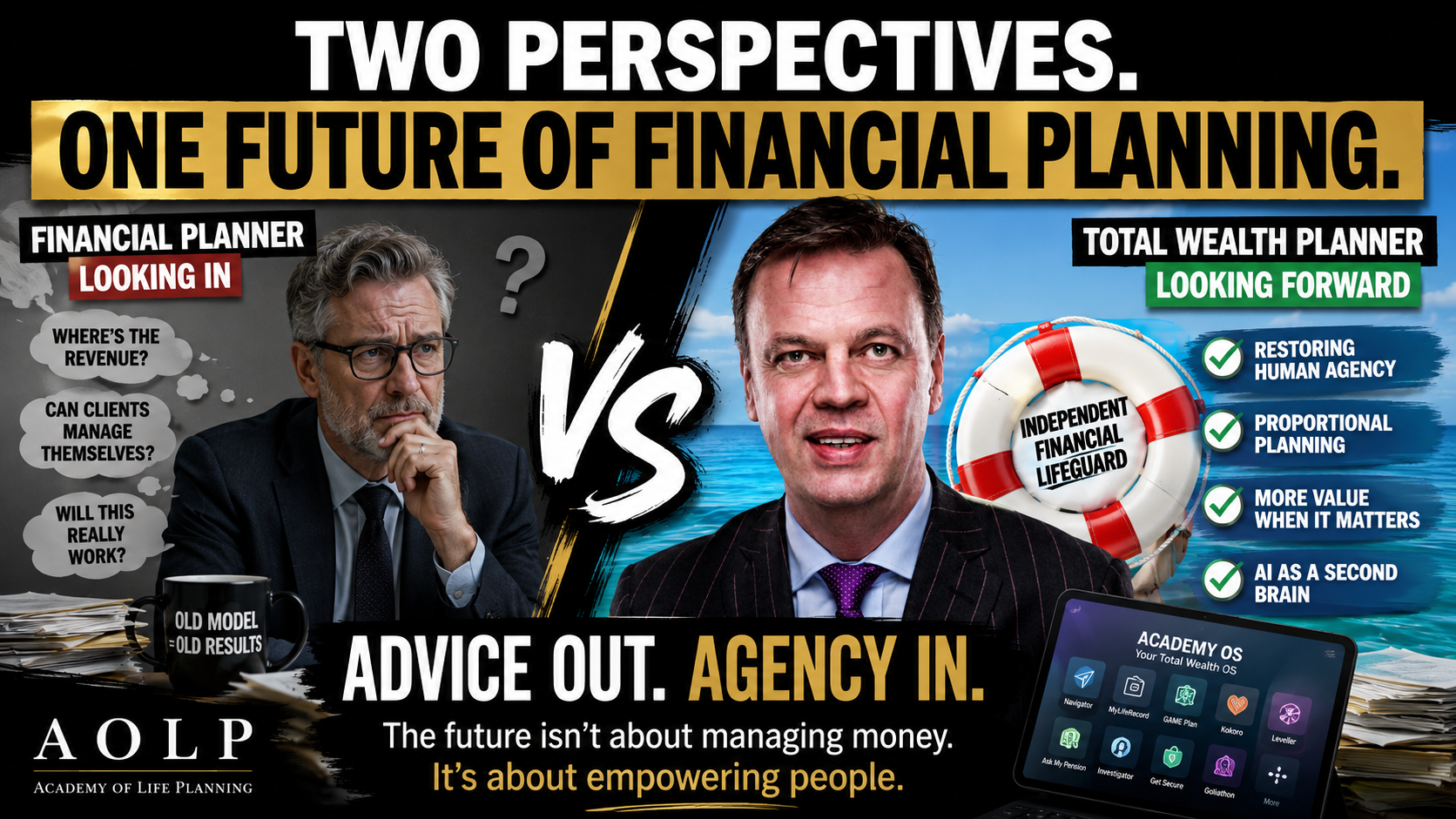
The biggest difference between those inside and outside the Academy isn’t belief in human agency. It’s that those inside have stopped asking whether the future is coming and have started building businesses for it.
When you’re inside the movement, you see a different future from those looking in.
Over the past few weeks, I’ve been speaking to two very different groups of financial planners.
The first group are experienced planners who are members of the Academy of Life Planning. They use Academy OS, attend Practice Management Circle, experiment with AI and are actively building practices around restoring human agency.
The second group are experienced planners who are curious about what we’re doing, but haven’t yet become involved.
The difference in perspective has been fascinating.
Looking from the outside
When planners first encounter Total Wealth Planning, the questions are almost always the same.
“Where does the recurring revenue come from?”
“Can clients really manage their own finances?”
“How can a business survive without assets under management?”
“Interesting… but I need to spend more time understanding it.”
These are sensible questions.
They’re the questions I would probably have asked myself a decade ago.
They arise because the profession has spent many years assuming that financial planning and ongoing advice are inseparable.
If clients become more capable, doesn’t that reduce the need for the planner?
Looking from the inside
The conversation inside the Academy is completely different.
Interestingly, our Total Wealth Planners are no longer asking whether the philosophy works.
Instead they’re asking questions like:
“How do we explain this more simply?”
“How should we package different levels of support?”
“Should we call it a Lifeguard or a Helpline?”
“How do we price proportional planning?”
The conversation has moved from whether to how.
That tells me something important.
The commercial model hasn’t disappeared.
It’s changed.
Traditional financial advice often assumes an ongoing commercial relationship built around managing assets.
Total Wealth Planning starts somewhere else.
It asks:
How do we help people become increasingly capable of managing their own financial lives?
That changes everything.
The planner’s role is no longer to remain at the centre of every decision.
The planner’s role is to help the client become confident enough to make more decisions independently.
That doesn’t eliminate the need for professional support.
It changes when that support is valuable.
Proportional Planning
One of the principles we’ve developed over many years is what we call Proportional Planning.
Most people can manage around 90% of their finances, 90% of the time.
Academy OS exists to support that.
But life isn’t always ordinary.
Retirement.
Bereavement.
Divorce.
Inheritance.
Business sale.
Financial exploitation.
Those are moments when people often benefit from another experienced brain alongside their own.
That’s why we’ve recently begun describing the role of a Total Wealth Planner as an Independent Financial Lifeguard.
Not someone who swims for you.
Someone who watches, supports, educates and is ready when the water becomes difficult.
What our planners are discovering
What has encouraged me most is that our existing Total Wealth Planners aren’t questioning whether this direction is commercially viable.
They’re refining it.
They’re experimenting with different subscription models.
Different review frequencies.
Different ways of explaining the service.
Different ways of integrating AI into the client relationship.
They’re helping shape a new profession.
That’s a very different conversation from asking whether restoring human agency is desirable.
Two ways of looking at the future
Those outside the Academy often see AI as something that threatens advisers.
Those inside increasingly see AI as something that restores capability to citizens.
If citizens become more capable, the planner’s role doesn’t disappear.
It evolves.
From information provider…
to thinking partner.
From expert…
to second brain.
From dependency…
to confidence.
From managing money…
to helping people navigate life.
The profession is changing
Every profession reaches moments when its underlying assumptions are questioned.
Financial planning is entering one of those moments.
Clients are arriving having already asked ChatGPT.
They understand investment charges.
They compare platforms.
They challenge recommendations.
Information asymmetry is disappearing.
That doesn’t make planners less valuable.
It changes where value is created.
The planners already exploring this transition aren’t waiting for certainty.
They’re experimenting.
Learning.
Sharing.
Building together.
That’s what the Academy of Life Planning has become.
Not simply a place to learn financial planning.
A place to explore what planning becomes in the age of AI.
Ready to explore?
If you’re a planner who believes the future lies in restoring human agency rather than creating greater dependency, we’d love to have you join the conversation.
Because the most interesting question is no longer:
“How do we use AI?”
It’s:
“What kind of planner do people need when AI has already made them more capable?”
Discover more, visit the Academy of Life Planning.

