
Imagine you discover something has gone badly wrong.
Perhaps a financial institution has made a mistake. Perhaps an insurer has refused a claim. Perhaps you believe you have been misled, treated unfairly, or suffered a significant financial loss.
You decide to do what responsible citizens are told to do.
You gather evidence.
You write letters.
You follow the complaints process.
You contact the regulator.
You contact the ombudsman.
You fill in the forms.
You wait.
Then you discover something unexpected.
The real challenge is not proving your case.
The real challenge is understanding the system itself.
A typical person may find themselves navigating multiple organisations simultaneously:
- The company they are complaining about.
- An internal complaints department.
- A regulator.
- An ombudsman service.
- A court or tribunal.
- The Information Commissioner’s Office.
- Professional bodies.
- Consumer organisations.
- Law enforcement agencies.
Each organisation has different rules.
Different timescales.
Different evidence requirements.
Different jurisdictional limits.
Different definitions of what they can and cannot investigate.
What appears to be a single problem to the individual is often divided into separate pieces by the system.
One organisation may say it is a legal issue.
Another may say it is a regulatory issue.
Another may say it is a matter for the courts.
Another may say it falls outside their remit altogether.
The individual is left trying to work out where responsibility begins and where it ends.
For many people, this is where exhaustion starts to replace confidence.
Complexity Becomes a Barrier to Justice
Most people are not lawyers.
Most people are not regulators.
Most people are not investigators.
Most people are not trained in evidential standards, jurisdictional boundaries, procedural rules, data protection law, complaint handling frameworks, or judicial review.
Yet the modern complaints ecosystem often assumes they can quickly acquire these skills whilst dealing with the stress of a dispute.
The result is predictable.
People become overwhelmed.
Deadlines are missed.
Evidence becomes disorganised.
Important issues become buried beneath paperwork.
Many eventually abandon perfectly legitimate concerns because the process itself becomes too difficult to navigate.
This is not necessarily because anyone intended harm.
It is often because the system evolved in separate pieces over many years, each organisation solving its own problem without considering the experience of the person trying to navigate the whole journey.
The Hidden Cost of Complexity
When people discuss access to justice, they often focus on cost.
Legal fees.
Court fees.
Professional advice.
Those costs matter.
But complexity is also a cost.
Every additional form.
Every referral.
Every new organisation.
Every unexplained process.
Every request to start again.
These all consume something valuable:
Human energy.
When people are already distressed, frightened, exhausted, or financially vulnerable, that energy becomes a scarce resource.
The practical reality is that many people do not need someone to take over their case.
They need help understanding where they are, what options exist, and what sensible next steps might be available.
They need clarity.
They need structure.
They need confidence.
Above all, they need their agency restored.
Restoring Agency, Not Creating Dependency
At Get SAFE, we believe the answer is not to create greater dependence on experts.
Nor is it to encourage people to fight every battle alone.
The goal is something different.
The goal is to help people become capable navigators of their own situation.
That means:
- Organising information clearly.
- Understanding processes.
- Identifying realistic options.
- Asking better questions.
- Making informed decisions.
- Knowing when professional help may be appropriate.
The objective is not to tell people what to think.
The objective is to help them think clearly when the stakes are high.
A Question Worth Asking
Whether a complaint ultimately succeeds or fails is often determined by the evidence and the law.
But before any of that comes into play, there is another question.
How many ordinary people could realistically navigate today’s complaints, regulatory, legal, and ombudsman systems without assistance?
If the answer is “not many”, then perhaps the issue is not simply individual capability.
Perhaps it is also a question of system design.
And perhaps the most important form of support is not representation, advocacy, or advice.
Perhaps it is helping people regain the clarity, confidence, and agency needed to navigate complexity for themselves.
That is the problem Get SAFE exists to address.
Case Study: When the Process Becomes the Problem
Richard Loxton’s case raises an important question for anyone concerned with consumer protection:
How many ordinary people could realistically navigate a system this complex without assistance?
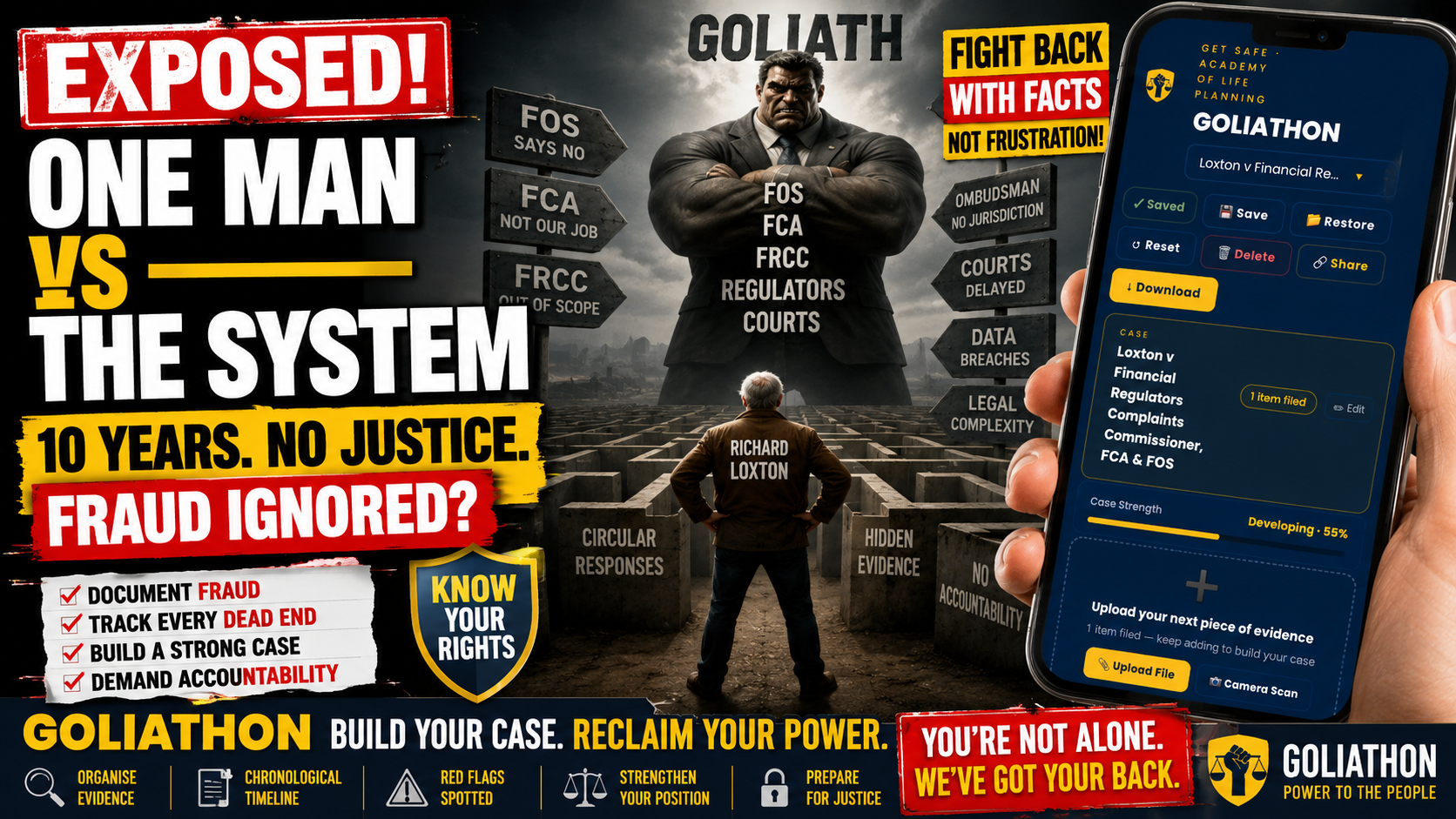
Mr Loxton, a former soldier and vulnerable consumer, has spent almost a decade pursuing complaints relating to an insurance dispute that began in 2016–2017. According to his evidence dossier, he believes that documented evidence of fraud was repeatedly overlooked, downgraded, or treated as a customer service issue rather than being properly investigated.
Over the years, the matter has passed through multiple organisations, including the Financial Ombudsman Service (FOS), the Financial Conduct Authority (FCA), the Financial Regulators Complaints Commissioner (FRCC), county courts, legal regulators, and other public bodies. Each organisation has its own procedures, jurisdictional limits, evidential requirements, and escalation routes.
Whether Mr Loxton’s allegations are ultimately upheld is a matter for the relevant authorities and courts. Get SAFE takes no position on the outcome.
What makes the case noteworthy is the sheer complexity of the journey itself.
His 124-page Super Complaint argues that responsibility has repeatedly been passed between organisations, with each body relying on procedural boundaries or jurisdictional limitations to avoid addressing the central concerns being raised.
The result is a situation that many consumers would find overwhelming.
To follow the case, an individual must understand complaint procedures, ombudsman schemes, financial regulation, fraud legislation, data protection law, court processes, evidential standards, judicial review, and the interaction between multiple public bodies.
Most people do not possess this knowledge.
Most people are not investigators.
Most people are not lawyers.
Most people are not regulators.
Yet when something goes wrong, they are often expected to navigate all of these systems while dealing with stress, uncertainty, and potential financial loss.
That is why this case matters.
Not because it proves that any institution has acted unlawfully.
Not because it proves that every allegation is correct.
But because it highlights a wider challenge facing thousands of people every year.
When systems become so complicated that only specialists can understand them, access to justice becomes increasingly difficult for ordinary citizens.
The lesson is simple.
Consumer protection is not only about rules, regulators, or enforcement powers.
It is also about whether ordinary people can realistically understand, navigate, and use the systems that are supposed to protect them.
If they cannot, then complexity itself becomes a barrier.
And that is precisely the problem Get SAFE exists to help people overcome.


Much of the debate around consumer protection starts at the back end — complaints, redress, enforcement and compensation.
But by then, the critical moment has already passed.
The first question should be much simpler:
Did the person genuinely understand what they were being asked to sign?
For decades, the system has often treated disclosure as a proxy for understanding. If the document existed, the risk warning was included, and the signature was obtained, informed consent was frequently assumed.
Yet anyone who has ever tried to read a complex financial prospectus, pension transfer report, adviser agreement, settlement deed, investment memorandum or insurance contract knows that disclosure and understanding are not the same thing.
The arrival of tools such as The Leveller creates an interesting challenge for the industry.
If an ordinary person can now upload a document and receive a plain-English explanation of hidden costs, power imbalances, unusual clauses, waived protections and key questions within minutes, it becomes harder to argue that complexity is simply the consumer’s responsibility to navigate alone.
Consumer responsibility only makes sense when consumers have a realistic opportunity to understand.
Perhaps the emerging test for a trustworthy system is not whether information was technically disclosed, but whether a reasonably capable person could realistically understand the implications before making the decision.
That feels like a much higher standard.
And probably a fairer one.