
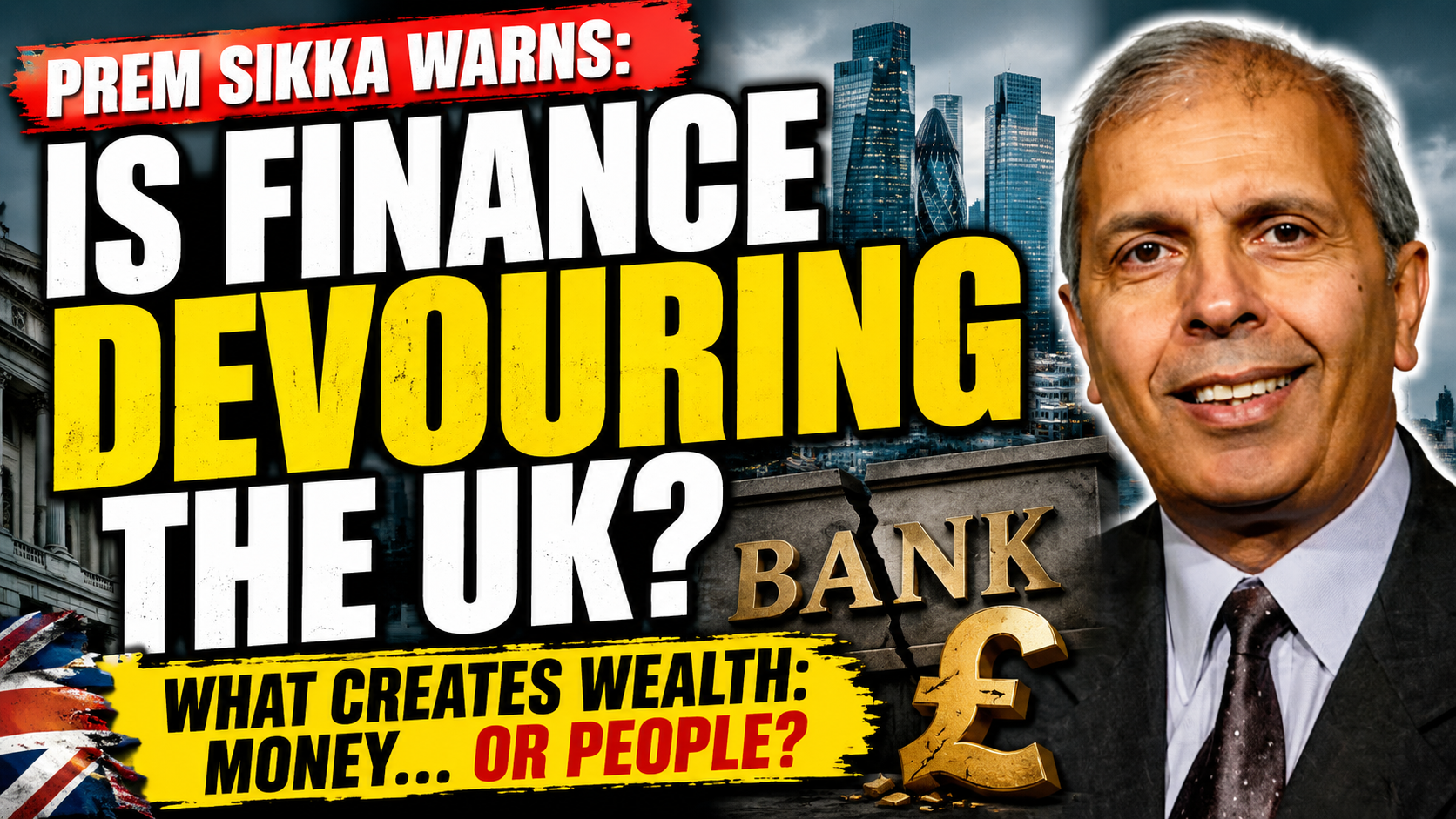
Is the Finance Industry Devouring the UK Economy — or Have We Forgotten What Creates Wealth?
A recent article by Prem Sikka asks a provocative question: has Britain’s obsession with finance come at the expense of the real economy?
It is a question worth asking.
For decades, successive governments have treated the financial services sector as one of the UK’s greatest economic strengths. The City of London is protected, promoted and celebrated as a global success story. Yet during the same period, many communities have experienced stagnant wages, declining high streets, weak productivity growth and a growing sense of economic insecurity.
Professor Sikka argues that the finance industry has become extractive rather than productive, diverting talent, capital and political attention away from activities that create lasting prosperity.
But perhaps the deeper question is not whether finance is good or bad.
Perhaps the real question is this:
What actually creates wealth?
Is wealth created by the movement of money?
Or is wealth created by the capabilities of people?
If a nation invests primarily in financial capital while neglecting human capital, social capital, health, skills, enterprise and community resilience, should we be surprised when growth becomes fragile?
Finance undoubtedly has an important role. It provides liquidity, allocates capital, manages risk and supports investment. The problem arises when finance ceases to be the servant of the economy and becomes its master.
The challenge facing Britain may not be that we have too much finance.
It may be that we have spent too little time developing the assets that finance is supposed to support.
Human capability.
Entrepreneurship.
Innovation.
Skills.
Purpose.
Community.
In short, the productive capacity of people.
Viewed through this lens, the debate is not really about banks, private equity or financial regulation.
It is about whether public policy is designed to maximise financial capital or human potential.
The answer to that question may determine Britain’s future far more than the next Budget, the next interest-rate decision or the next stock market rally.
Curious how others see this:
Has the UK become too dependent on financial capital, or is the problem that we have failed to invest sufficiently in human capital and productive enterprise?

