
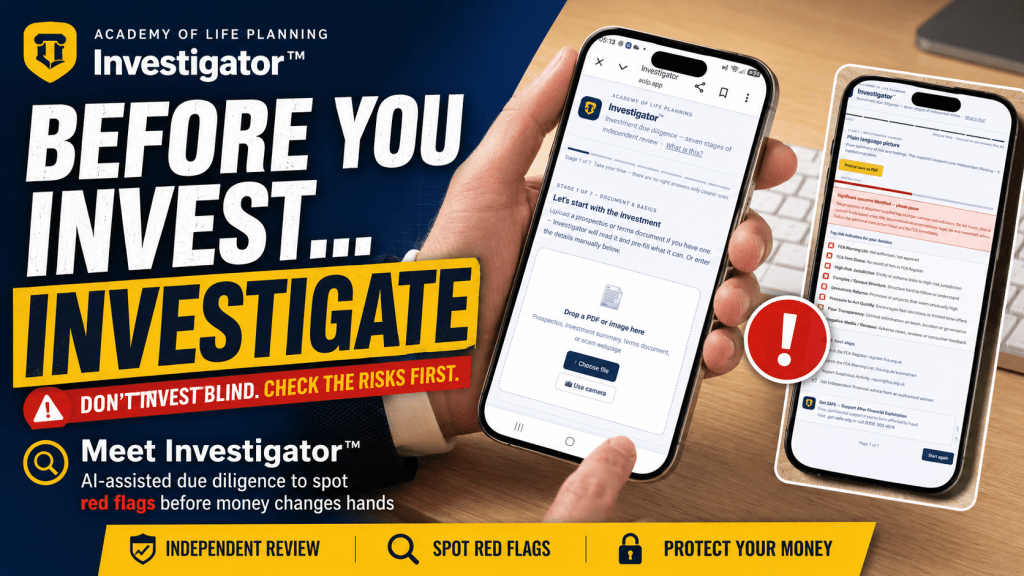
Before you invest, investigate: a free AI-assisted tool to help people pause, question, and understand investment risk before money changes hands.
Investment fraud is often described as a crime of deception. That is true, but it is not enough.
The deeper problem is the collapse of human agency at the point of decision.
In 2025, UK Finance members reported £1.28bn stolen through payment fraud. Investment scams alone reached £221.5m, up 40%, across almost 15,000 reported cases. These were not simply “bad investments” that went wrong. They were often examples of social-engineered authorised payment fraud: situations where people were persuaded, pressured, reassured, or manipulated into transferring money themselves.
That distinction matters.
In unauthorised fraud, someone breaks into the system. In authorised push payment fraud, someone breaks into the person’s decision-making environment. The victim may still press the button. They may still appear to have consented. But the consent has often been shaped by false credibility, fake websites, cloned brands, social media adverts, professional-looking documents, urgency, emotional pressure, and the promise of returns that appear too attractive to ignore.
This is why the problem cannot be solved by bank controls alone.
Banks can intervene at the payment stage. Regulators can issue warnings. Platforms can remove some adverts. Police can investigate after the event. But by the time the victim is standing at the edge of the transfer, much of the harm architecture may already have done its work.
The missing layer is the person’s own ability to pause, question, verify, and understand before money changes hands.
That is what we mean by restoring human agency. Agency is the ability to understand, choose, and act in your own life. In the context of investment fraud, it means helping a potential victim recognise pressure, test claims, check public records, understand what protections they may be giving up, and consider the real-life consequences of loss before they are swept into the transaction.
This matters even more now because fraud is becoming more scalable and convincing. AI can help criminals create fake websites, persuasive messages, cloned voices, and credible-looking investment narratives at speed. The old advice to “be careful” is no longer sufficient. People need practical tools that strengthen their decision-making in the moment.
Investment fraud is not only a financial crime problem. It is an agency problem.
The answer is not to frighten people into paralysis, nor to tell them they must always hand authority to someone else. The answer is to give them a structured way to slow down, examine the evidence, ask better questions, and seek appropriate help before acting.
Before the complaint.
Before the loss.
Before the shame.
Before the long fight for redress.
Prevention begins with a pause.
And in a world where fraudsters are using technology to erode human agency, public-interest technology must be used to restore it.
Investigator™: Restoring Human Agency Before Money Changes Hands
Most financial harm does not begin with a stolen password.
It begins earlier.
It begins with a document that looks official. A prospectus. A brochure. A presentation deck. A subscription agreement. A “limited opportunity”. A reassuring email. A confident salesperson. A trusted intermediary. A promise that the risk has been dealt with somewhere else in the paperwork.
And too often, the person being asked to invest is left facing the most important financial decision in the room with the least power in the room.
They may have money at stake. They may have life savings at stake. They may have pension security, family stability, or future independence at stake. But they do not have the same information, language, time, confidence, or institutional support as the party asking them to sign.
That is the imbalance Investigator™ has been built to address.
Investigator™ is a free, AI-assisted investment due diligence tool from the Academy of Life Planning. It helps people pause, examine, question and understand an investment before committing money. It does not give financial advice. It does not tell someone whether to invest. It does not replace a regulated adviser, solicitor, tax specialist, accountant, or other professional.
Its purpose is more fundamental.
It helps restore human agency.
The problem: complexity weakens consent
In theory, investment documents disclose risk.
In practice, risk is often disclosed in a way that many ordinary people cannot use.
The warning may be there. The capital-at-risk statement may be there. The offshore jurisdiction clause may be there. The limitation on compensation may be there. The conflict of interest may be there. The tax uncertainty may be there. The embedded cost may be there. The lack of liquidity may be there.
But if the person reading the document cannot see what matters, understand what it means, or connect it to their own life, the disclosure has not truly empowered them.
This is one of the central failures in modern financial services. Information is provided, but capability is not restored. Documents comply, but people remain dependent. The paperwork may be technically complete while the human being remains exposed.
That is not meaningful agency.
Agency means more than being allowed to choose. It means having enough clarity, confidence, and practical understanding to make a decision under your own power.
What Investigator™ does
Investigator™ allows someone to upload an investment prospectus or photograph a document. The tool reads the material, extracts key terms, and flags risk indicators before the user answers a single question.
It then guides the person through a structured seven-stage investigation.
The stages cover the nature of the investment, client classification, protections the investor may be asked to waive, consent and pressure tactics, offshore and jurisdictional risk, public-source checks, structural asymmetry, and the real-life consequences of loss.
At the end, Investigator™ produces a plain-English summary. It includes a risk score, consequence cards, practical next steps, and a unique reference number. The output can be printed as a clean PDF.
The result is not an advice report. It is not a recommendation. It is not a suitability assessment.
It is a thinking aid.
That distinction matters.
Investigator™ does not seek to replace professional judgement. It helps people arrive at the point where they can ask better questions, spot obvious red flags, seek appropriate help, and avoid being rushed into a decision they do not understand.
Why this is needed now
Investment fraud is not only a crime problem. It is a capability-asymmetry problem.
The person promoting the investment usually knows the language. They know the process. They know which reassurances sound credible. They know how to create urgency. They know how to make risk feel remote and reward feel immediate.
The investor, by contrast, may be dealing with hope, fear, pressure, embarrassment, loyalty, greed, grief, debt, retirement anxiety, or a desire to recover from a previous loss.
That is not a neutral decision environment.
And when complex products, offshore structures, unregulated promotions, introducer networks, pension transfers, crypto assets, private debt, mini-bonds, property schemes, carbon credits, litigation funding, or “exclusive” investment opportunities are involved, the asymmetry can become dangerous very quickly.
The old model assumes that people should either read everything themselves or hand authority to a professional.
The Academy of Life Planning believes there is a third path.
People should be helped to think clearly for themselves before the damage is done.
Due diligence before dependency
The purpose of Investigator™ is not to turn everyone into a financial expert.
It is to give people a structured way to slow down.
A person does not need to understand every derivative, tax clause, trust structure, fund mechanism, or regulatory perimeter issue to ask useful questions.
They need to know when to pause.
They need to know what cannot safely be taken on trust.
They need to know whether the person promoting the investment is authorised, whether the firm exists, whether warnings have been issued, whether protections are being waived, whether money is moving offshore, whether capital is genuinely protected, and whether the consequences of loss would be survivable.
They need to know whether “you could make money” has quietly become “you could lose everything”.
Investigator™ is designed around that practical human need.
Seven stages of clearer thinking
Investigator™ guides users through seven stages.
First, it identifies what the investment appears to be. Many people are sold one thing emotionally while the document describes something quite different legally.
Second, it examines client classification. This is crucial because people may be asked to certify themselves as sophisticated, high net worth, professional, elective professional, or otherwise outside ordinary retail protections without fully understanding what they are giving up.
Third, it looks at consent and pressure. A decision made under urgency, social proof, fear of missing out, recovery pressure, or emotional manipulation is not the same as a decision made with calm understanding.
Fourth, it considers offshore and jurisdictional issues. Where the investment is based, where the money moves, and which legal system governs the arrangement can make an enormous difference if something goes wrong.
Fifth, it prompts public checks. These include checks against sources such as the FCA Register, FCA Warning List, Companies House, and Action Fraud.
Sixth, it examines structural asymmetry. Who wrote the document? Who controls the information? Who gets paid? Who carries the downside? Who can exit? Who has recourse?
Seventh, it brings the decision back to life consequences. What would happen if this money was lost? Would it affect housing, care, retirement, family stability, debt, health, or independence?
This final stage is important because money is never just money. It is stored life energy. It represents past work, future security, family promises, health choices, and personal freedom.
Plain English is a protection tool
One of the most powerful things Investigator™ does is translate.
Not simplify in a patronising way. Not reduce risk to slogans. But translate dense financial language into usable questions.
A good plain-English summary can change the whole decision.
It can turn “this appears to be a structured investment linked to an index” into “your capital may be at risk if the index falls beyond a stated barrier”.
It can turn “not covered by deposit protection” into “this is not the same as money in a bank account”.
It can turn “secondary market may be limited” into “you may not be able to sell easily if you need your money back”.
It can turn “tax treatment uncertain” into “you should not assume you know the after-tax outcome”.
It can turn “issuer credit risk” into “even if the investment formula works, you are still exposed to the issuer’s ability to pay”.
That is how agency is restored: not by overwhelming people with more information, but by helping them see what the information means.
Not advice. Not a shortcut. A safer starting point.
It is essential to be clear about what Investigator™ is not.
It is not financial advice.
It is not legal advice.
It is not tax advice.
It is not a regulated service.
It does not decide whether an investment is suitable for someone.
It does not approve, reject, recommend, endorse, or arrange investments.
Its role is to support independent thinking before a person commits money.
That may sound modest. But in many real-world cases, the ability to pause and ask better questions is exactly what was missing.
The harm often happens before the complaint, before the Ombudsman, before the litigation, before the regulatory report, before the victim support group, before the campaign.
Prevention begins at the point of decision.
From financial advice to human agency
The Academy of Life Planning exists to restore human agency in financial and life decisions.
That means we are not simply trying to give people better answers. We are trying to help people become less dependent on someone else’s answers.
Investigator™ sits firmly within that mission.
It gives individuals a practical way to examine an investment proposition before they are drawn into a transaction they do not understand. It helps them identify the questions that need answering. It helps them recognise when reassurance is not evidence. It helps them distinguish disclosure from understanding.
Most importantly, it helps them reclaim the right to pause.
Because a person who can pause is harder to pressure.
A person who can question is harder to manipulate.
A person who can understand the downside is harder to exploit.
And a person who can organise their concerns into clear next steps is no longer alone with a pile of intimidating paperwork.
A public-interest tool for a new era
AI is often discussed in financial services as something firms will use to improve efficiency, reduce costs, personalise marketing, monitor risk, or automate internal processes.
That is only half the story.
AI must also be available to individuals.
People should be able to use AI to read what they are being asked to sign. To test what they are being told. To identify hidden complexity. To prepare better questions. To protect themselves before harm occurs.
If firms can use AI to increase institutional capability, individuals must be able to use AI to restore personal capability.
Otherwise, the asymmetry grows.
Investigator™ is one small but important step in the opposite direction.
It is not there to make people suspicious of every investment. It is there to help them become more awake, more careful, more informed, and more able to act under their own authority.
Before you invest, investigate.
Before you sign, understand.
Before you trust, verify.
That is not cynicism.
That is agency.
For those already affected by financial exploitation, Get SAFE exists as the human stabilisation layer. Its role is not to take over cases, promise outcomes, give legal advice, or turn personal harm into a campaign. It is there to help people get safe first: to pause, breathe, organise what has happened, understand the decision in front of them, and surface practical next steps without losing their dignity or sense of control. Investigator™ sits upstream of that same mission. It helps people pause before harm occurs. Get SAFE supports people when harm has already happened. Both are built on the same principle: restoring human agency when complexity, pressure, fear, or exploitation has started to take it away.

