
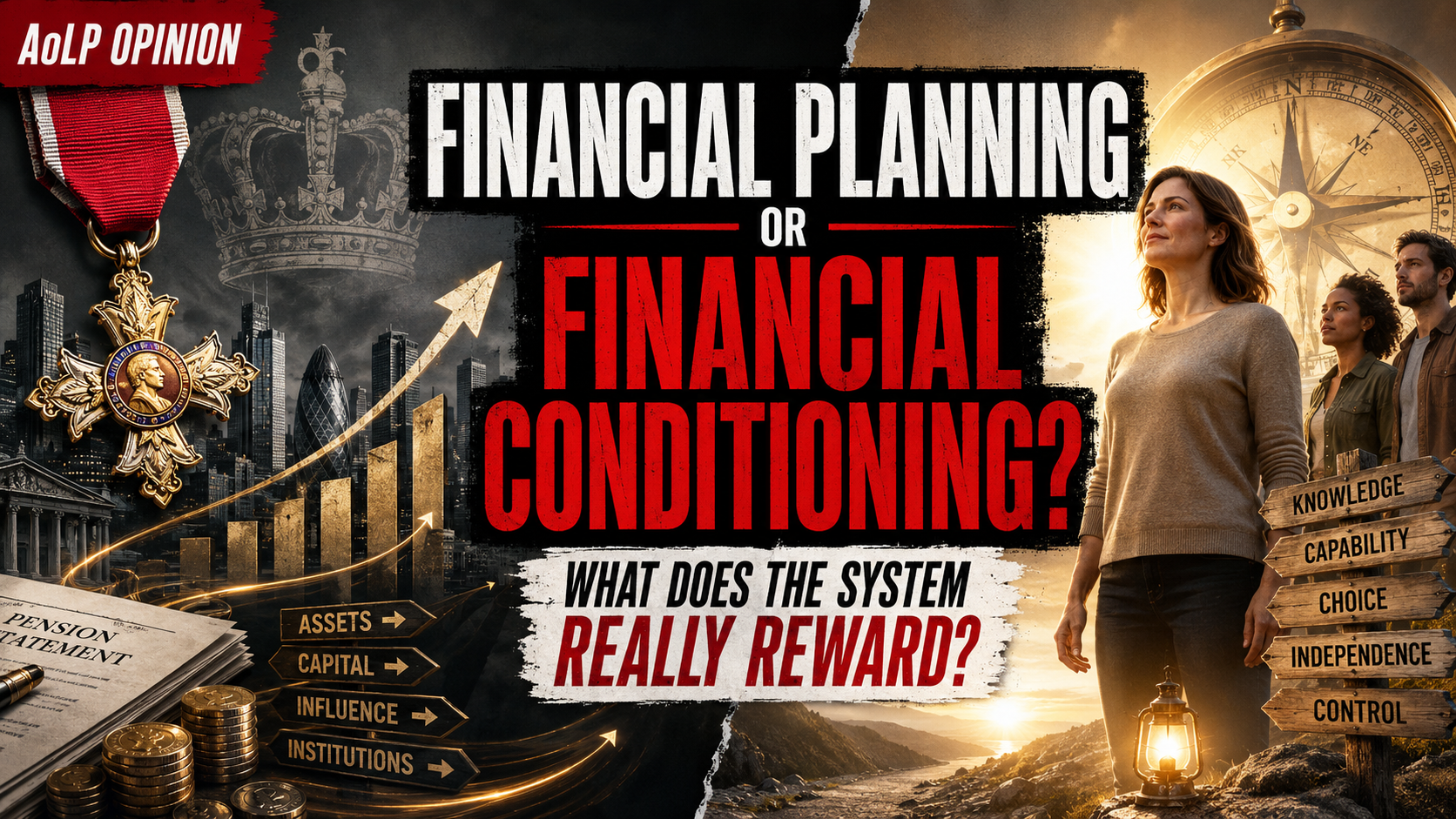
The King’s Birthday Honours List 2026 offered a small but revealing moment for anyone watching the future of financial planning.
Chris Hulatt, co-founder of Octopus Group, was awarded a CBE for services to entrepreneurship. On one level, this is easy to understand. Octopus has become one of the most visible entrepreneurial success stories in UK financial services: a group associated with investment, energy, venture capital, estate planning, financial coaching, advice, institutional relationships and capital mobilisation.
This is not a personal criticism of Chris Hulatt. Nor is it an argument that entrepreneurship should not be recognised. Building a significant business takes courage, persistence and skill.
But honours do not simply reward individual virtue. They also reveal what the state, business culture and professional establishment currently choose to value.
And in financial services, the pattern is familiar.
We tend to reward scale.
We reward capital formation.
We reward asset mobilisation.
We reward institutional influence.
We reward the ability to build platforms, attract assets, influence policy, open distribution channels and shape markets.
What we recognise far less often is the quieter work of restoring human agency.
That distinction matters.
The question beneath the honour
The public conversation often treats financial services innovation as an unquestioned good. If a firm expands access, builds technology, raises capital, reaches more consumers or creates a new route into financial products, it is usually described as progress.
Sometimes it is.
But not always.
The deeper question is not whether a model is entrepreneurial. The deeper question is what kind of human being the model produces.
Does it produce a person who is clearer, safer, more capable and more confident in their own judgement?
Or does it produce a more compliant participant in the financial product economy?
Those are not the same thing.
By restoring agency, I do not mean teaching people a little more about financial capital and calling that empowerment. Financial capital is usually how we store wealth already created; human capital is how most people create wealth in the first place — through their skills, judgement, relationships, health, adaptability, creativity and contribution.
Human agency means developing the self-capability to understand that distinction, apply it to real life, and turn knowledge into action under one’s own energy — not merely becoming a better-informed participant in someone else’s financial system.
This is the distinction at the heart of the Academy of Life Planning’s work.
Financial planning should not merely help people enter the system more efficiently. It should help them become more capable authorities in their own lives.
Financial help or financial conditioning?
Much of the modern advice-gap conversation is framed around access.
More people need access to guidance.
More people need access to coaching.
More people need access to advice.
More people need access to investing.
More people need access to pensions.
Again, there is truth in this. Many people are underserved. Many are confused. Many are vulnerable to poor decisions, weak systems, coercive contracts, unsuitable products and opaque charges.
But access to a system is not the same as agency within that system.
A person can be given access to financial products and still remain dependent.
They can be coached into better financial behaviour and still remain conditioned to accept the system’s assumptions.
They can be nudged into investing and still not understand the wider architecture of their life, work, health, relationships, purpose, risk, creativity or future earning power.
This is why the distinction between financial planning and financial conditioning matters.
Financial conditioning teaches people how to behave inside the existing system.
Agency-restoration planning helps people understand the system, question it, navigate it and decide how much authority they wish to retain for themselves.
One improves participation.
The other restores power.
The recurring pattern: follow the assets
Over the past few years, I have written several times about the same underlying pattern.
The wealth industry talks about innovation, but often means better asset gathering.
It talks about segmentation, but often means concentrating service around clients who can justify higher fees.
It talks about the Great Wealth Transfer, but often frames the next generation as assets to be retained.
It talks about coaching, but some models risk becoming warm-up funnels for regulated product distribution.
It talks about consolidation, but often treats adviser firms, platforms, model portfolios and client books as tradeable asset-flow infrastructure.
And government now increasingly talks about pension capital as a tool for national investment, infrastructure and economic growth.
Different language. Same gravity.
Where will the assets go?
Who will control the flow?
Who will capture the margin?
Who will manage the relationship?
Who will sit between the person and their own financial future?
This does not mean every adviser, entrepreneur, planner, coach, minister, platform or investment firm is acting badly. That would be far too crude. Many people inside the system are sincere, competent and motivated by public benefit.
The problem is structural.
Financial services has a gravitational pull towards intermediation. The person becomes a client. The client becomes a portfolio. The portfolio becomes assets under management. The assets become revenue. The revenue becomes valuation. The valuation becomes institutional influence.
Somewhere along that chain, the human being can disappear.
Human capital comes first
This is particularly serious for people who do not already have significant investable assets.
For many households, the most important asset is not a pension pot, an ISA or an investment portfolio.
It is human capital.
By human capital, I mean the person’s capacity to create value over time through their health, skills, adaptability, relationships, creativity, confidence, judgement, earning power and contribution.
Most people will earn vastly more through their lifetime labour, learning and creativity than they will ever accumulate in financial assets.
Yet conventional financial planning still tends to begin with financial capital.
How much do you have?
Where is it invested?
What products do you need?
What risk profile are you?
What pension contributions can be made?
Those questions may have a place. But they are not the starting point for a life.
An agency-centred approach begins differently.
What is already present in this person’s life?
What capability can be strengthened?
What pressure needs to be reduced?
What decision needs to be clarified?
What dependency can be safely unwound?
What future earning power can be developed?
What relationships, skills, confidence or resilience can be rebuilt?
What would help this person become less vulnerable to institutions, advisers, employers, platforms, creditors, scammers or policy shifts?
This is not soft thinking. It is strategic planning at the human level.
The future is not advice. It is agency.
For decades, financial advice has been built around delegation.
The client delegates complexity to the adviser. The adviser selects products, manages assets and produces recommendations. The client receives advice and is expected to implement it.
That model may still suit some people. But it is not the future for everyone.
The rise of AI, open information, direct-to-consumer platforms and consumer-side technology is changing the power balance. People can now access tools, explanations, comparisons and second opinions that were once available only through professionals.
This should be welcomed.
But there is a risk.
If the industry uses technology merely to improve distribution, automate fact-finding, segment clients, increase productivity and gather more assets, then technology will not restore agency. It will simply modernise dependency.
AI can either strengthen institutional power or restore individual capability.
That is one of the defining public-interest questions of our time.
The Academy of Life Planning’s position is simple:
Advice out. Agency in.
That does not mean nobody ever needs specialist advice. It means the purpose of genuine expertise should be to make itself progressively less necessary, not more.
The best planner does not become the permanent authority in the client’s life.
The best planner helps the person become more capable of being the authority in their own life.
What should we reward?
This brings us back to the honours system.
There is nothing wrong with recognising entrepreneurship. Britain needs builders, innovators and risk-takers.
But if public recognition in financial services flows mainly towards those who scale institutions, mobilise capital and expand market participation, then we should at least notice what remains invisible.
Where are the honours for those helping ordinary people resist financial harm?
Where are the honours for those helping families understand complex decisions without handing over control?
Where are the honours for those building tools that help people read contracts, challenge unfairness, organise evidence or recover clarity after exploitation?
Where are the honours for those strengthening human capability rather than institutional reach?
Where are the honours for those making people less dependent on advice, not more?
Perhaps this is too much to expect from a honours system shaped by the priorities of state, business and institutional life.
But it is not too much to expect from the future of financial planning.
The real test
The real test of financial innovation is not whether it scales.
The real test is whether it liberates.
Does it make people clearer?
Does it make them safer?
Does it reduce dependency?
Does it increase capability?
Does it help them understand what they are signing, buying, accepting or delegating?
Does it strengthen their ability to act under pressure?
Does it restore confidence after harm?
Does it help them build a life, not just a portfolio?
If the answer is no, then we should be careful before calling it empowerment.
It may simply be financial conditioning with better branding.
From asset capture to agency restoration
The financial system keeps asking how to move, retain, consolidate and deploy people’s money.
The Academy of Life Planning asks a different question:
How do we restore the person’s authority over their own life?
That is the dividing line.
Financial advice manages assets.
Financial coaching may improve behaviour.
Financial technology may increase access.
But Total Wealth Planning exists to restore human agency.
It begins with what is already present. It places life before money. It treats financial capital as supportive infrastructure, not the centre of the system. It recognises that human capability, confidence, judgement and meaning are not secondary to wealth planning. They are the foundation of it.
The future of financial planning should not be measured by assets gathered, products opened, platforms scaled or institutions honoured.
It should be measured by people restored.
Because the question is no longer whether the wealth industry can innovate.
The question is whether it can stop saving itself long enough to help people recover their own agency.
Curious how others see this.

