
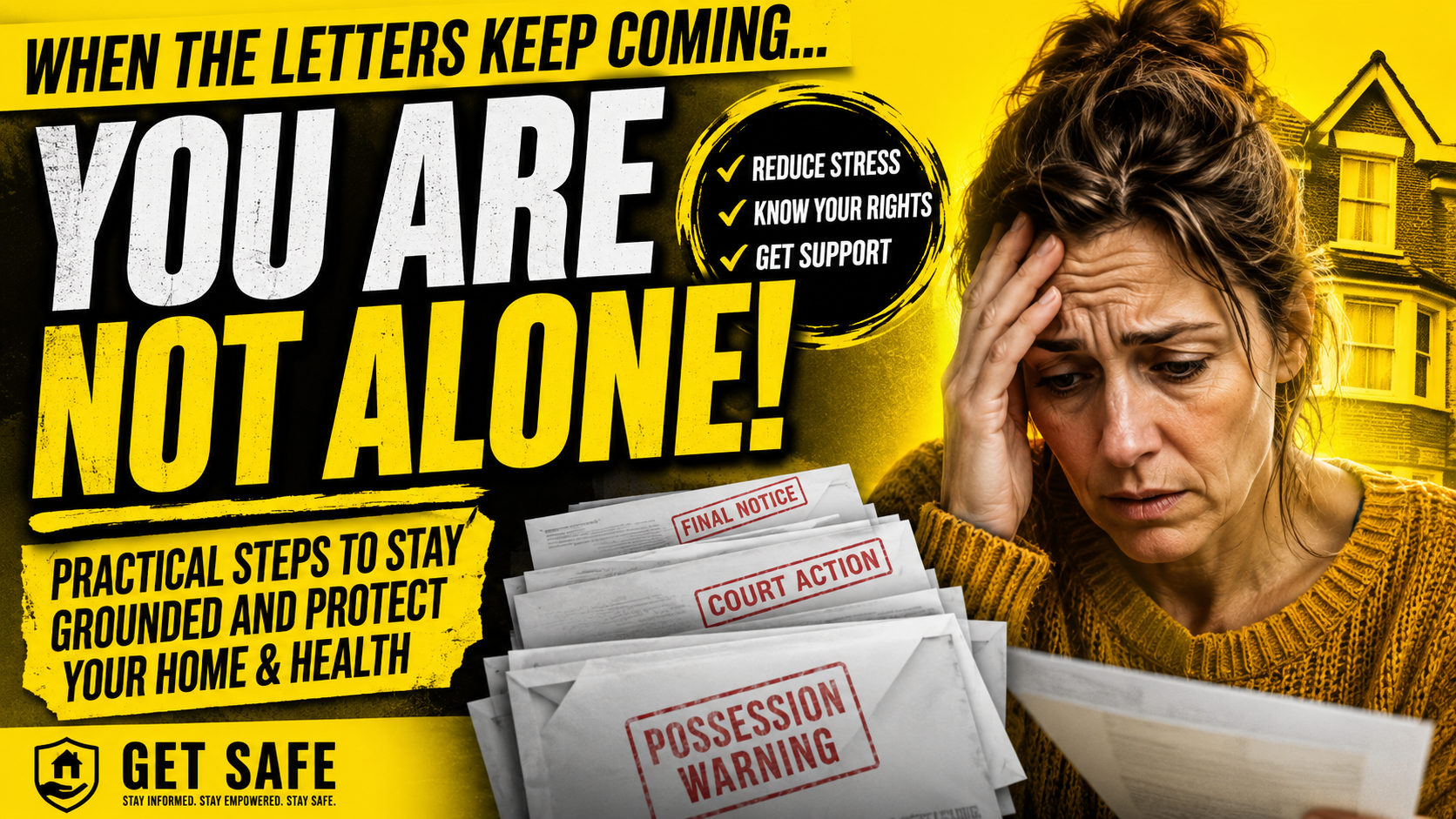
There comes a point in some financial disputes where the problem stops being only legal or financial.
It becomes physiological.
You stop sleeping properly. You tense when the post arrives. Your body reacts before your mind has even processed the letter.
For many people facing long-running mortgage disputes, debt enforcement, litigation, or institutional pressure, the real damage is not just the paperwork — it is the gradual erosion of stability, clarity, confidence, and health.
At Get SAFE, we see this often.
People tell us:
- “I’m shaking opening envelopes.”
- “I can’t think clearly anymore.”
- “I feel exhausted all the time.”
- “I used to be capable — now I can barely respond to emails.”
- “I’m frightened of what comes next.”
If this sounds familiar, please hear this first:
Your nervous system is reacting to prolonged threat. That is not weakness. It is a human survival response.
And before anything else, stabilisation matters.
Not proving everything. Not winning every argument. Not exposing the whole system.
Stabilisation.
Because once someone becomes overwhelmed, exhausted, isolated, or medically unwell, their ability to think clearly and make good decisions begins to collapse.
That is why the first priority is often not legal strategy.
It is restoring enough safety and clarity for someone to function again.
The Most Important Distinction: An Application Is Not the End
One of the biggest triggers for panic is misunderstanding procedural letters.
For example:
- an application for a warrant is not the same as an eviction tomorrow
- a solicitor’s letter is not the same as a court order
- silence from an institution is not always evidence of conspiracy
- receiving a bill does not necessarily mean immediate liability
When people are traumatised, the brain often jumps immediately to catastrophe.
That is understandable — but dangerous.
The first practical step is almost always:
- slow down,
- separate facts from fears,
- and identify what actually requires action today.
Often, far less is urgent than it first appears.
Practical Things That Do Help
In situations involving mortgage possession, enforcement, or housing risk, the following are often far more important than trying to fight the entire historical dispute:
1. Medical Evidence
If stress is affecting your physical or mental health:
- speak to your GP,
- obtain records,
- and document vulnerability properly.
Courts, housing services, and safeguarding systems are much more responsive to evidence-based vulnerability than to broad allegations.
2. Shelter and Housing Advice
Many people delay contacting housing organisations because emotionally it feels like “giving up.”
It isn’t.
Shelter England and local housing teams deal with:
- eviction risk,
- warrant suspensions,
- homelessness prevention,
- and vulnerability every day.
Getting inside the support system early often reduces panic and creates practical options.
3. Keep Communication in Writing
If phone calls trigger anxiety or confusion:
- request written communication only.
Written communication:
- creates a record,
- slows escalation,
- and reduces pressure.
That is not “refusing to engage.”
It is structured engagement.
4. Don’t Try to Carry the Whole System
This is important.
Many people begin researching:
- securitisation,
- trust structures,
- hidden ownership,
- regulatory failures,
- corruption theories,
- and internet legal arguments.
Some concerns may feel emotionally valid.
But trying to prove an entire systemic theory while already traumatised usually increases distress and weakens focus.
The court will generally focus on:
- current vulnerability,
- proportionality,
- safeguarding,
- procedural fairness,
- and practical circumstances.
Not every historic theory.
Trauma Changes Time Perception
People under prolonged stress often live psychologically in:
- the last threat,
- or the next feared threat.
The body begins anticipating danger before it arrives.
That is why:
- the postman feels frightening,
- silence feels ominous,
- and every letter feels like catastrophe.
But sometimes the safest thing you can do is this:
Pause.
Make tea.
Leave the envelope unopened for an hour.
Breathe before reacting.
You are allowed to slow things down internally, even when systems around you feel fast and aggressive.
The Role of Get SAFE
Get SAFE is not a law firm.
We do not replace solicitors, debt advisers, housing specialists, or medical professionals.
Our role is different.
We help people:
- stabilise,
- organise,
- think clearly,
- communicate calmly,
- and reconnect with practical support routes before panic takes over.
Because often the first thing people lose in these situations is not their legal position.
It is their sense of agency.
And restoring that — even quietly, one step at a time — matters.
If you are in this kind of situation today:
Please focus first on:
- your health,
- your safety,
- your clarity,
- and your support network.
You do not need to solve everything today.
You only need the next calm step.
We are building a national support network so people facing financial exploitation, housing crisis, or institutional overwhelm are not left alone.
Not everyone can afford a solicitor. Not everyone has family support. And not everyone is strong enough to navigate complex systems while traumatised, ill, or afraid.
Your donation helps keep calm, human, practical support available for people who need it most.
Every contribution helps us:
- support vulnerable individuals,
- provide stabilisation and guidance,
- develop free tools and resources,
- and restore human agency when people feel powerless.
If you believe nobody should face these situations alone, please support the mission.

