
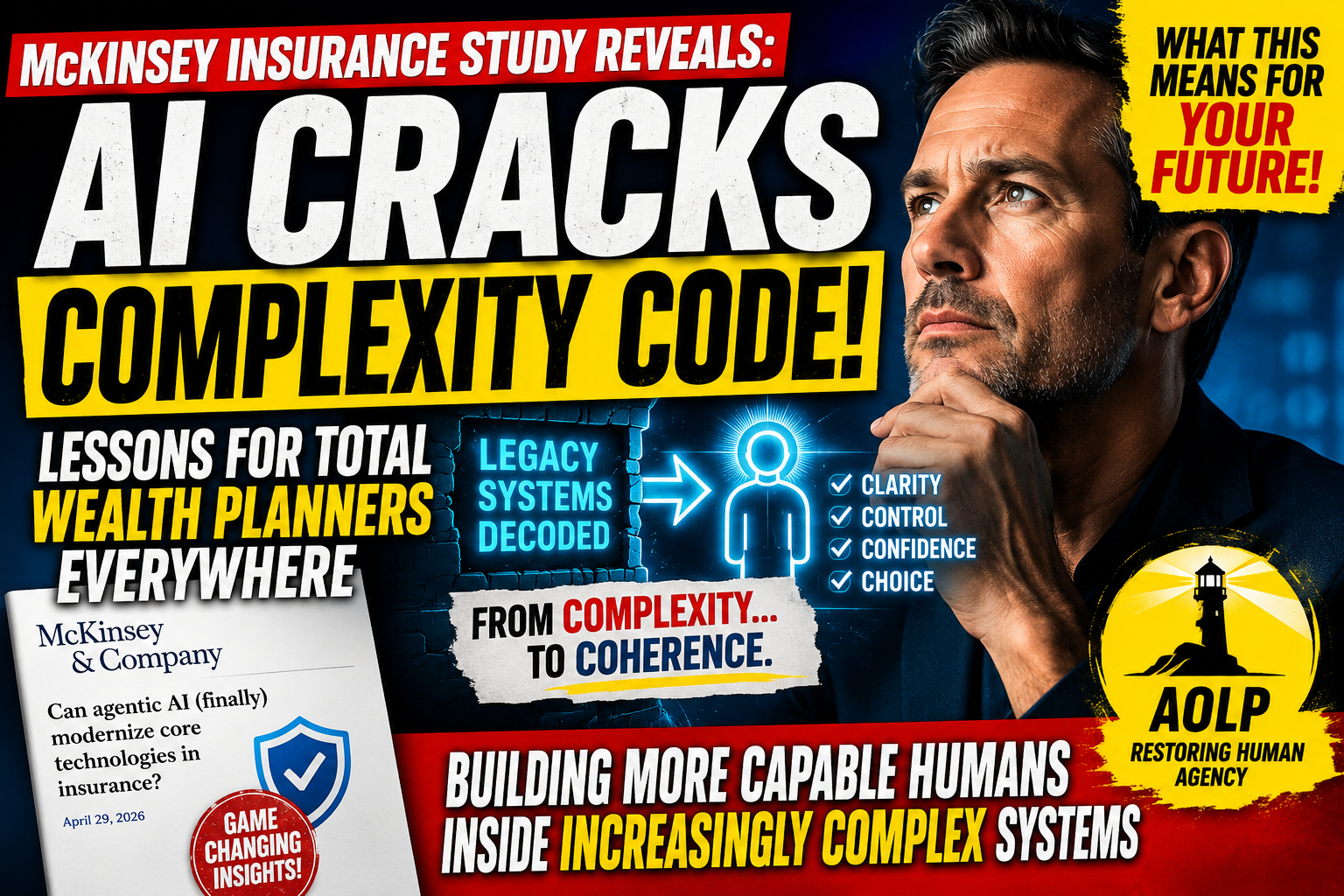
A recent McKinsey study examining the insurance industry may have revealed something far bigger than insurance. In its April 2026 paper, Can agentic AI (finally) modernize core technologies in insurance?, McKinsey argues that AI agents are beginning to unlock decades of institutional complexity by reverse engineering legacy systems, translating embedded logic into understandable workflows, and coordinating operational processes at scale.
On the surface, the article is about insurance technology.
But beneath the surface lies a much more profound signal for society, for financial planning, and for the future role of the Total Wealth Planner.
Because what McKinsey is really describing is the gradual collapse of complexity as a moat.
For decades, institutions held structural power partly because ordinary people could not realistically navigate the systems surrounding them. Knowledge was fragmented. Rules were buried inside opaque processes. Decision-making required specialist interpretation. Organisational scale created informational asymmetry.
Now AI is beginning to change that.
Not merely by making institutions more efficient, but by making complexity increasingly interpretable.
That distinction matters enormously.
The Real Bottleneck Is Not Information
One of the most important observations in the McKinsey study is this:
“The biggest bottlenecks are rarely typing code but rather the loops of discovery, mapping, testing, reconciliation, and cutover.”
Translated into human terms, this means something remarkably familiar to anyone working in Total Wealth Planning.
The true bottleneck is not access to information.
It is the human ability to:
- make sense of complexity
- maintain coherence
- interpret competing signals
- structure decisions
- regulate overwhelm
- act intentionally over time
Modern society increasingly overwhelms those capacities.
Individuals are expected to navigate:
- pensions
- mortgages
- insurance
- taxation
- subscriptions
- legal contracts
- digital systems
- healthcare administration
- employment transitions
- long-term uncertainty
often while simultaneously managing stress, ageing parents, burnout, redundancy, grief, relationship breakdown, or declining health.
This is not simply a financial literacy issue.
It is a cognitive and emotional load issue.
Many people are not failing because they lack intelligence.
They are failing because the systems surrounding them increasingly exceed normal human processing capacity.
The Shift from Information Scarcity to Coherence Scarcity
Historically, financial planners operated within an environment of information scarcity.
Professional value often came from:
- technical expertise
- access to specialist knowledge
- interpreting products
- understanding regulation
- navigating institutional systems
But AI increasingly compresses those informational advantages.
Agentic systems can already:
- analyse contracts
- identify inconsistencies
- model scenarios
- surface hidden risks
- summarise technical information
- compare complex options
- structure workflows
- reverse engineer opaque logic
McKinsey’s insurance article describes AI agents translating decades-old legacy code into plain English and reconstructing institutional logic that previously took specialists years to decode.
The implications extend far beyond insurance.
Because the same underlying capability can increasingly be applied to:
- financial products
- legal agreements
- consumer contracts
- regulatory frameworks
- claims processes
- administrative systems
- evidence bundles
- life planning decisions
This changes where human value sits.
The future Total Wealth Planner is unlikely to win primarily through possessing more information than the client.
The future value increasingly lies in helping clients:
- maintain coherence
- regulate complexity
- sequence decisions safely
- align actions with values
- build practical capability
- remain intentional under pressure
In other words:
From information intermediation
toward human capability development.
Complexity Is Becoming a Structural Risk
One of the least recognised realities of the modern era is that complexity itself is becoming economically and psychologically harmful.
Every additional layer of:
- institutional process
- compliance
- financialisation
- digital administration
- algorithmic decision-making
- platform dependency
- legal fragmentation
creates additional cognitive burden.
And when cognitive burden rises too far, human agency deteriorates.
People delay decisions.
Avoid paperwork.
Miss critical details.
Freeze under uncertainty.
Default to institutional authority.
Become vulnerable to exploitation.
This is particularly visible during periods of stress or vulnerability.
Which is why the future of planning cannot simply revolve around optimising investment returns.
The future of planning increasingly involves helping humans remain functional, coherent, and capable inside systems too complex to navigate alone.
The Planner as a Coherence Builder
The McKinsey article repeatedly emphasises that successful AI deployment still requires:
- governance
- traceability
- human oversight
- escalation paths
- operational controls
- explainability
That is an important validation signal.
Because despite the hype surrounding AI automation, the future is unlikely to belong entirely to autonomous systems.
It is more likely to belong to human-AI collaboration systems.
This is precisely where the future Total Wealth Planner may become increasingly valuable.
Not as a product intermediary.
But as:
- a translator of complexity
- a stabilising presence
- a systems guide
- a decision architect
- a coherence builder
- a human-centred navigator
The role becomes less about controlling decisions for people and more about helping people regain the capacity to make coherent decisions themselves.
That is a fundamentally different philosophy of planning.
Scalable Restoration of Individual Coherence
This may become one of the defining opportunities of the AI era.
Historically, personalised support struggled to scale economically.
Institutions solved scale through standardisation.
But standardisation often strips away:
- context
- nuance
- individuality
- dignity
- emotional reality
AI changes the economics of this equation.
For the first time, it may become possible to scale personalised cognitive support without fully industrialising the human being.
That matters profoundly.
Because the future challenge is not simply smarter systems.
It is ensuring humans remain capable enough to live meaningfully within them.
This is why the Academy of Life Planning increasingly focuses on:
- restored human agency
- cognitive load management
- emotional calibration
- safety rails
- practical next-step interfaces
- capability development
- decision support systems
The objective is not dependence on AI.
The objective is augmentation of human capability.
Lessons for Total Wealth Planners Everywhere
The deeper lesson from the McKinsey insurance study is not merely technological.
It is civilisational.
As AI increasingly dismantles informational monopolies, the future value of planning shifts upward:
- from information to interpretation
- from products to people
- from transactions to capability
- from institutional dependency to human agency
- from optimisation alone to coherence
The planner of the future may not primarily be the person who knows the most.
They may increasingly be the person who helps others remain coherent enough to navigate complexity wisely.
That is a very different kind of professional identity.
And perhaps a far more important one.
The Academy of Life Planning believes the future belongs not to the systems that most efficiently automate humans…
…but to the ecosystems that most effectively build more capable humans inside increasingly complex systems.

