
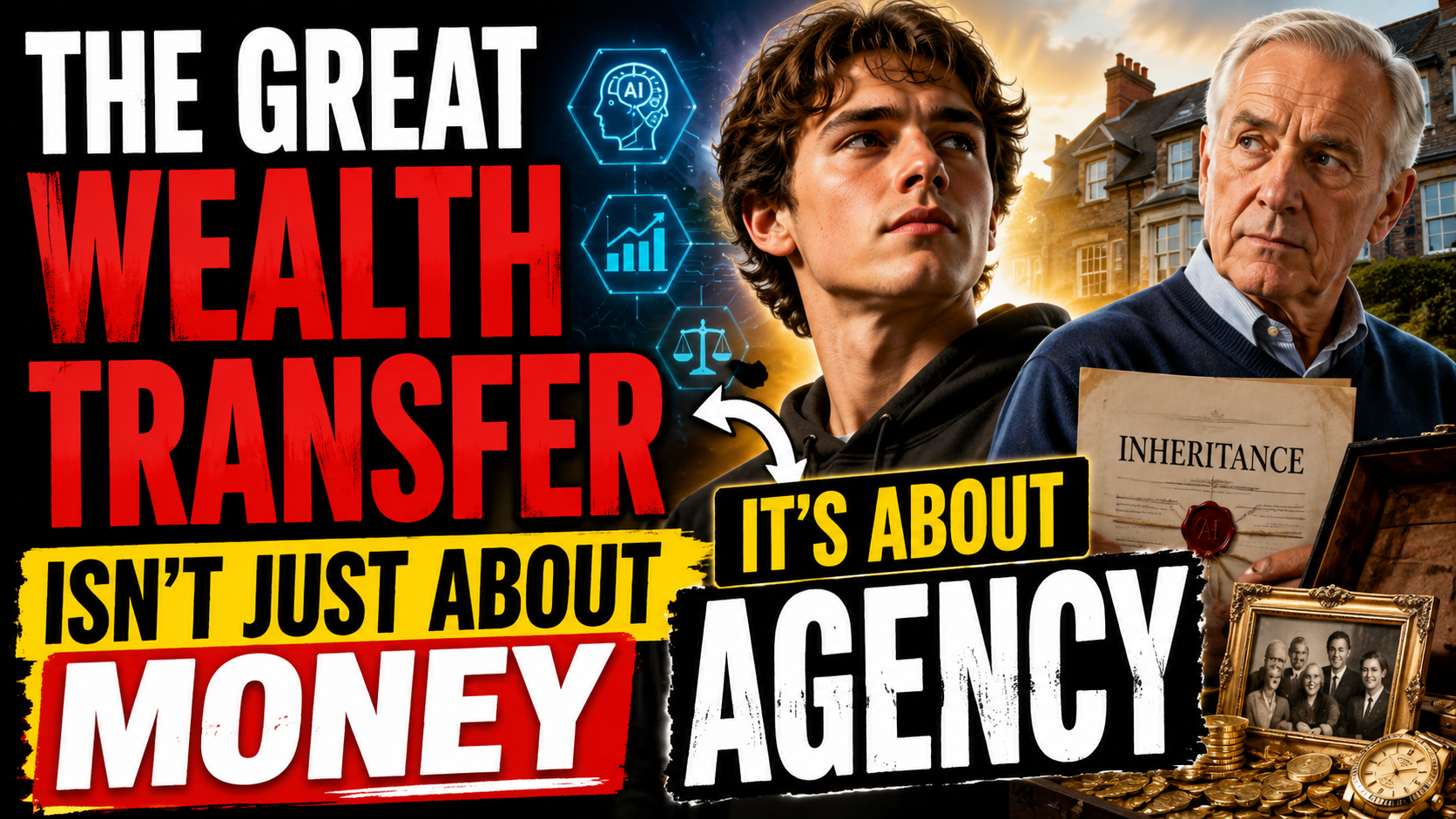
The financial planning profession is beginning to wake up to the scale of what is coming.
The Chartered Insurance Institute recently warned that the UK advice sector may be underprepared for the largest intergenerational transfer of wealth in British history — an estimated £5.5 trillion expected to pass between generations by 2050.
The concern is understandable.
Many advice firms worry about losing relationships after bereavement. Others are struggling to engage adult children who may eventually inherit family wealth. The profession is asking an increasingly urgent question:
How do we preserve continuity across generations?
But beneath that question sits another — perhaps even more important — one:
What if the next generation does not want financial planning to operate in the same way as the last?
That possibility changes everything.
For decades, financial advice largely operated inside a world of information asymmetry.
Advisers held specialist knowledge.
Consumers relied on institutions.
Financial products were difficult to understand.
Planning tools were inaccessible.
Technical interpretation required gatekeepers.
In that environment, delegation made sense.
But AI is beginning to alter the economics of knowledge itself.
Not because AI replaces human expertise entirely.
But because it dramatically lowers the cost of:
- understanding
- interpretation
- comparison
- modelling
- second opinions
- financial education
- scenario testing
This matters particularly for younger generations.
Gen Z and younger Millennials are growing up inside AI-enabled environments. They are accustomed to interactive systems, on-demand explanation, conversational interfaces, and collaborative digital tools.
They are often less comfortable with:
- opaque authority
- institutional dependency
- information gatekeeping
- delegated understanding
That does not mean they reject guidance.
It means they may expect guidance to work differently.
The traditional industry framing of the “Great Wealth Transfer” is still heavily asset-centric:
- retaining assets under management
- retaining inheritor relationships
- preserving continuity of advice
- improving engagement with beneficiaries
But the deeper transition may not simply concern wealth.
It may concern decision-making capability itself.
In other words:
the Great Wealth Transfer may also become a Great Agency Transfer.
This distinction matters because the UK already has a structural limitation embedded within the current model.
Only around one in ten UK adults currently access regulated financial advice.
That means the overwhelming majority of citizens already navigate life, money, uncertainty, work, debt, housing, care responsibilities, retirement decisions, bereavement, and intergenerational pressures without ongoing professional support.
Against that backdrop, the idea that traditional advisory infrastructure alone can absorb a £5.5 trillion societal transition appears increasingly unrealistic.
Particularly when:
- adviser populations remain constrained
- many firms are consolidating
- younger consumers expect digital-first interaction
- AI tools are normalising rapidly
- trust in institutions remains fragile
This does not mean advisers become irrelevant.
Far from it.
But it may mean the role evolves.
The future may not belong to professionals who merely possess answers.
It may belong to professionals who help human beings remain coherent inside increasingly complex systems.
That is a very different proposition.
The article correctly identifies behavioural and emotional barriers surrounding inheritance:
- family dynamics
- trust
- bereavement
- end-of-life conversations
- economic abuse
- emotional complexity
These are not primarily investment problems.
They are human transition problems.
And human transition problems require more than technical product expertise.
They require:
- communication
- judgement
- emotional calibration
- structured thinking
- planning literacy
- behavioural support
- decision confidence
- long-term coherence
This is where the distinction between “advice” and “agency” becomes increasingly important.
Advice traditionally centres on transferring recommendations from expert to consumer.
Agency centres on increasing the individual’s capability to participate meaningfully in decisions affecting their own life.
The two are not mutually exclusive.
But they are not identical either.
In an AI-enabled world, the balance may begin to shift.
Consumers may increasingly expect:
- tools alongside professionals
- transparency alongside expertise
- participation alongside delegation
- understanding alongside recommendations
This is why the future of planning may become less product-centric and more capability-centric.
The core strategic question may no longer be:
“How do we retain inheritors as clients?”
But rather:
“How do we help the next generation become more capable stewards of wealth, life, relationships, and long-term decisions?”
That is a broader challenge than financial advice alone.
It moves planning closer to:
- human capital development
- decision capital
- behavioural resilience
- intergenerational communication
- life navigation
- adaptive capability
And perhaps this is where the profession has its greatest opportunity.
Not simply to protect assets.
But to help restore human agency in a world becoming increasingly complex, automated, and psychologically demanding.
Because ultimately, wealth without agency can still leave people vulnerable.
But agency — the ability to think clearly, decide consciously, adapt intelligently, and navigate complexity with confidence — may become one of the most valuable forms of wealth of all.
And that may be the real transition now beginning.

