
After 15 years of listening to people let down by financial advice, I’ve finally understood who my business is for. And why AI could change everything.
By Steve Conley | Founder, Academy of Life Planning | 26 October 2026
Over the past few weeks, I’ve been taking a hard look at my business.
Not at the qualifications. Not at the technology. Not at the planning frameworks I’ve spent years developing.
At the customers.
Specifically, why people have paid me for financial planning over the past 15 years.
And I’ve noticed something that, in hindsight, should have been obvious.
Every one of my personal clients came to me after a less-than-satisfactory experience with a regulated financial adviser.
They weren’t necessarily looking to change investments.
They weren’t looking for someone to take over their money.
They had a problem they expected their financial adviser to solve.
And the adviser hadn’t solved it.
Fifteen years. The same story.
Let me tell you about some of the people I’ve met.
A pensioner had accumulated cash savings. Interest rates were low. His adviser recommended moving the money into a portfolio containing unregulated investments. Those investments subsequently failed.
Was the problem really that the pensioner needed more investment risk? Or did he need someone to help him understand what his savings were for, how much risk he could afford and whether doing nothing was a perfectly reasonable option?
A woman wanted to pass money to her children with warm hands — while she was alive to enjoy seeing them benefit.
Her adviser proposed a solution designed to pass wealth with cold hands, after death. The arrangement generated income she didn’t want and required intrusive medical examinations.
She had asked for help making a gift. She received an investment-led solution to a different problem.
An investor’s adviser failed to respond adequately as the Woodford investment scandal unfolded. Fees continued while the investment became trapped in an increasingly serious liquidity crisis.
The client needed someone paying attention to the consequences for them.
A couple were paying approximately £10,000 a year for ongoing financial advice.
Their annual review had become, in their description, a cup of coffee and a slice of cake.
They weren’t objecting to paying for expertise. They were questioning what they were getting for the money.
A recently widowed woman approached an adviser for help getting her finances in order.
The proposed fees were so high that she felt she might as well hand over the keys to her apartment.
What she needed was patient explanation, organisation and reassurance at one of the most difficult moments of her life.
A business owner thought he needed a Small Self-Administered Scheme (SSAS) to buy larger business premises because his growing stock was taking up too much space.
But when we examined the business, the underlying problem wasn’t a shortage of premises.
It was stock control.
He didn’t need a pension scheme to purchase a property.
He needed better stock management.
And then there was the woman buying her dream home.
She asked her adviser to verify the source of funds for the purchase.
Instead, she was persuaded against the purchase and encouraged to remain invested.
The question she had asked wasn’t answered in the way she expected.
These are examples from real conversations and cases I’ve encountered, with identifying details omitted. They are not findings about every adviser or a judgement on the suitability of every recommendation made. They illustrate the recurring mismatch I saw between the problem presented and the service delivered.
And the list goes on.
Different people. Different circumstances. Different financial problems.
But a remarkably consistent underlying pattern.
They needed financial planning. They were offered financial intermediation.
The problem wasn’t always the adviser. It was the business model.
I want to make an important distinction.
There are excellent regulated financial advisers. There are circumstances where regulated investment advice is essential. And managing investments can be a valuable service.
But we need to examine the incentives.
When a business earns its income from assets under management, it has a commercial reason to attract and retain assets.
When revenue depends on ongoing fees, the business has a commercial reason to retain an ongoing relationship.
Neither incentive automatically produces bad advice.
But neither guarantees that the customer’s actual problem will receive the attention it deserves.
Consider the business owner who needed better stock control.
There was no investment portfolio to manage in the solution.
Or the woman who wanted to give money away while she was alive.
Helping her give money away might reduce the assets available to manage.
Or the client who simply wanted reassurance before making a financial decision.
That might require an hour of expertise, followed by several years in which no professional help is needed.
An episodic problem doesn’t necessarily justify a continuous fee.
Yet much of the financial advice industry has built its economics around continuous fees.
This creates a structural mismatch.
The customer wants a problem solved.
The business needs a relationship maintained.
And what happens when the problem is solved?
For an agency-led planner, that is a successful outcome.
For an asset-based recurring revenue model, it may create an awkward commercial question.
Why I founded the Academy of Life Planning
In 2012, I decided there had to be another way.
I’d spent decades in financial services, including senior leadership roles at HSBC. I understood the technical work and the economics of financial intermediation.
But I also believed something was missing.
The purpose of financial planning should be to make people more capable of directing their own lives.
Not to make them permanently dependent on somebody else.
So I founded the Academy of Life Planning.
My starting principle was simple:
Life before money. Agency before advice.
Financial planning should begin by understanding someone’s life, aspirations, responsibilities and problems.
Only then should we consider what their financial resources might make possible.
Our GAME Plan™ framework — Goals, Actions, Means and Execution — grew from that principle.
And over time, the Academy has developed tools to help people organise information, explore choices, model alternatives and maintain their own plans.
The ambition has always been to transfer capability to the customer.
But there was a practical obstacle.
For much of the past 15 years, sophisticated financial planning tools and analysis were expensive to produce. Clients often needed a professional to operate the technology on their behalf.
Then AI arrived.
AI changes who can do the planning
Today, a reasonably capable person with access to AI can do things that previously required substantial professional support.
They can organise financial information.
Build lifetime cashflow models.
Explore alternative retirement dates.
Examine pension choices.
Compare the consequences of different decisions.
Interrogate financial documents.
Prepare questions for their adviser.
And, increasingly, build their own tools.
That doesn’t make people infallible.
It makes them more capable.
And that’s a profound change.
Because the financial advice industry has traditionally operated in a world where the professional had the information, the tools and the expertise, while the client had the problem.
AI is changing that balance.
The client can now arrive with research, scenarios, calculations and questions.
Sometimes the client may have examined a problem more thoroughly than the adviser expected.
The client is no longer necessarily the least informed person in the room.
The next financial advice review could be very different
We’ve recently launched a free app called Ask My Adviser™.
It helps people examine the advice they’re receiving.
They can upload suitability reports, review letters, fee statements and client agreements.
The app helps them understand what they’re paying, what services they’ve been promised, what evidence supports the recommendations and what questions remain unanswered.
Importantly, it considers the strongest fair case for the adviser too.
The objective isn’t to manufacture complaints.
It’s to create a better conversation.
The app produces an editable meeting agenda that the client can take into their next review.
Imagine the difference.
Instead of arriving for coffee and cake, the client arrives with a structured examination of the services, charges, assumptions, alternatives and outcomes.
They can ask:
- What exactly am I paying for?
- Which parts of the service have I actually used?
- What decisions did your advice help me make?
- What could I now do independently?
- Where do I genuinely need professional expertise?
- Would paying for help when I need it be better value than paying continuously?
Good advisers should welcome informed questions.
Good advice should stand up to scrutiny.
And good client relationships should become stronger when the client becomes more capable.
What happens when clients compare the costs?
We’ve also been developing ways for people to compare the long-term cost of continuous percentage-of-assets fees with episodic planning fees.
Consider a simple illustration.
Someone with a £500,000 investment portfolio paying an annual advice fee of 1% is paying £5,000 in the first year alone.
If the portfolio grows, the fee generally grows with it.
That may be reasonable if the client receives and values ongoing services commensurate with the cost.
But what if the client mainly needs a few hours of financial planning each year?
What if some years they need no human support at all?
What if they can maintain their own plan, explore scenarios using AI and bring in a professional only when something genuinely complicated arises?
Now the comparison becomes interesting.
At Total Wealth Planner, a 50-minute Zoom meeting costs £50. A focused Second Brain Session costs £297. Ongoing support begins with our Independent Financial Lifeguard service at £29 per month.
We also provide higher levels of support for people who need regular planning reviews.
Our approach is straightforward.
The client owns the plan.
Academy OS provides continuous planning capability.
Human expertise is available when it adds value.
Your plan is continuous. Your need for a planner isn’t.
Why I’ve changed my virtual high street
I’ve spent the past few weeks rebuilding the Total Wealth Planner website, updating our services, prices, explanations and social media presence.
And the exercise has forced me to recognise something.
I had been trying to explain a new financial planning philosophy to the world.
But the people who had actually paid me were telling me something much simpler.
They already knew they had a problem.
They had already sought financial advice.
They simply hadn’t received the planning help they needed.
I didn’t need to persuade them that financial planning was valuable.
They already believed it was.
I needed to show them where they could find it.
So the question at the heart of the business is now:
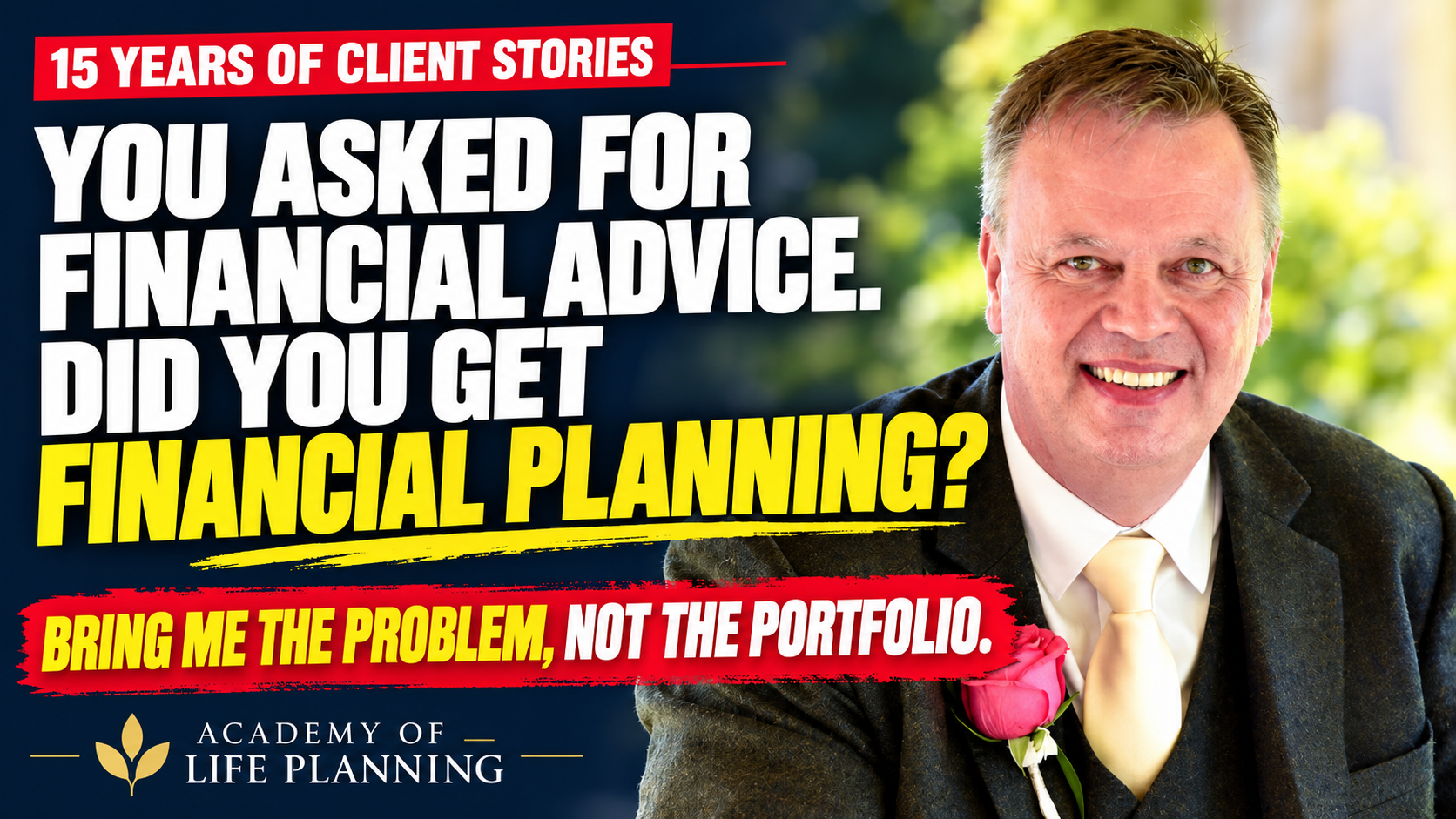
You asked for financial advice. Did you get the planning help you needed?
And the invitation is:
Bring me the problem, not the portfolio.
That is what I do.
I help people organise complex circumstances, test assumptions, explore options, identify blind spots and make decisions they understand.
I don’t sell financial products, manage investments or charge a percentage of assets.
Where a decision requires regulated product advice or specialist legal or tax expertise, we recognise that boundary.
Where the client can proceed independently, we help them become capable of doing so.
And where experienced human judgement adds value, we make it available.
The next six to twelve months could be revealing
Here is my prediction.
I think we may be approaching a moment when a growing number of financial advice clients suddenly recognise the deal they’ve been offered.
Not because someone tells them financial advisers are bad.
But because they can finally examine the relationship intelligently for themselves.
They’ll have tools to understand their fees.
Tools to examine recommendations.
Tools to test alternative financial futures.
Tools to identify the questions nobody has answered.
And tools to estimate what comparable planning support might cost elsewhere.
Some will conclude that their adviser provides excellent value.
Others may be surprised by what they discover.
I suspect this could become much more visible over the next six to twelve months.
That’s a prediction, not a certainty. It depends on how quickly clients adopt AI tools, how well those tools perform and how confidently people use them.
But I see little immediate commercial incentive for established firms to abandon profitable assets-under-management fee structures.
Why would they rush to replace recurring revenue with occasional hourly fees?
The advisers may not change their business models quickly. But their clients may change their expectations very quickly indeed.
And that is where the real disruption could begin.
Why I’m here
After 15 years, I can finally describe my place in the market more clearly.
I’m here for the person who has been to a financial adviser and still doesn’t have an answer to the question that matters.
The widow who needs help rebuilding confidence.
The retiree who needs to understand their choices.
The family trying to decide how much they can give away.
The business owner who needs someone to see beyond the obvious financial product.
The investor who wants to scrutinise what they’re paying and receiving.
And the increasingly capable person who wants an experienced second brain without surrendering control of their financial life.
I am also here for the financial planners who recognise that this is where the profession could go.
Professionals who want to be paid for their judgement, skill and contribution rather than the assets they control.
The Academy of Life Planning exists to help both.
Through education, tools and professional development, we want to make independent financial planning available to more people, at a cost proportionate to the help they actually need.
Not everybody needs a financial adviser all the time.
But everybody deserves the capability to understand their circumstances, question what they’re told and seek trustworthy support when it matters.
The financial services industry has spent decades building systems for managing people’s money.
It’s time we built systems that help people manage their own lives.
That’s why I’m here.
And, after 15 years, it’s clearer to me than ever.
Have you received financial advice but still have unanswered questions?
If you’re facing a financial decision, concerned about advice you’ve received or wondering whether you’re getting value from an ongoing adviser relationship, we can help.
- Try Ask My Adviser™ — Free
Examine your advice documents and prepare better questions for your adviser. - Explore Total Wealth Planner™
Discover continuous planning tools and professional support when you need it. - Book a 50-minute Zoom meeting — £50
Bring me the problem. Let’s explore what help you actually need.
Life before money. Agency before advice. Bring me the problem, not the portfolio.

