
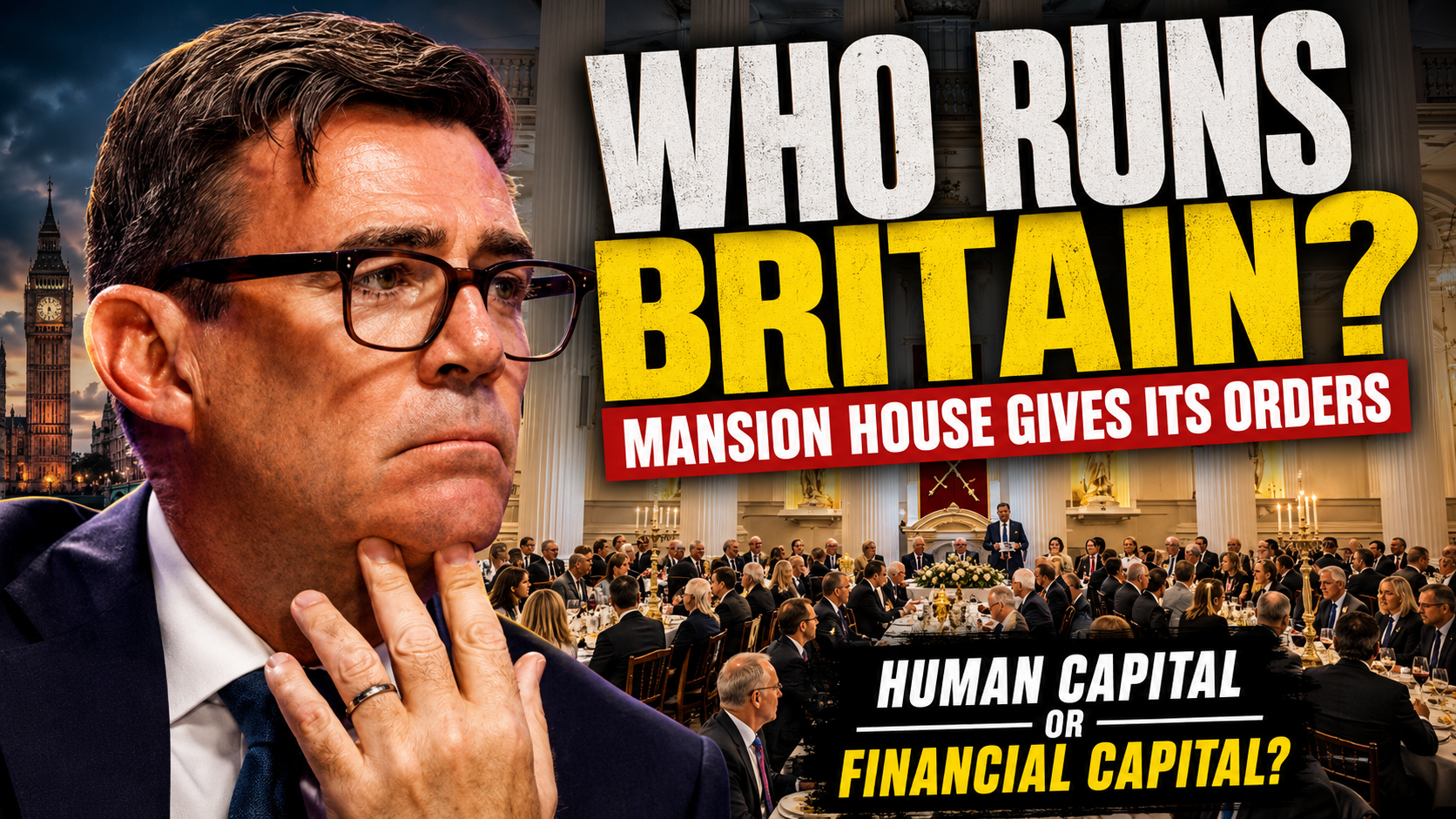
Britain does need growth. But we may have spent too long asking the wrong people what growth means.
Something revealing happened this week.
Britain had a new Prime Minister. And almost immediately, the financial establishment began telling him what he was allowed to do.
Andy Burnham was warned that unless he restrained public spending, Britain could face higher borrowing costs and market turmoil. Investors and economists called for spending restraint, while former advisers questioned whether his ambitions could be reconciled with the demands of the bond markets.
There is an important economic reality here.
Governments cannot ignore the price at which they borrow. Fiscal credibility matters. Inflation matters. Debt sustainability matters.
But something else matters too.
Who gets to decide what Britain is trying to achieve?
Because there is a difference between listening to markets and allowing markets to govern.
And that distinction may prove critical to Andy Burnham’s premiership.
The mistake Starmer made
Keir Starmer’s government inherited a stagnant economy and quite reasonably made economic growth its priority.
The problem was not wanting growth.
The problem was accepting too readily the establishment’s definition of how growth happens.
At Mansion House in 2025, Rachel Reeves placed financial services explicitly at the centre of the government’s economic strategy.
The government promised to make regulators regulate for growth, cut regulatory burdens, accelerate approvals and unleash more investment through the financial system.
The Chancellor went so far as to say:
“Britain cannot succeed and meet its growth ambitions without a financial sector that is fighting fit and thriving.”
That became the governing mental model.
Develop financial capital and prosperity will follow.
Make finance more competitive.
Unlock investment.
Reduce regulatory friction.
Mobilise pensions.
Encourage risk-taking.
Get capital moving.
Growth would then ripple outward into higher wages, better jobs and rising living standards.
There is nothing inherently wrong with any of those things.
Financial capital is important.
But it is not the economy.
It is infrastructure for the economy.
And confusing the financial system with the economy itself is one of the most persistent mistakes in modern economic policy.
What if we have the hierarchy backwards?
My own view is different.
Human capital development matters more than financial capital development.
Financial capital is money capable of being deployed.
Human capital is people capable of doing things.
Their knowledge.
Their health.
Their skills.
Their confidence.
Their creativity.
Their judgement.
Their relationships.
Their resilience.
Their ability to learn, cooperate, innovate, build businesses, raise families and participate meaningfully in society.
Money does not create prosperity by itself.
People do.
Capital can amplify human capability. But capital without capability can just as easily inflate asset prices, concentrate ownership and increase the returns flowing to those who already possess capital.
That distinction matters enormously.
The OECD defines human capital as the knowledge, skills and personal characteristics embodied in people that help them become productive. More recent OECD work finds a robust positive relationship between human-capital accumulation and aggregate productivity, although countries differ considerably in how effectively they translate those capabilities into economic output.
So perhaps Britain’s growth question should not begin:
How do we get investors to deploy more capital?
Perhaps it should begin:
How do we enable millions more people to develop and deploy their capabilities?
That leads to a very different growth strategy.
Financial capital asks: where can money earn a return?
Human capital asks: what might this person become?
Think about the consequences.
If you believe financial capital is the principal engine of growth, your attention naturally gravitates towards interest rates, investment incentives, pension assets, financial regulation, corporate taxation and investor confidence.
These things matter.
But if you believe human capability is the principal engine of sustainable prosperity, you start looking somewhere else.
Education.
Skills.
Housing.
Health.
Childhood development.
Entrepreneurship.
Transport.
Digital capability.
Community infrastructure.
Economic security.
Access to knowledge.
The ability to retrain.
The ability to start something.
The ability to recover from failure.
And increasingly, access to artificial intelligence that gives ordinary people capabilities once reserved for large organisations and highly paid professionals.
Suddenly a welfare payment, a library, an apprenticeship, preventative healthcare or affordable childcare is not merely a “cost”.
It may be productive infrastructure.
And a human being stops appearing on the national balance sheet principally as a taxpayer, worker, consumer or claimant.
They become what they always were:
a productive asset capable of development.
This is where Burnham’s philosophy becomes interesting
Before becoming Prime Minister, Andy Burnham wrote with Steve Rotheram:
“We believe we need to rebalance this country in favour of ordinary people and away from a powerful establishment.”
That sentence now matters far more than it did when it was written.
Because rebalancing Britain in favour of ordinary people sounds straightforward when you are outside Downing Street.
It becomes considerably harder when you occupy it.
The establishment rarely needs to issue instructions behind closed doors.
Its power is more sophisticated than that.
It defines the boundaries of what is considered “credible”.
What markets will tolerate.
What investors require.
What constitutes responsible government.
Which spending is an investment.
Which spending is a cost.
Which institutions deserve protection.
Which risks society can take.
And which alternatives are dismissed as economically impossible.
That does not require conspiracy.
It is how institutional power works.
People operating within a system naturally interpret the world through the incentives, models and assumptions of that system.
Bankers see capital allocation.
Investors see risk and return.
Bond markets see repayment capacity.
Treasuries see fiscal headroom.
Businesses see competitiveness.
None of those perspectives is illegitimate.
But neither is any one of them the national interest.
The bond market is a constraint. It is not a sovereign.
The danger for Burnham is therefore not that he listens to markets.
He must.
The danger is that market reaction becomes the overriding test of whether a policy is legitimate.
That would simply reproduce the architecture he once promised to challenge.
Already the pressure is visible.
Borrowing costs have risen substantially amid wider global bond-market turbulence. Burnham has insisted that fiscal responsibility will remain important, while declining to abandon his broader programme.
This is where political courage requires more than defiance.
It requires an alternative economic model.
Saying “we will spend more” is not enough.
Nor is saying “markets are wrong”.
Burnham needs to be able to say:
This investment increases Britain’s productive capacity because it develops the capability of its people.
That is a much stronger argument.
Borrowing indefinitely to finance consumption is clearly unsustainable.
Borrowing or reallocating resources to increase the future productive capability of a nation is a different proposition.
The real debate should therefore be about productive human investment, not simply “spending versus cuts”.
Britain doesn’t suffer from a shortage of money
This is perhaps the strangest part of the whole debate.
Britain is an extraordinarily wealthy country.
We have trillions held in pensions, property, investments and institutional portfolios.
The question is not whether financial capital exists.
The question is what that capital is serving.
A society can possess enormous financial wealth while millions of its citizens feel economically insecure, powerless and unable to develop their potential.
That is not simply an inequality problem.
It is an allocation problem.
We have become extremely sophisticated at developing financial capital.
We measure it.
Manage it.
Advise on it.
Tax it.
Invest it.
Protect it.
Optimise it.
We have entire industries devoted to helping capital compound.
Imagine if we applied the same seriousness to helping people compound.
From GDP growth to capability growth
This is where I think the argument needs to go next.
Economic growth should remain important.
Without productivity growth, governments eventually end up fighting over an increasingly constrained pool of resources.
But GDP should be understood as an output of a functioning human system rather than the purpose of the system itself.
The more fundamental objective is developing people’s capacity to participate in creating prosperity.
That means shifting the question from:
How do we grow the economy?
towards:
How do we grow the productive capability of the people who constitute the economy?
The distinction sounds subtle.
It isn’t.
One makes people instruments of economic policy.
The other makes economic policy an instrument of human development.
Capital should serve people
This is ultimately why the debate taking place around Burnham matters.
The financial establishment is perfectly entitled to warn a Prime Minister about borrowing costs.
Markets contain information governments should not ignore.
But markets should inform democratic government, not replace it.
Mansion House does not possess some privileged definition of Britain’s national interest.
Neither does Whitehall.
Neither do politicians.
A healthy society has to keep asking a more fundamental question:
What economic architecture enables ordinary people to develop their capabilities and exercise meaningful agency over their lives?
That is the rebalancing Britain now needs.
Not financial capital versus human capital.
Financial capital in service of human capital.
Markets in service of society.
Technology in service of people.
Institutions that develop capability rather than dependency.
Because the true productive capacity of Britain does not reside in the Square Mile.
It resides in nearly 70 million human beings.
And perhaps the most important growth strategy Britain could adopt is finally to start investing accordingly.

