
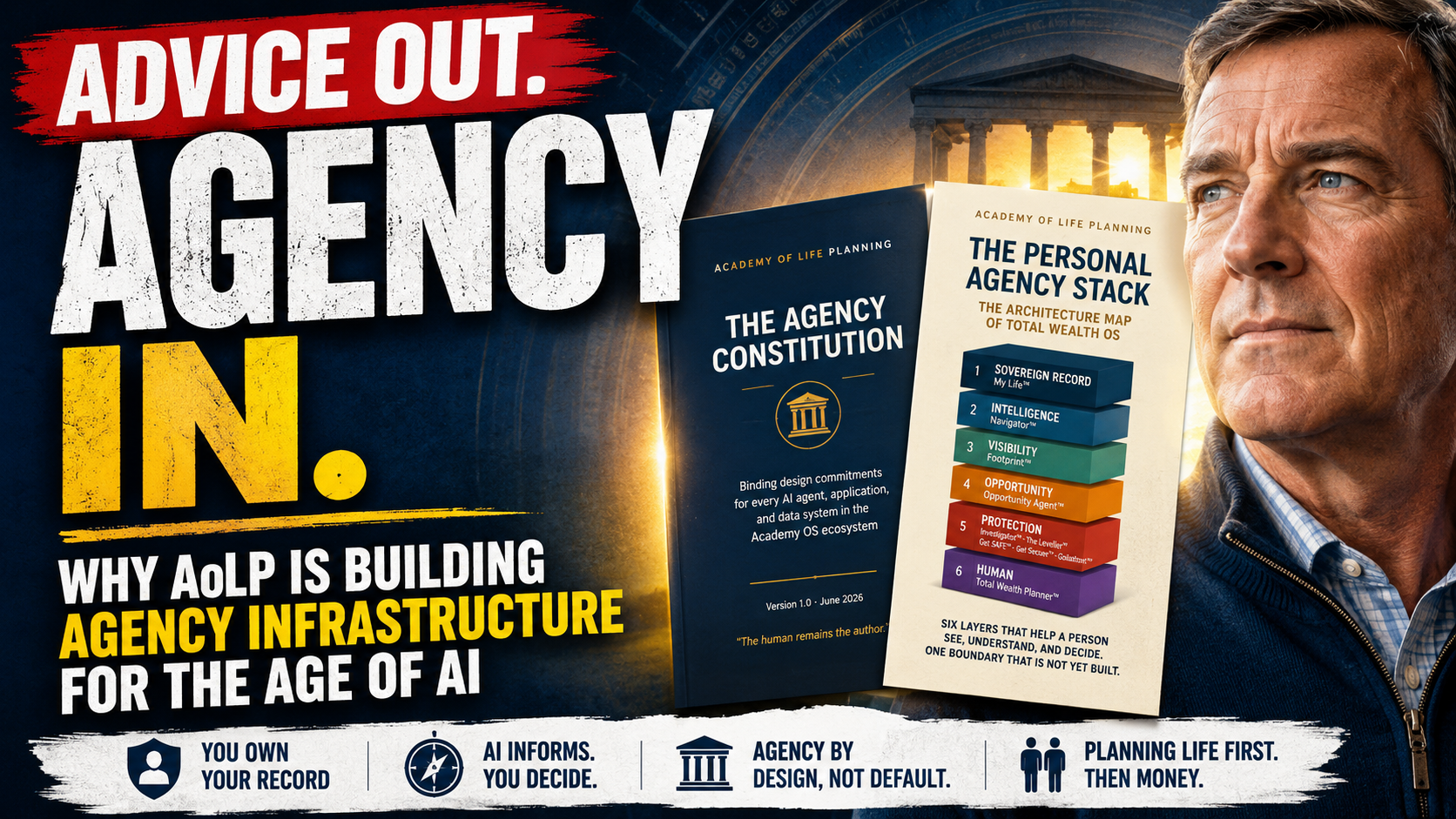
At first, we thought we were building a collection of tools.
My Life™ began as a sovereign personal record. Navigator™ emerged as a way of helping people make sense of complexity. Investigator™, The Leveller™, Get SAFE™, Get Secure™, and Goliathon™ each addressed a different challenge that people encounter when navigating financial systems, life transitions, or recovery from harm.
Viewed individually, they looked like separate applications.
Viewed together, a different picture began to emerge.
Each tool seemed to be answering a different question that people ask when they are trying to understand their lives, make decisions, protect themselves, or move forward. What initially appeared to be a growing portfolio of applications was gradually revealing itself as something more coherent: an architecture for human agency.
That realisation has led us to publish two foundational documents for the Academy ecosystem.
The first is the Agency Constitution. The second is the Personal Agency Stack.
Neither document was planned at the outset. Both emerged from the practical realities of building systems in an age when artificial intelligence is becoming increasingly capable and increasingly influential.
The challenge we found ourselves confronting was not technological.
It was constitutional.
Most discussions about AI focus on capability. They ask what systems can do, how accurate they are, how much work they can automate, or how efficiently they can process information.
Important as those questions are, they leave a deeper issue unresolved.
As AI becomes more capable, who remains the authority?
A system can be intelligent without making people more capable. It can remove effort without creating understanding. It can generate recommendations without strengthening judgement. In some circumstances, it can even create new forms of dependency while presenting itself as empowerment.
The Academy’s mission has always been to restore human agency. As our technology evolved, we realised that mission needed to be embedded in the architecture itself, not simply described in marketing language.
The Agency Constitution was our response.
Rather than beginning with features, it begins with boundaries. It establishes a series of design commitments that every application, AI agent, and data system within the ecosystem must satisfy. Among other things, it states that the human remains the author, that the record belongs to the person, that consent must be specific rather than implied, and that every interaction should build capability rather than reliance. The Constitution exists to ensure that the mission cannot be quietly undermined by convenience, commercial pressure, or technological enthusiasm.
Yet a constitution only tells us how a system should behave. It does not explain what the system is for.
That question led to the second document.
The Personal Agency Stack is an attempt to describe the architecture that had gradually emerged around My Life™. What became apparent was that the ecosystem was not organised around applications at all. It was organised around questions.
People begin by trying to understand themselves. They want clarity about their goals, assets, responsibilities, relationships, experiences, and aspirations. That is the role of the sovereign record.
From there, they seek understanding. They want help interpreting information, exploring options, understanding trade-offs, and recognising risks that might otherwise remain hidden. That is the role of the intelligence layer.
Sooner or later, they become curious about what the wider world already knows about them, what opportunities might exist beyond their current horizon, how to protect themselves from harm, and who they can turn to when complexity exceeds what they can comfortably manage alone.
Each layer addresses a different aspect of human agency. Together, they form a coherent system designed to help people see more clearly, understand more deeply, and make decisions under their own authority.
One of the most important discoveries within this process was recognising where the architecture stops.
Every layer in the stack exists to inform, illuminate, structure, interpret, surface, or support. None of them exists to act on behalf of the individual. Every output ultimately returns to the person for review. The system may analyse, research, organise, compare, draft, and propose, but the moment of decision remains human. The person remains the witness. The person remains the authority.
That distinction may become increasingly important as AI capabilities continue to accelerate.
The temptation throughout the technology sector is to move rapidly from intelligence to automation. We have deliberately chosen a different path. The architecture includes an explicit execution boundary, not because autonomous action is impossible, but because it raises a different category of question requiring a different category of governance. Until such a framework exists, the system stops at understanding and returns responsibility to the individual.
Perhaps the greatest surprise in all of this is that the architecture turned out not to be wealth-shaped.
Wealth remains the entry point. It remains the practical application through which many people first encounter the Academy. Yet the architecture itself extends far beyond financial optimisation. It encompasses identity, family, health, purpose, reputation, opportunity, protection, recovery, and human support. What emerged was not merely a wealth operating system, but the foundations of a sovereign agency operating system.
The Academy began with a simple observation: all planning begins with what is already present.
The Agency Constitution and the Personal Agency Stack are the next step in that journey.
One explains how the system must behave.
The other explains what the system is for.
Together they provide a foundation for building technology that serves people without replacing them, informs decisions without making them, and helps individuals remain the authors of their own lives in an age increasingly shaped by artificial intelligence.


Brilliant overview and action foundation
Mark Scorer, Tel: 020 8569 9276, Mob: 07973 626 036
MV Seacrest, The Hollows, off Kew Bridge Rd Brentford, TW8 0DZ