
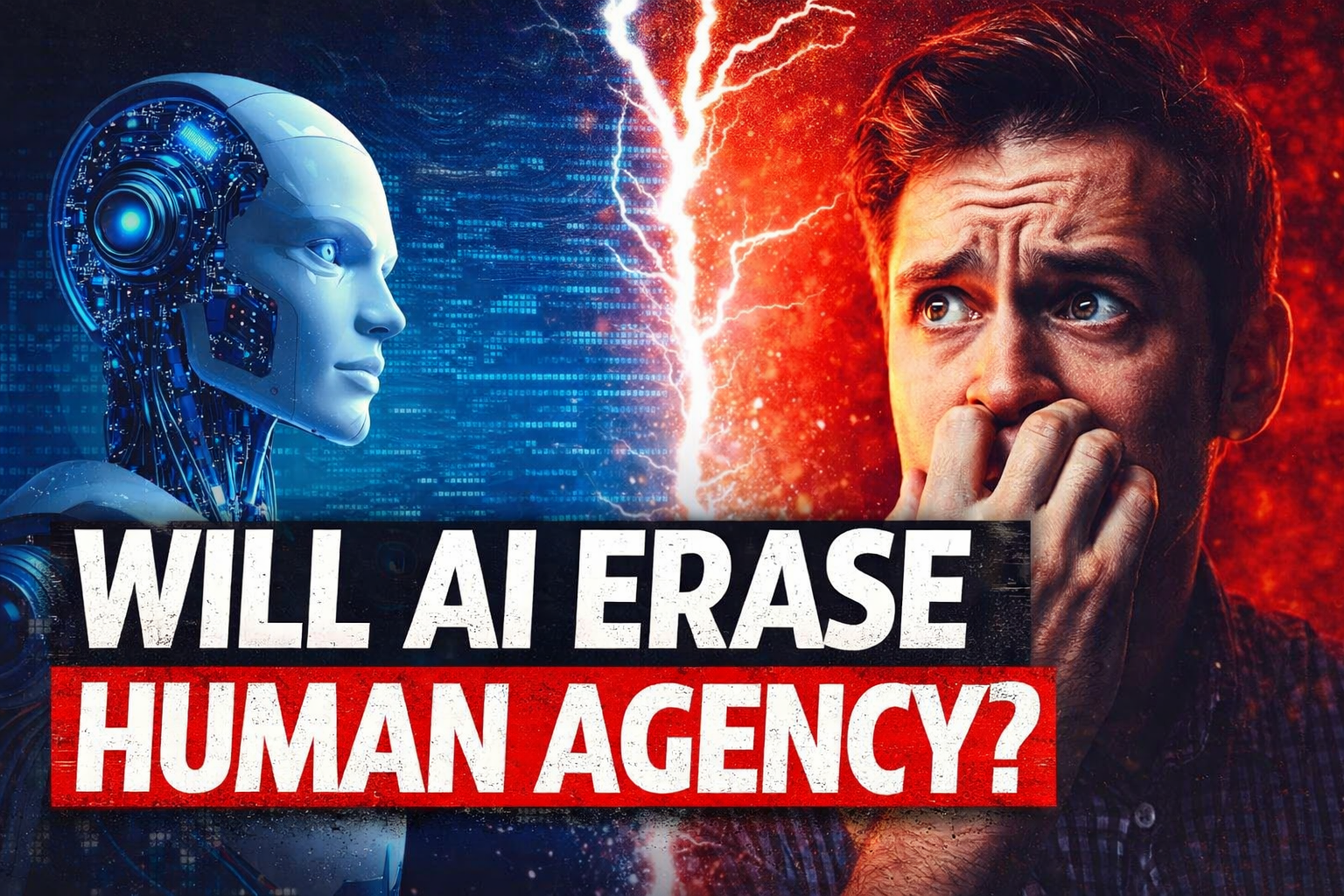
Why the future of financial planning will be defined not by AI capability… but by who retains control of the thinking.
We Are Solving the Wrong Problem
Most conversations about AI in financial planning are focused on one question:
How do we use AI to improve advice?
It sounds sensible.
But it’s the wrong question.
Because it assumes the core issue is efficiency.
It isn’t.
The real issue is agency.
And unless that is understood—and designed for—we risk building a system that delivers:
Faster answers.
With less thinking.
And greater confidence in being wrong.
A Fundamental Shift Is Underway
A recent academic study on Human–AI Agency in the Age of Generative AI makes something clear:
This is not just another wave of automation.
It is a qualitative shift in how humans think, decide, and create value.
[Source: Human-AI agency in the age of generative AI, Sebastian Krakowski.]
Generative AI is no longer:
- A tool for prediction
- A system for optimisation
It is now:
- A partner in idea generation
- A participant in decision-making
- A catalyst for new ways of thinking
And that changes everything.
From Advice to Agency
Traditional financial planning has always been built on asymmetry:
- The adviser knows
- The client follows
AI removes that asymmetry.
Not by eliminating expertise—but by redistributing thinking capability.
Clients can now:
- Model scenarios
- Explore strategies
- Generate options
At a level previously reserved for professionals.
Which means the role of the planner must evolve.
Not away from value.
But toward a different kind of value:
From providing answers → to designing thinking
The Hidden Risk No One Is Solving
The research highlights a critical danger.
Without intentional design, AI can reduce human agency through:
- Over-reliance
- Passive acceptance
- Loss of critical thinking
- “Hallucinated” confidence in incorrect outputs
In financial planning, this is not a minor issue.
Because decisions are:
- Long-term
- Often irreversible
- Emotionally significant
When agency is lost, the outcome is predictable:
Better tools.
Worse decisions.
Why This Problem Exists
The issue is not AI itself.
It is how humans interact with it.
Most people default to:
- Accepting fluent outputs as truth
- Skipping evaluation
- Outsourcing judgement
Because AI feels authoritative.
But fluency is not accuracy.
And speed is not wisdom.
The Missing Discipline: Human–AI Agency Design
What the research implies—but does not fully resolve—is this:
Human–AI agency must be designed.
Not assumed.
This is where Total Wealth Planning becomes critical.
Because it already provides a structured decision-making framework.
The AoLP Response: Designing for Agency
At the Academy of Life Planning, this becomes a practical discipline.
A way of working that ensures AI strengthens—not weakens—human judgement.
1. The Human Owns the Question
All planning begins with intent.
Not data.
Not tools.
Not outputs.
The individual defines:
- What matters
- What they are trying to achieve
- What a good life looks like
AI is then used to explore—not define—the problem.
2. AI Expands Possibility — Humans Make Meaning
Generative AI is exceptional at:
- Producing options
- Recombining ideas
- Expanding the search space
This aligns with its strength in divergent thinking.
But meaning—what matters, what fits, what is right—remains human.
The decision is not in the options.
It is in the interpretation.
3. Judgement Cannot Be Automated
The most important stage of planning is not generation.
It is evaluation.
Trade-offs.
Constraints.
Context.
This is where humans must remain fully engaged.
Because no model can:
- Live your life
- Carry your consequences
- Define your priorities
4. Friction Must Be Preserved
Modern systems aim to remove friction.
But friction is what protects thinking.
Without it:
- Decisions become reactive
- Outputs go unchallenged
- Errors compound quickly
In Total Wealth Planning, friction is intentional.
It shows up as:
- Reflection points
- Structured questions
- Deliberate pauses
These are not inefficiencies.
They are safeguards.
5. Ownership Must Be Explicit
A decision is only real when it can be explained.
If someone cannot articulate:
- Why they chose a path
- What they rejected
- What risks they accept
Then they have not decided.
They have followed.
And following is the opposite of agency.
A New Role Emerges
This changes the role of the financial planner fundamentally.
No longer:
- Product selector
- Information gatekeeper
- Recommendation engine
But something more valuable:
The Designer of Human–AI Agency
A Total Wealth Planner:
- Structures the thinking process
- Guides interaction with AI
- Protects against cognitive shortcuts
- Builds long-term decision capability
In simple terms:
You don’t provide answers.
You build better decision-makers.
The GAME Plan Was Built for This Moment
This is where your framework becomes strategically powerful.
The GAME Plan already aligns with human–AI agency:
- Goals → Human intention
- Actions → Directed behaviour
- Means → Resources (including AI)
- Execution → Real-world outcomes
AI fits naturally into the system.
But it never leads it.
Because:
The plan begins with meaning.
Not machinery.
The Commercial Reality
This is not just philosophy.
It is where the market is moving.
Because:
- Information is no longer scarce
- Tools are widely accessible
- Clients are increasingly capable
So value shifts.
From:
- Knowledge
- Access
- Recommendation
To:
Clarity, structure, and decision integrity
That is premium territory.
And it is defensible.
The Strategic Position of AoLP
The Academy of Life Planning is not competing on:
- Better advice
- Better tools
- Better products
It is leading on something more fundamental:
Restoring human agency in the age of AI
By developing:
The Total Wealth Planner
A professional who is:
- Human-first
- AI-enabled
- Agency-driven
A Final Reflection
The study concludes that the outcomes of AI will not be determined by the technology itself—
But by how humans choose to use it.
That is the real inflection point.
AI does not remove responsibility.
It amplifies it.
The Future of Financial Planning
The future will not be defined by:
- Who has the best models
- Who has the fastest tools
- Who automates the most
It will be defined by:
Who preserves the quality of thinking.
Because in the end:
Wealth is not created by information.
It is created by decisions.
And decisions require agency.
Curious how others are thinking about this—especially those already integrating AI into their planning process.
 Academy of Life Planning