
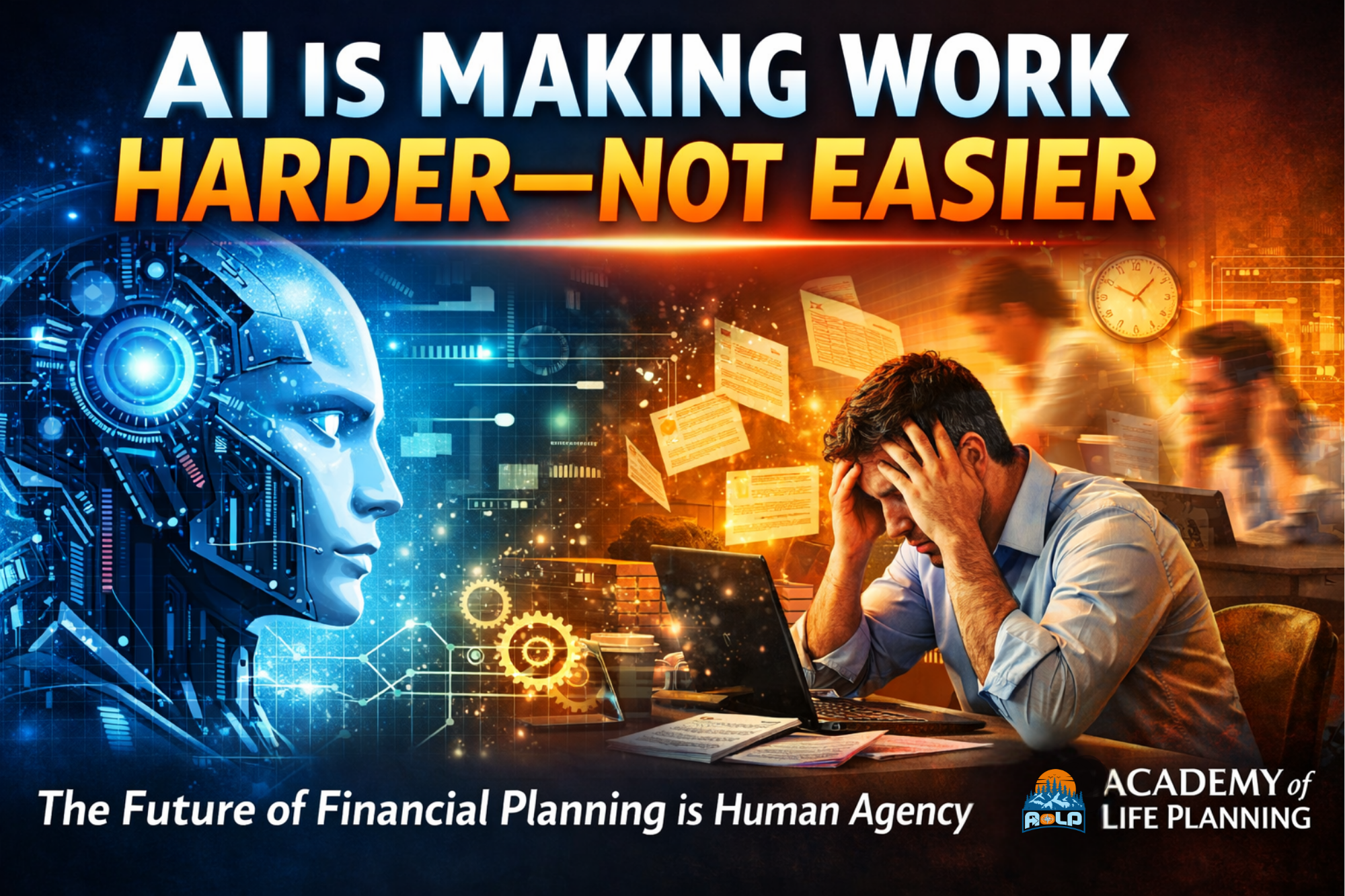
Why the Future of Financial Planning Is Human Agency
For years we have been told that artificial intelligence will make work easier.
AI will automate tasks.
AI will save time.
AI will free us to focus on higher-value work.
But new research from the Harvard Business Review suggests something very different is happening.
In an eight-month study of employees using generative AI tools, researchers found that AI did not reduce work at all.
It intensified it.
Workers began doing more tasks, taking on broader responsibilities, and working across more hours of the day — often voluntarily. What initially felt like productivity gains gradually turned into expanding workloads, increased multitasking, and blurred boundaries between work and rest.
The paradox is simple:
AI makes more possible.
And when more becomes possible, people do more.
The result is not less work.
It is more capability — and more pressure.
This emerging reality has important implications for the future of financial planning.
The Real Shift: Capability Is Expanding Faster Than Clarity
AI dramatically lowers the cost of knowledge.
Tasks that once required specialists can now be attempted by anyone with the right prompts. Research, analysis, writing, modelling, coding — all suddenly become accessible.
This creates what the study described as task expansion.
People step into work that previously belonged to others. They experiment, explore, and push their own boundaries.
But as capability expands, something else happens.
Work becomes continuous.
Because starting a task is now so easy — simply typing a prompt — work begins to slip into moments that were once breaks. Workers send “one last prompt” before leaving their desk. They experiment during meetings. They continue small tasks late into the evening.
The boundary between work and rest softens.
Over time, this creates a new pattern of work: more threads, more multitasking, more cognitive load.
Workers feel productive.
But they do not feel less busy.
In fact, many feel busier than before.
This reveals a deeper truth about the AI age:
The real scarcity is no longer knowledge.
It is clarity.
The Hidden Risk of AI: Productivity Inflation
When AI accelerates work, expectations quietly rise.
If tasks can be done faster, people begin to expect faster responses.
If individuals can attempt more things, organisations expect broader scope.
Without anyone explicitly asking for it, the pace of work increases.
The study describes a self-reinforcing cycle:
- AI accelerates tasks
- Faster tasks raise expectations
- Higher expectations increase reliance on AI
- Increased reliance expands the scope of work
Over time, what began as productivity becomes work intensification.
The risk is not simply longer hours.
It is cognitive fatigue and poorer decision making.
This is where the conversation about financial planning must evolve.
The Financial Planning Profession Is Facing the Same Shift
The financial advice profession has historically focused on one primary domain:
financial capital.
Portfolios
Pensions
Tax strategies
Investment allocation
These remain important.
But in the age of AI, the dominant asset in most people’s lives is becoming even more powerful:
human capital.
Human capital includes:
- skills
- knowledge
- experience
- creativity
- decision-making ability
- adaptability
AI dramatically amplifies human capital.
It allows individuals to:
- analyse complex information
- model scenarios
- build businesses
- explore new careers
- generate ideas
- design new systems
But this amplification creates a new challenge.
Without direction, expanded capability leads to overextension.
People can attempt more.
But they struggle to decide what they should attempt.
Agency Is Becoming the Most Valuable Skill
In the industrial age, knowledge was scarce.
Experts held the answers.
Clients relied on advisers because advisers possessed information that individuals could not access themselves.
But in the AI age, knowledge is abundant.
The challenge is no longer finding answers.
It is choosing which answers matter.
This is the domain of human agency.
Agency means:
- defining what matters most in life
- making conscious choices about time and energy
- deciding what to pursue and what to ignore
- aligning financial decisions with personal values and purpose
When capability expands, agency becomes essential.
Without agency, people simply respond to the accelerating pace around them.
With agency, they can direct that capability toward a meaningful life.
The Future Role of the Financial Planner
This shift fundamentally changes the role of financial planners.
Traditional advice models focus on products and implementation.
But in a world where AI empowers individuals to analyse investments, model scenarios, and research strategies themselves, the planner’s most valuable role becomes something different.
Not product distribution.
Not technical modelling.
But structured thinking.
Planners become partners in helping clients:
- clarify goals
- prioritise decisions
- structure resources
- pace execution
- protect well-being
In other words, planners help clients govern their expanded capability.
This is the essence of Total Wealth Planning.
A Framework for the AI Age
At the Academy of Life Planning, we teach a framework called the GAME Plan:
Goals → Actions → Means → Execution
It is a simple but powerful cycle.
Goals define direction.
Actions translate intention into movement.
Means organise the resources needed to succeed.
Execution turns plans into reality.
In an AI-accelerated world, this cycle becomes more important than ever.
Because when everything becomes possible, the most valuable skill is knowing where to focus.
The GAME Plan provides a structure for that focus.
It helps individuals pause, reflect, and align their financial architecture with the life they truly want to build.
The Opportunity for Financial Planners
The rise of AI will not eliminate the need for planners.
But it will change the nature of the profession.
The planners who thrive will not simply manage portfolios.
They will help clients navigate a world of expanding possibility.
They will help people:
- align their finances with their lives
- manage the growth of their human capital
- maintain balance in a faster world
- convert capability into meaningful outcomes
In other words, they will help clients exercise agency.
A New Era for Financial Planning
Artificial intelligence is not just a technological shift.
It is a human one.
It expands what individuals can do.
But expansion without direction leads to overload.
The future of financial planning lies in helping people turn expanded capability into intentional living.
That is the mission of the Academy of Life Planning.
And it is why, in the age of AI, the most valuable asset people possess is not their portfolio.
It is their human capital — guided by clear agency.
Find out more, visit the Academy of Life Planning.
 Academy of Life Planning
Q&A: AI, Overwhelm, and the Role of the Total Wealth Planner
Q:
Hi Steve,
This is very interesting. It resonates with my own experience—particularly the idea of a 10x productivity gain and the need for my brain to operate at that speed, which can sometimes feel overwhelming.
It suggests that simply “throwing AI at the problem” without the right level of human support could lead people to abandon what they start. It reminds me of what we used to call “information overload.”
I can see how this strengthens the role of the Total Wealth Planner, but it also means we need the right skills to support clients through the process.
From my perspective, this reinforces a practitioner-supported, AI-driven Total Wealth Planning model. Clients may initially think they can do it alone, but I’m not convinced many will complete the journey without support.
I’d be interested to hear how far others have got with the AI GAME Plan—and how many actually complete it.
Graham
A:
Graham, this is exactly the right observation—but there’s a subtle shift worth making.
Let me take you back to before AI.
When I first asked you to complete your Total Wealth Plan, what was your reaction?
If I hadn’t prompted you, there’s a good chance you wouldn’t have done it at all.
Now fast forward to after you completed it.
Notice something important:
The challenge wasn’t complexity.
The challenge was resistance.
AI hasn’t created that resistance—it has exposed it.
What AI does is remove friction from doing the work.
But it doesn’t remove the human barriers to starting the work:
Once someone starts, the process is:
So the role of the Total Wealth Planner becomes clearer—not diminished, but elevated.
Not as:
👉 the provider of answers
But as:
👉 the catalyst for action
👉 the guide through resistance
👉 the keeper of momentum
AI can accelerate thinking.
But it doesn’t initiate commitment.
That’s where we come in.
And this is the commercial insight:
Clients may believe they can do it alone.
But the real value is not in access to the tool.
It’s in:
That’s the gap Total Wealth Planners fill.
So you’re right—completion rates matter.
But the deeper truth is this:
The future of planning isn’t about who has the best tools.
It’s about who can help people use them.