
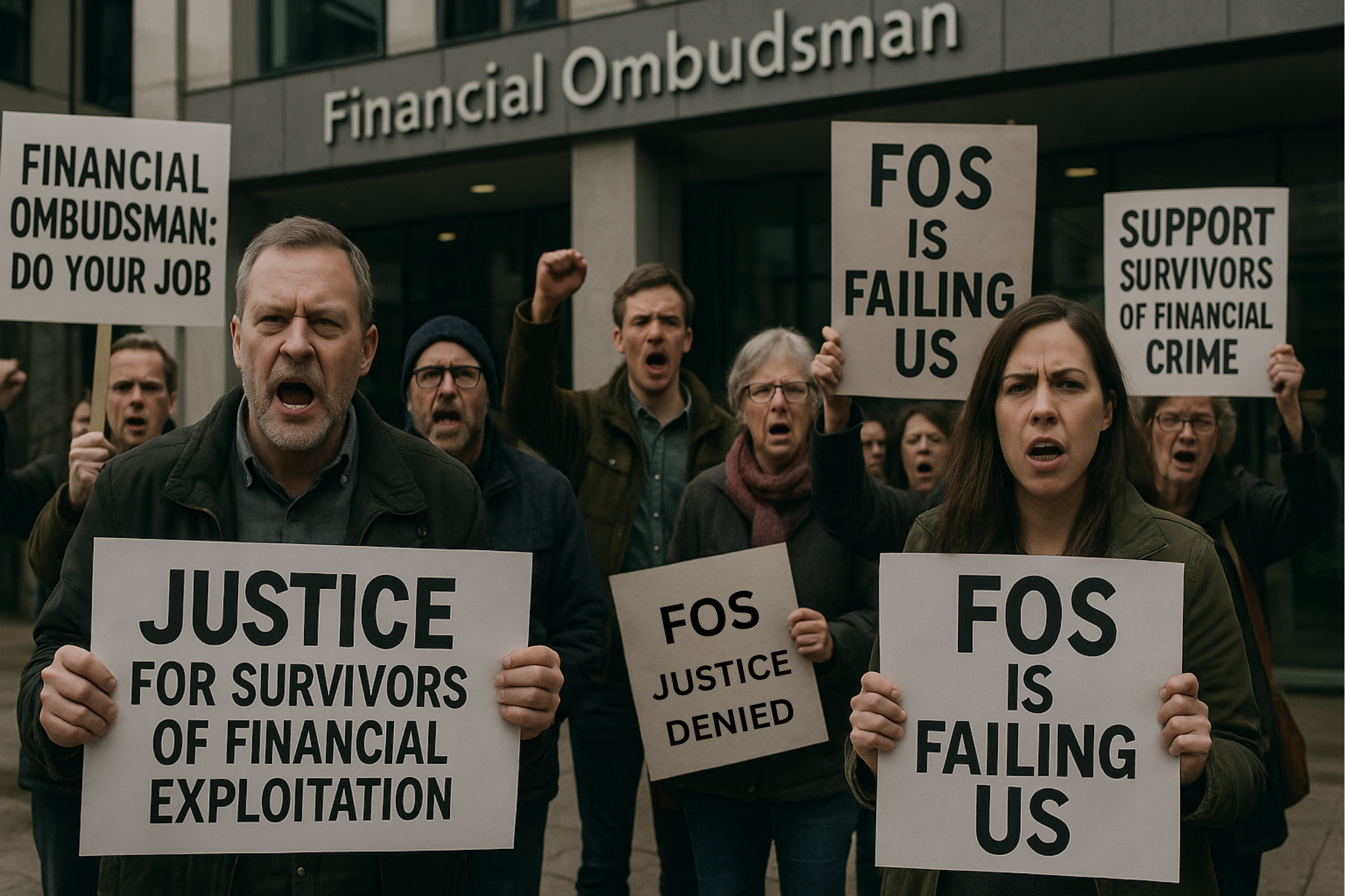
“Justice too long delayed is justice denied.” – Martin Luther King Jr.
The Financial Ombudsman Service (FOS) was meant to be a safety net—a free, fair, and accessible route for ordinary people to seek redress when the financial system fails them. But for thousands of victims of financial exploitation, that promise rings hollow.
At the Academy of Life Planning and through our Get SAFE initiative, we’ve worked alongside survivors of serious financial harm: individuals misled by trusted professionals, defrauded through complex pension schemes, or manipulated into financial ruin by bad actors hiding behind glossy brochures and regulatory logos. These people come to the FOS seeking accountability. What they often find instead is silence, deflection, and dismissal.
FOS: A Service in Name, Not in Spirit
The reality is this: the FOS has become a failing gatekeeper rather than a champion of consumer justice. Its processes are opaque, its decisions inconsistent, and its outcomes—at best—underwhelming.
Here’s what we consistently see:
- Systemic misconduct reduced to isolated incidents.
Even in the face of widespread evidence—such as forged documents, conflicted advice models, or regulatory arbitrage—the FOS treats cases in a vacuum. This suits the system. It avoids the domino effect of recognising that if one complaint is upheld as systemic, many more may follow. - A labyrinthine process that exhausts the vulnerable.
Survivors are often retraumatised by the very system meant to help them. FOS language is technical, timelines are tight, and evidentiary burdens fall on individuals who may have lost everything—including their ability to trust institutions. - Redress that doesn’t redress.
In cases involving six-figure losses, FOS may offer £300 for “distress and inconvenience.” Rarely does it deliver full restitution. Often, the true cost—psychological, reputational, or intergenerational—is never acknowledged. - No learning, no change.
The FOS doesn’t issue warnings, public interest recommendations, or systemic alerts. So harmful practices repeat, emboldened by the absence of public consequences.
Case in Point: The Survivors Left Behind
Take Artur’s case. He presented crystal clear evidence of forged RSA complaint records. FOS upheld the firm’s version. Why? Because the process protects institutions, not truth.
Or Gary’s case. A lifetime of savings—£542,000—lost to a Castle Trust mis-selling scandal. The FOS? Slow, dismissive, procedural. No holistic view. No urgency.
Or the thousands defrauded through QROPS pension transfers, where UK firms initiated and processed the harm. The FOS has barely scratched the surface—citing “complexity” or “offshore jurisdiction” as excuses.
All of these examples share one trait: the victims had done everything right. But the system wasn’t designed to serve them.
A Culture of Containment, Not Courage
What we’re witnessing is institutional gaslighting—where survivors are made to doubt their experience, their evidence, even their emotional reactions. FOS outcomes often say, in effect: Nothing happened. You’re overreacting.
This is more than administrative failure. It’s a breach of the social contract. When justice becomes a public relations exercise, the institutions meant to serve us instead serve the system.
Towards a New Justice Infrastructure
This is why we created Get SAFE (Support After Financial Exploitation)—a grassroots, free-to-need, citizen-led initiative that equips survivors with the tools, templates, and tenacity to seek redress outside broken systems. Through our Citizen Investigator’s Playbook, AI-assisted advocacy, and peer support, we help people reclaim power and dignity.
And we’re not alone. Across the UK, survivors are rising—armed with truth, supported by community, and no longer willing to wait politely.
Reclaiming the Future
The FOS may have been built with good intentions, but its structure now serves something else entirely. It’s time we acknowledged that the real perimeter of justice lies beyond regulation—in the hands of citizens willing to shine a light, ask hard questions, and never back down.
We don’t need another placatory leaflet. We need a reckoning.
Join us. Get SAFE. Get heard. Reclaim what’s yours.
Addendum: In Response to FT Adviser’s Call for a “Long-Stop”
This week, FT Adviser called for urgent reform to the Financial Ombudsman Service’s (FOS) complaints procedure—focusing heavily on the burden placed upon financial advisers, including emotionally distressing cases of widows, hospitalised IFAs, and mortgage professionals targeted years after giving advice.
While I agree with Simoney Kyriakou that the system is broken, I respectfully offer a broader—and perhaps less institutionally comfortable—view.
The FOS is failing. But it is not just failing advisers. It is failing everyone.
It is failing the consumer defrauded in good faith.
It is failing the elderly person misled into a toxic pension transfer.
It is failing the whistleblower whose evidence was dismissed.
And yes, it is failing the conscientious adviser who is collateral damage in a poorly governed complaints process.
Calls for a 15-year “long-stop”—a time-bar that prevents consumers from raising historical complaints—sound reasonable only if we assume all claims outside this window are spurious or dishonest. But that assumption collapses under scrutiny.
In financial exploitation, harm often emerges slowly, years after the fact. Victims may be unaware, misinformed, traumatised, or manipulated into silence. In many QROPS pension fraud cases, for example, the full scale of the damage isn’t clear until long after the transaction—by which point, firms may have vanished and records gone “missing.”
A blanket long-stop risks locking out the very people FOS was created to serve. If we care about justice, we must not let legitimate claims be silenced just to protect institutional convenience.
A Better Solution
Let’s fix the complaints process, but not by pitting advisers against consumers. Instead:
- Introduce a triage system that filters vexatious or CMC-led boilerplate claims early—without punishing genuine victims.
- Provide proper funding and training so the FOS can handle complex cases with forensic competence, not form-letter replies.
- Require firms to maintain minimum retention of records if they are to remain liable—and provide transparency to consumers.
- Create an independent review process for both parties to appeal FOS findings without the prohibitive cost of judicial review.
- Most importantly, distinguish between malice and malpractice—and design a system that can tell the difference.
Protect the Advisers. But Don’t Abandon the Public.
Let’s not turn FOS reform into a protectionist retreat. Let’s make it a genuine modernisation—one that serves truth, justice, and both sides of the complaint process.
The answer to poor complaints handling is not fewer complaints being heard. It’s better handling.
—
📣 We stand for survivors, truth-seekers, and ethical advisers alike. Join us at Get SAFE and help us build a fairer, more transparent financial justice system.
About Get SAFE
Get SAFE (Support After Financial Exploitation) was born from a simple truth: too many victims of financial abuse are left to suffer in silence.
We exist in memory of Ian Davis—for the ones who did everything right, only to be failed by the systems they trusted. We know that behind every vanished pension, every ignored complaint, and every stonewalled letter is a person—frightened, exhausted, and too often alone.
Get SAFE offers more than sympathy. We offer structure, support, and solidarity.
We provide a voice where there’s been silence, and clarity where there’s been confusion.
We stand beside those who have been exploited, not just to help them recover—but to help them reclaim their story and rebuild their future.
Because financial justice is not a luxury.
It’s a human right.
If you or someone you know has been affected by financial exploitation, we are here.
You are not alone.

