
When people are harmed by powerful institutions, the first battle is rarely fought in court.
It is fought in confusion.
A survivor may have years of emails, letters, bank statements, screenshots, court papers, call notes and regulatory correspondence. Somewhere in that material may be the truth of what happened. But truth alone is not enough. It has to be organised. It has to be understood. It has to be presented in a way that someone else can follow.
That is the David and Goliath struggle faced by many people after financial exploitation, institutional negligence or systemic failure.
The institution usually has the lawyers, the systems, the language, the records, the process knowledge and the confidence. The individual often has trauma, confusion, scattered evidence and a deep sense that something is wrong — but no clear way to show it.
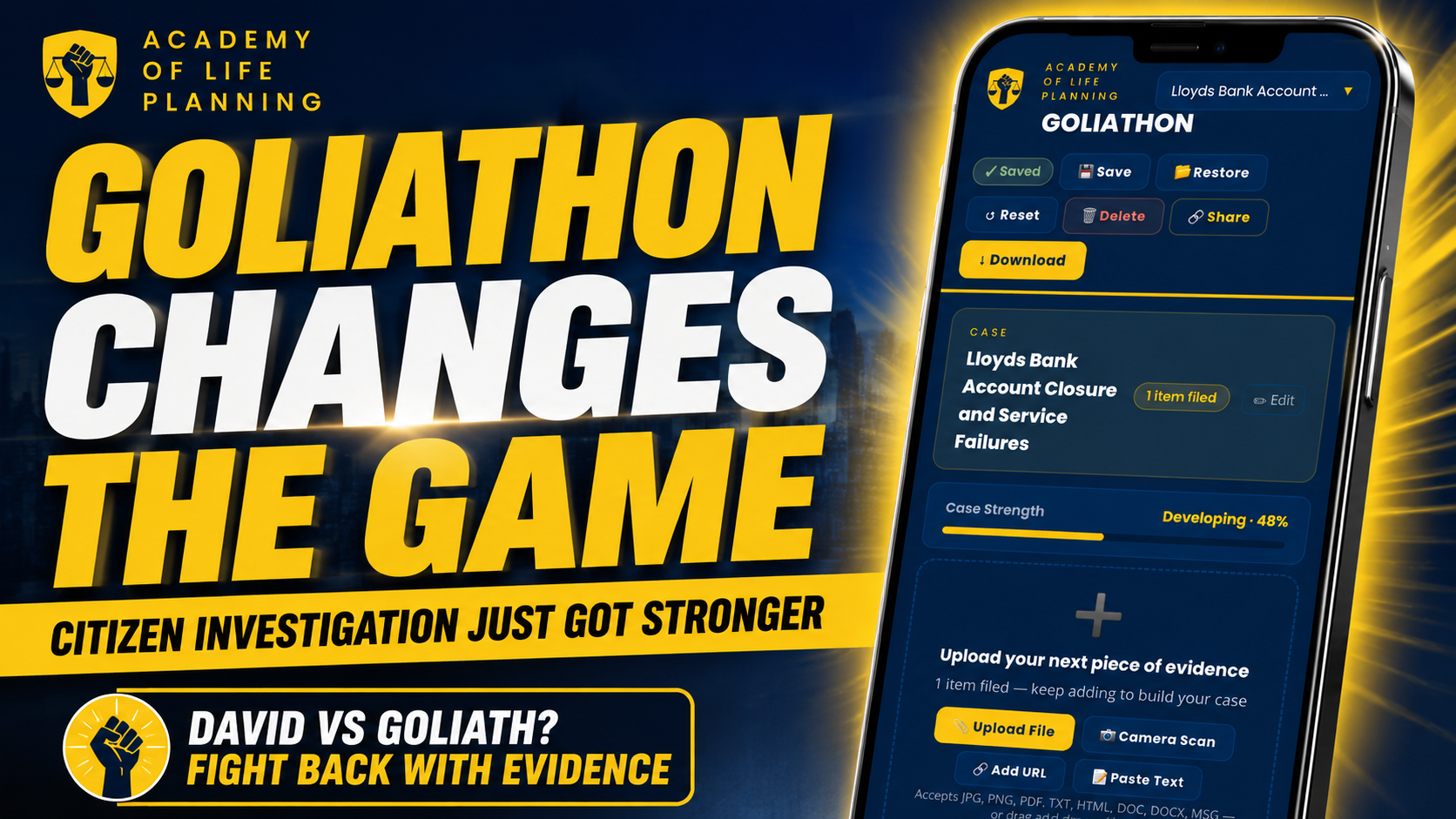
Goliathon was created to change that.
It is a free Get SAFE tool that helps people turn scattered documents into a structured evidence dossier. But the latest release takes Goliathon far beyond document organisation.
It now helps citizen investigators understand what their evidence shows, what it may mean, what questions remain unanswered, and how to present the case to someone with the power to act.
That changes the game completely.
Where Goliathon Started
Goliathon was already doing something valuable.
It could take years of scattered material — emails, letters, screenshots, bank statements, court papers and other records — and turn them into a structured, chronological evidence library.
From that, it could help produce:
a clear timeline
a witness statement
a structured evidence record
a set of possible next steps
That was useful because many survivors arrive at the door of a solicitor, ombudsman, regulator or court with either too little organised evidence, or far too much unstructured material.
Both situations create the same problem.
The person is hard to help.
Not because their case lacks merit. Not because they are unreliable. Not because they are exaggerating. But because the signal is buried inside the noise.
The first version of Goliathon helped reduce that noise.
But it was still largely an organiser. It processed evidence and described it. It did not yet fully help the survivor understand what their evidence actually meant, or prepare them to have a more productive conversation with a solicitor, ombudsman, regulator or judge.
That is what has now changed.
1. Fact and Inference Are Now Clearly Separated
Every piece of evidence in Goliathon now contains two clearly labelled sections.
WHAT THIS SHOWS records only what the document directly states. Names. Dates. Figures. Positions. Events. Statements made by parties. No interpretation. No spin. Just what is actually there.
WHY IT MATTERS explains what the evidence might mean in the wider context of the case. This is explicitly presented as analysis, not fact.
This distinction matters enormously.
Every professional who reads a case file instinctively separates what is proven from what is argued. A solicitor will do this. A judge will do this. An ombudsman caseworker will do this. A regulator will do this.
The problem is that most harmed individuals are never taught to make that distinction for themselves.
Understandably, they often tell the whole story at once: what happened, what they believe it means, how it affected them, why they feel betrayed, and what they think the institution did wrong.
That human story matters. But in a decision-making environment, the evidence has to be separated from the argument.
Until now, Goliathon risked mixing those layers together.
Now it teaches the survivor how to think about their own case before anyone else gets involved.
That is not just a formatting improvement. It is a shift in capability.
The survivor is no longer simply gathering evidence. They are learning how evidence works.
2. Goliathon Now Generates the Key Questions in the Case
The second major change is the introduction of Key Questions in This Case.
After each piece of evidence is added, Goliathon now generates and updates a plain-language list of the questions the case still needs to answer.
These are not legal arguments. They are not allegations. They are not dramatic claims.
They are the honest, specific questions that remain unresolved.
That matters because people who have been harmed are often forced to tell their story repeatedly. They explain what happened to one person, then another, then another. Each time, the emotional burden is heavy. Each time, the risk of being misunderstood increases.
Goliathon moves the survivor away from repeating the whole story and towards identifying the questions that still need answers.
That is a very different starting point.
Instead of arriving with a folder of documents and a feeling of injustice, a survivor can now walk into a solicitor’s office, hand over a structured dossier, and say:
“These are the five questions the other side still has not answered.”
That is powerful.
It does not turn the survivor into a lawyer. It does not replace legal advice. It does not decide the case.
But it does help the survivor become clearer, calmer and better prepared.
That is what restored agency looks like in practice.
3. The Decision-Maker Summary
The most significant addition is the new Decision-Maker Summary.
Every complete Goliathon dossier now contains a one-page summary written for a judge, ombudsman, regulator, solicitor or other professional reading the case for the first time.
It has a simple structure:
What this case is about
Two plain sentences that explain the essence of the matter.
The core dispute
The unanswered questions the institution has not yet addressed.
The strongest evidence filed so far
The most important documents or records currently in the dossier.
The single most important next action
The next practical step that appears most relevant from the evidence reviewed.
This is where Goliathon becomes more than an evidence organiser.
It becomes a roadmap.
That matters because decision-makers are busy. A judge may have limited time to read a bundle before a hearing. An ombudsman caseworker may be carrying a heavy caseload. A solicitor seeing a new client may have one hour to understand years of distress, paperwork and institutional behaviour.
The Decision-Maker Summary is written for those realities.
It gives the reader the essential frame of the case in the time it takes to read a single page.
This is not about manipulating the reader. It is about respecting their constraints.
A confused bundle creates friction. A structured roadmap creates access.
When the case is easier to understand, it becomes harder to dismiss.
Why This Changes Citizen Investigation
Citizen investigation is often misunderstood.
It is not about conspiracy thinking. It is not about making accusations without evidence. It is not about turning harmed people into amateur lawyers.
At its best, citizen investigation is disciplined truth recovery.
It is the process of helping ordinary people gather, organise, test and present the evidence of what happened to them when powerful institutions have failed, denied, delayed or obscured accountability.
That work requires more than passion.
It requires structure.
This is where Goliathon now changes the game.
It helps survivors move through four stages:
First, from scattered documents to an organised evidence library.
Second, from emotional narrative to a clear timeline.
Third, from confusion to key unanswered questions.
Fourth, from overwhelming bundle to decision-maker summary.
That is a profound shift.
The survivor moves from “Please believe me” to “Here is what the evidence shows, here is what it may mean, and here are the questions that still need answering.”
That is not aggression.
That is agency.
Everything Else Included in the Latest Release
Alongside the three major structural changes, the latest release also includes several practical improvements.
There is now a Paste Text entry method. This means a dated file note, personal account, phone note or written record can be entered directly without needing a file upload. It can then be treated as part of the evidence library.
There is duplicate file detection. Goliathon now recognises when the same document has already been uploaded and warns the user. This helps prevent inflated evidence libraries, repeated records and inconsistent summaries.
MSG file support has been fixed, so Outlook email files now process correctly. This matters because legal exports and institutional correspondence often contain large numbers of MSG files.
The dossier output also now uses clean numbered lists throughout, removing the double-numbering artefacts that could previously make the output look machine-generated.
These may sound like small technical changes, but they matter.
A dossier has to look credible. It has to be easy to follow. It has to avoid unnecessary duplication. It has to work with the messy formats real people actually have.
Good evidence work is not glamorous. It is disciplined, practical and clear.
Turning Survivors into Strategists
People harmed by institutions often arrive in one of two states.
Some have almost nothing organised. They know something went wrong, but they cannot show it clearly.
Others have everything. Every email. Every letter. Every screenshot. Every bank statement. Every call note. But the material is so overwhelming that the pattern is hard to see.
Goliathon addresses both problems.
It organises the evidence.
Now, with this latest release, it also helps the survivor understand what the evidence shows, what it may mean, what questions it raises, and how to present the matter to someone with the power to act.
That is the real breakthrough.
Because the David and Goliath struggle is not only about size. It is about asymmetry.
The institution has systems. The individual has fragments.
The institution has professional language. The individual has lived experience.
The institution has process knowledge. The individual has distress.
Goliathon helps narrow that gap.
It does not give legal advice. It does not promise outcomes. It does not replace professional support. But it does help people become more organised, more informed and more capable of participating in their own case.
That is what Get SAFE exists to do.
Not to take over.
Not to escalate recklessly.
Not to turn every case into a campaign.
But to help people stabilise, structure what has happened, surface their options, and recover the agency that institutional harm so often removes.
A New Standard for Citizen Evidence Dossiers
The latest release of Goliathon points towards a new standard for citizen investigation.
A good dossier should not simply contain documents.
It should show what each document proves.
It should separate fact from inference.
It should identify the questions that remain unresolved.
It should help a professional understand the case quickly.
It should reduce the emotional and cognitive burden on the survivor.
It should support better conversations with solicitors, ombudsmen, regulators and courts.
And above all, it should help the harmed person move from overwhelm to clarity.
That is why this release matters.
Goliathon began as a way to organise evidence.
It is now becoming a way to restore agency in the face of institutional power.
For many people facing their own Goliath, that could make all the difference.
Goliathon is a free evidence dossier tool created by Steve Conley and Get SAFE (Support After Financial Exploitation).
It helps people organise evidence, separate facts from assumptions, identify unresolved questions, and present complex cases in a way that is easier for decision-makers to understand.
Goliathon is designed to support clarity, structure, and restored agency. It does not provide legal advice, financial advice, or mental health advice, and it does not determine the outcome of any case.
If you have ever felt overwhelmed by years of documents, correspondence, and unanswered questions, Goliathon was built for you.
Learn more and start building your evidence dossier at:

