
For much of the past half century, financial planning technology has been built on a relatively narrow assumption: that the individual sitting in front of the system is fundamentally stable. Stable income, stable employment, stable identity, stable direction. The task of the software, therefore, has largely been to optimise financial efficiency around an already functioning life.
Yet increasingly, this assumption no longer reflects reality.
Many people are not approaching planning from a position of stability, but from a position of transition, disruption, exhaustion, or uncertainty. Some are recovering from business failure or redundancy. Others are navigating divorce, burnout, illness, caregiving pressures, financial exploitation, or the slow psychological erosion that comes from living inside systems that feel ever more complex and impersonal. Even those who appear outwardly successful often describe a quieter disorientation: a sense that they are functioning financially while lacking strategic clarity about the wider direction of their lives.
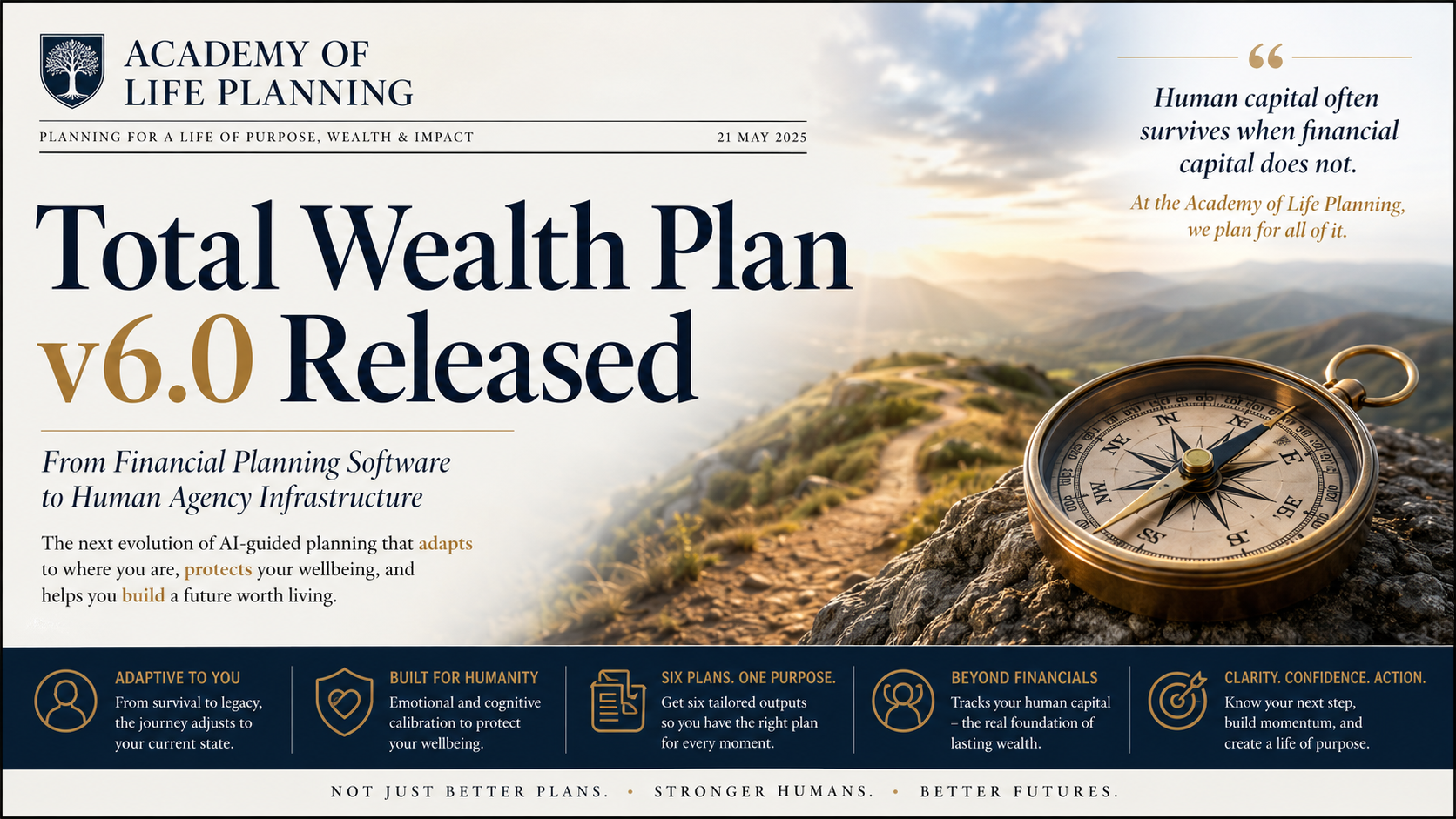
It is against this backdrop that the Academy of Life Planning is releasing Total Wealth Plan v6.0.
While it would be easy to describe TWP v6.0 simply as an AI-guided planning framework, that description now feels incomplete. What is emerging is something closer to a human-centred decision infrastructure: a system designed not merely to model money, but to help individuals regain clarity, coherence, and agency under conditions of uncertainty.
This distinction matters because the limitations of traditional planning are becoming increasingly visible. Much of the financial planning profession still operates within frameworks developed during an era when expertise was scarce, information moved slowly, and consumers were structurally dependent on intermediaries to interpret complexity on their behalf. Today, however, artificial intelligence is rapidly democratising access to sophisticated analytical capability. The central challenge is no longer simply access to information. It is the human capacity to navigate information wisely, emotionally, and coherently.
TWP v6.0 attempts to respond to that challenge directly.
Rather than beginning with balance sheets or investment allocations, the system starts with a more fundamental question: what state is the individual actually operating from? The framework identifies whether a person is currently in survival, stabilisation, recovery, rebuild, growth, expansion, or legacy mode, and adapts the planning process accordingly.
This may appear deceptively simple, but it represents a profound departure from conventional planning logic. Someone struggling to pay rent next week does not need a fifty-year retirement projection. Equally, someone entering a period of expansion and financial freedom may require far deeper strategic modelling than a simple budgeting framework can provide. The system therefore adjusts not only the financial horizon, but also the pacing, emotional depth, cognitive complexity, and practical outputs of the planning journey itself.
This adaptive architecture may ultimately become one of the most important aspects of the platform.
In recent years, discussions around artificial intelligence have focused heavily on productivity, automation, and efficiency. Yet the more difficult and arguably more important question concerns human capability: how individuals maintain clarity, judgement, and agency inside increasingly automated systems. TWP v6.0 sits squarely within this emerging space. It is less concerned with replacing human judgement than with strengthening it.
One of the clearest examples of this philosophy is the system’s emphasis on what the Academy calls “human capital continuity.” Traditional financial planning tends to measure wealth primarily through accumulated financial assets. TWP broadens the frame considerably. It explicitly tracks skills, relationships, resilience, reputation, health, routines, emotional capacity, community, and meaning alongside financial capital.
The underlying premise is both simple and psychologically important: when financial capital collapses, human capital often survives.
For an individual emerging from redundancy, insolvency, divorce, or professional crisis, this distinction can be transformative. A failed business may erase savings, but it does not necessarily erase competence, adaptability, networks, or accumulated experience. By making these forms of capital visible again, the system attempts to counter the psychological tendency to interpret financial loss as total personal collapse.
This broader conception of wealth also explains why TWP increasingly resembles neither traditional financial planning software nor conventional life coaching. It occupies an unusual space between strategic planning, behavioural insight, scenario modelling, reflective practice, and practical execution. Importantly, however, it stops short of becoming prescriptive. The platform does not claim certainty about the future, recommend specific products, or seek to replace regulated professional advice. Instead, it aims to help individuals think more clearly before engaging with implementation decisions.
The release of v6.0 also reflects a growing recognition that planning itself must become more cognitively humane. One of the more striking features of the system is its effort to regulate emotional and cognitive load throughout the process. If the platform detects signs of overwhelm, distress, or exhaustion, it simplifies the interaction, reduces intensity, and prioritises stabilisation over further analysis.
This is a subtle but important design choice. Much digital infrastructure today is built to maximise engagement, urgency, or behavioural extraction. TWP moves in the opposite direction. Its operating assumption is that overwhelmed humans make poorer decisions, and that good planning should increase a person’s capacity to act rather than intensify dependency or emotional flooding.
The same philosophy appears in the output structure itself. Rather than generating a single dense report, TWP produces multiple versions of the plan simultaneously: a short-form snapshot, an executive summary, a weekly action dashboard, a deep narrative reflection, a professional collaboration brief, and a family-friendly version. The implication is clear: different forms of understanding are needed at different moments. Sometimes a person requires strategic depth; at other times they simply need one practical next step.
Viewed in this light, TWP v6.0 may represent the early stages of a wider transition in the planning profession itself. As AI increasingly commoditises technical analysis, the future value of planning may lie less in information asymmetry and more in helping people maintain coherent self-direction amid uncertainty, complexity, and rapid change.
That is ultimately the deeper ambition behind the Academy of Life Planning’s work.
Not merely better portfolios.
Not merely improved optimisation.
But stronger humans, capable of navigating structurally uncertain systems without surrendering their agency in the process.
TWP v6.0 is not the finished form of that vision. The framework will undoubtedly evolve further as questions of emotional calibration, cognitive pacing, behavioural design, and ethical safeguards mature. But the release marks an important milestone in a larger shift already underway: from financial planning as product-centred optimisation toward planning as human agency infrastructure.
In the years ahead, that distinction may become increasingly significant.
For those curious to explore it themselves, Total Wealth Plan v6.0 is available to try now using Claude by Anthropic. You do not need traditional financial planning software, and you do not need to commit to an expensive advice process before beginning your thinking. The system is designed to help you understand where you are, clarify what matters, and identify practical next steps from your current position — whether you are rebuilding after disruption or planning from a position of growth. All that is required is honesty, a willingness to reflect, and access to Claude. The framework adapts to where you are, not where you think you should be.
Dowload the prompt instructions today.
No bank details are required, as no payment is required. It is absolutely free!

