
By Steve Conley | Academy of Life Planning
There are moments in financial services where a regulatory shift appears incremental on the surface, yet signals something far more profound beneath.
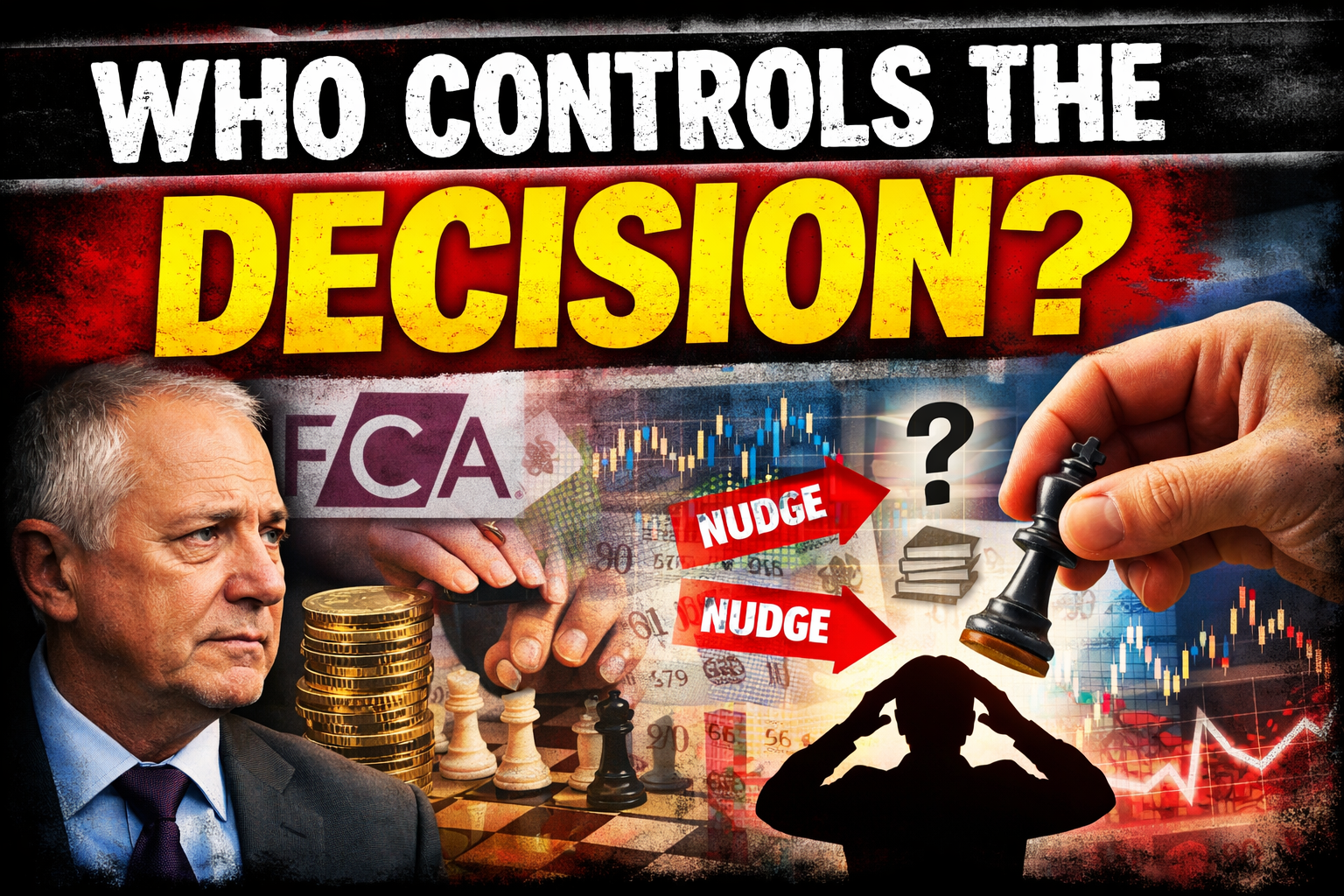
The FCA’s introduction of Targeted Support is one of those moments.
With firms such as Quilter and Royal London already moving at pace, the industry narrative is clear: millions more consumers will now receive guidance, nudges, and structured suggestions—particularly those who have historically sat outside the reach of full financial advice.
It is being positioned as progress.
In some respects, it is.
But it also raises a deeper question—one that goes to the heart of how financial decisions are made, who holds responsibility, and where true agency sits.
The Promise: Closing the Advice Gap
The stated intention behind Targeted Support is both logical and compelling.
For years, the industry has wrestled with the so-called “advice gap”—a large and growing population of individuals who:
- Do not meet the economic thresholds for full advice
- Feel overwhelmed by financial decisions
- Default to inaction, often to their long-term detriment
Targeted Support aims to address this by allowing firms to:
- Segment consumers into groups with “common characteristics”
- Provide tailored suggestions based on those group profiles
- Encourage engagement through timely prompts and nudges
In principle, this offers a scalable way to help people move forward.
In practice, however, it represents a fundamental shift in how influence is delivered.
The Reality: From Advice to Industrialised Guidance
Traditional financial advice—at least in its regulated form—operates on a clear premise:
The adviser is accountable for recommendations made to an individual.
Targeted Support changes that premise.
It replaces individualised accountability with group-based inference.
Instead of:
- “This is suitable for you”
We now have:
- “People like you may benefit from this”
This distinction is not semantic. It is structural.
It allows firms to operate at scale, but it also introduces a new model:
Industrialised financial guidance
Guidance that is:
- System-generated
- Behaviourally optimised
- Delivered without the same degree of individual responsibility
The Emerging Tension: Influence Without Accountability
At the centre of this model sits a quiet but significant asymmetry.
Consumers are influenced.
Decisions are made.
Outcomes follow.
But the framework explicitly avoids crossing the threshold into “advice.”
This creates a gap:
- Real-world impact remains high
- Formal accountability is reduced
In effect, we are entering a world where:
Influence scales faster than responsibility.
This is not a criticism of any single firm. It is a design feature of the system itself.
The Bridge Narrative—and What It Reveals
Quilter’s framing of Targeted Support as a “bridge to financial advice” is particularly instructive.
It reveals the strategic intent behind the model.
Targeted Support is not an endpoint.
It is an entry point.
A way to:
- Engage earlier
- Build familiarity
- Transition clients over time into more traditional advice relationships
In commercial terms, this is both rational and effective.
In structural terms, it reinforces a long-standing pattern:
The system remains oriented around guiding individuals toward managed outcomes, rather than equipping them to fully govern their own decisions.
The Deeper Issue: The Absence of Decision Ownership
Beneath the regulatory language and product design sits a more fundamental question:
Who owns the decision?
Targeted Support helps people act.
But it does not necessarily help them understand, internalise, and own the decision-making process itself.
Without that ownership:
- Confidence remains conditional
- Dependence remains embedded
- Mistakes become harder to process and learn from
What is gained in accessibility may, unintentionally, be lost in autonomy.
The Alternative Path: From Guidance to Agency
This is where a different model begins to emerge—one that is being accelerated not by regulation, but by technology.
Artificial intelligence is rapidly collapsing the traditional barriers of:
- Information asymmetry
- Technical modelling
- Scenario analysis
For the first time, individuals can access tools that allow them to:
- Interrogate assumptions
- Explore alternative outcomes
- Understand the consequences of their decisions in real time
This opens the door to something fundamentally different:
Self-governed financial planning
Not the absence of support.
But a redefinition of it.
Total Wealth Planning: A Post-Intermediation Model
At the Academy of Life Planning, this shift is expressed through the concept of Total Wealth Planning.
The distinction is simple, but profound.
Instead of:
- Advice delivered to the client
We focus on:
- Capability developed within the client
Instead of:
- Decisions influenced externally
We prioritise:
- Decisions owned internally
This is achieved through the integration of:
- Human Capital — the individual’s capacity to earn, adapt, and create
- Financial Capital — the assets and structures that support life goals
- Decision Capital — the ability to choose, choose well, and act with clarity
In this model, the planner is not the decision-maker.
They are a thinking partner.
The system is not a guide.
It is a tool.
And the client is not a passenger.
They are the pilot.
What Comes After Targeted Support
Targeted Support will, without question, help many people take a step forward.
It will reduce inertia.
It will increase engagement.
It will bring more individuals into the financial conversation.
But it does not resolve the underlying challenge.
Because the real issue is not access to guidance.
It is ownership of decision-making.
The next evolution of financial planning will not be defined by better nudges.
It will be defined by:
Restored agency
Where individuals are not simply supported in making decisions…
…but are equipped to understand, govern, and take responsibility for them.
A Moment of Transition
We are, quietly, moving from:
- A system built on intermediation
to - A system moving toward self-governance
Targeted Support is part of that transition.
But it is not the destination.
The destination is a world where:
People do not need to be guided toward better decisions
Because they have developed the capacity to make them for themselves
The question is no longer whether more support can be delivered.
It is:
Who, ultimately, is in control of the decision?
Steve Conley
Founder, Academy of Life Planning
Replacing extraction with empowerment
 Academy of Life Planning