
By Steve Conley
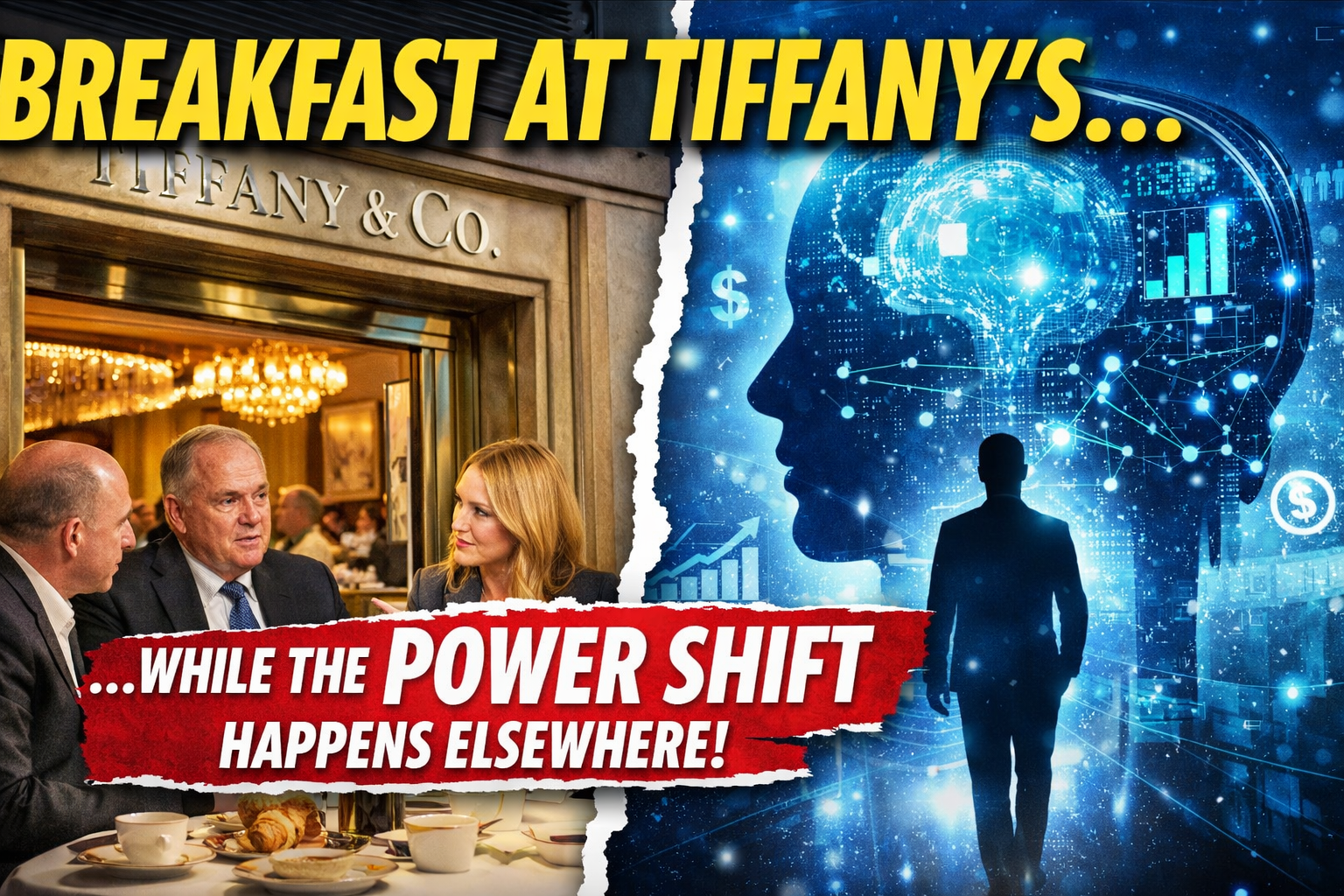
There’s something quietly symbolic about senior banking executives gathering at Tiffany’s to discuss the future of AI in finance.
Crystal glasses. Polished marble. Legacy institutions.
And conversations about “transformation.”
But here’s the uncomfortable truth:
While the industry debates how to upgrade itself… the centre of power is already moving somewhere else.
The Illusion of Transformation
On the surface, the narrative sounds compelling:
- Generative AI is now an operational imperative
- Firms must balance innovation with compliance
- AI will enhance customer experience and efficiency
- Data governance and cybersecurity are critical
All valid. All sensible.
And yet—all incomplete.
Because this isn’t transformation.
It’s optimisation.
👉 The system isn’t being reimagined. It’s being refined.
The Wrong Question
Most of the discussion in rooms like this revolves around:
- How do we deploy AI safely?
- How do we improve internal workflows?
- How do we maintain regulatory compliance?
- How do we enhance digital engagement?
But these are institution-led questions.
They assume the same structure remains intact.
They assume the same players remain central.
They assume the same model still holds.
They assume the system survives.
The Question That Isn’t Being Asked
Here’s the question that matters:
What happens when the individual no longer needs the system in the same way?
Because that’s where AI is really pointing.
Not toward better distribution.
Not toward faster processing.
Not toward improved reporting.
But toward something far more disruptive:
Direct access to understanding, modelling, and decision-making—without intermediation.
From Information Asymmetry to Agency
For decades, financial services has operated on a simple structural advantage:
- The institution knows more than the individual
- The adviser interprets complexity
- The product delivers the outcome
AI dismantles that model.
Rapidly.
Quietly.
Irreversibly.
Today, individuals can:
- Model financial scenarios in minutes
- Translate complex language into plain English
- Stress-test decisions before acting
- Access guidance without judgement or friction
👉 Not perfectly. Not always completely.
But enough.
Enough to shift the balance.
The Real Inflection Point
The industry describes this moment as:
“AI moving from experimental to operational.”
But that’s not the real inflection point.
The real shift is this:
From:
- Adviser-led decisions
- Product-centred solutions
- Institution-controlled processes
To:
- User-led decisions
- Planning-led thinking
- AI-supported autonomy
This isn’t a technology shift.
It’s a power shift.
The Strategic Misstep
The vast majority of AI investment in financial services is flowing into:
- Enterprise systems
- Compliance automation
- Internal productivity
- Customer communication tools
In other words:
👉 Improving how the system operates
But very little is being directed toward:
- Empowering individuals to think independently
- Building planning capability at the user level
- Supporting human capital development
- Enabling self-directed financial decision-making
This is the gap.
And it’s not a small one.
It’s structural.
The Tension They Can’t Resolve
The executives at Tiffany’s touched on something important:
- The need for governance
- The importance of control
- The risks introduced by AI
But here’s the contradiction:
The more capable AI becomes, the less dependent the user becomes.
And that creates tension.
Because institutions are trying to:
- Enable AI
- While still retaining control
- While still preserving existing models
That doesn’t hold indefinitely.
The Role of the Financial Planner
This is where the narrative often breaks down.
Because if AI handles:
- Information
- Modelling
- Translation
- Accessibility
Then what remains?
The answer is not “more distribution.”
It’s not “better product selection.”
It’s not “enhanced reporting.”
It’s something far more human—and far more valuable:
Judgement at the point of complexity, stress, or change
This is the foundation of the Total Wealth Planner.
Not as a product intermediary.
But as:
- A thinking partner
- A behavioural stabiliser
- A guide through uncertainty
- A guardian of long-term direction
👉 Not always needed.
👉 But essential at the right moments.
From 90/10 to 99/1
At the Academy of Life Planning, we’ve framed this as:
90% of people, 90% of the time, can manage their own financial lives—if properly supported.
AI accelerates that trajectory.
We are moving toward:
99% self-direction
1% human intervention—at critical moments
That is not a threat to planning.
It is a redefinition of planning.
What the Industry Is Missing
There was no discussion at Tiffany’s about:
- Human agency
- Financial self-sufficiency
- Life-first planning
- Human capital strategy
- Decentralised decision-making
And yet, these are the areas where the most profound change is happening.
Not inside institutions.
But outside them.
Two Futures Emerging
We are now seeing two parallel futures develop:
1. The Institutional Path
- AI-enhanced systems
- Greater efficiency
- Stronger compliance
- Improved scalability
2. The Human Path
- AI-empowered individuals
- Greater autonomy
- Direct decision-making
- Planning before product
The first is being heavily funded.
The second is being quietly adopted.
The Inevitable Convergence
These two paths don’t compete forever.
Eventually, they collide.
And when they do, the question won’t be:
“How do we improve the system?”
It will be:
“What is the system for, if the individual can already do most of it?”
The Real Shift
So yes—AI is transforming financial services.
But not in the way the industry is currently framing it.
This isn’t about:
- Better tools
- Faster processes
- Smarter systems
It’s about something far more fundamental:
Restoring human agency in a system that was built without it
Final Thought
The breakfast at Tiffany’s was elegant.
Insightful.
Well-intentioned.
But it represents a world that is trying to evolve within its existing frame.
Meanwhile, outside that room:
- Individuals are gaining capability
- AI is lowering barriers
- The need for intermediation is quietly declining
The industry is upgrading the system.
The world is redesigning it.
A Different Starting Point
If you’re exploring what this shift means for your role, your business, or your future in financial planning—
Start here:
👉 What if the client doesn’t need you most of the time?
👉 What if your value exists only at the moments that matter most?
👉 What if planning isn’t about managing money—but about guiding lives?
That’s the work of a Total Wealth Planner.
And that’s where the future is being built.
Further details available from the Academy of Life Planning.
 Academy of Life Planning