
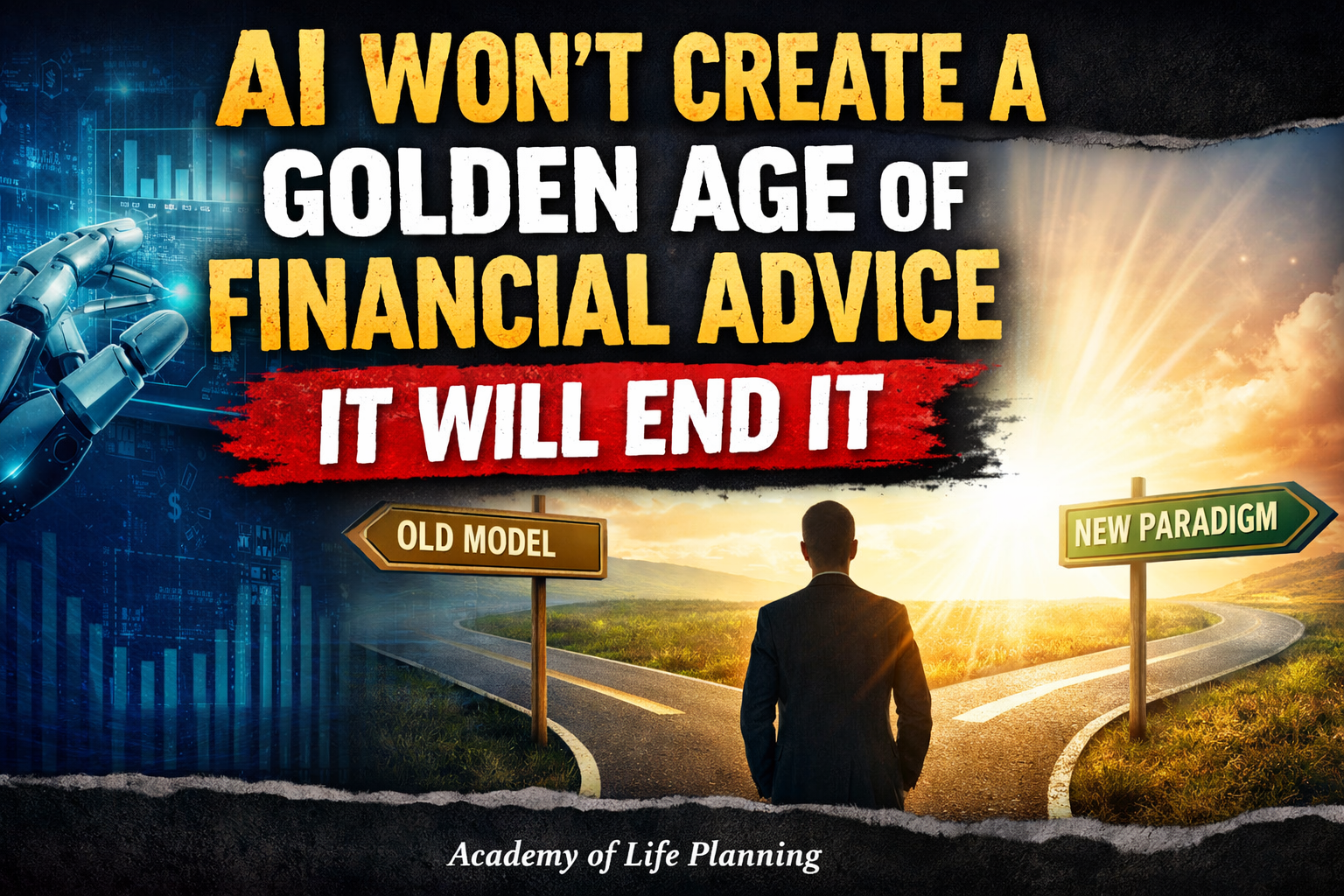
The financial advice industry is asking the wrong question.
Most commentary right now sounds like this:
“How can firms use AI to improve advice?”
It’s a comfortable question.
A safe one.
But it assumes something that is no longer true:
👉 That advice remains the centre of the system
It doesn’t.
The Real Shift Isn’t Technological — It’s Structural
AI is not just making advisers more efficient.
It is doing something far more disruptive:
- It is collapsing the cost of financial modelling
- It is democratising access to knowledge
- It is removing the need for gatekeepers
What used to require:
- qualifications
- paraplanners
- expensive software
- layered firms
…can now be done by an individual, with the right tools, in a fraction of the time.
This is not evolution.
This is compression.
The Industry Is Optimising the Wrong Layer
Most firms are responding by:
- automating paraplanning
- improving workflows
- increasing productivity
That’s logical.
But it’s also misdirected.
Because these are improvements to a model that is quietly becoming obsolete.
👉 AI doesn’t just make advice more efficient.
It makes large parts of advice unnecessary.
The Rise of the Capable Individual
For the first time in history, individuals now have access to:
- AI-driven financial modelling
- scenario planning
- tax and pension analysis
- structured thinking frameworks
Not perfectly.
Not flawlessly.
But sufficiently.
And that word matters.
Because:
People don’t need perfection.
They need enough clarity to make decisions.
Information Was Never the Scarce Resource
The industry has always operated on an implicit assumption:
If we provide better information, people will make better decisions.
But we now know that isn’t true.
Because:
- Information is abundant
- Tools are improving
- Yet confusion remains
Why?
Because the real constraint is not information.
It is:
👉 Decision-making
Welcome to the Age of Decision Capital
As AI commoditises:
- data
- modelling
- technical analysis
A new scarcity emerges:
👉 Clarity under uncertainty
👉 Judgement when decisions carry weight
👉 The ability to know what not to do
This is what we call:
Decision Capital
And it cannot be automated away.
The Role of the Planner Must Change
If AI can:
- build the plan
- run the numbers
- generate scenarios
Then what remains?
Not product selection.
Not report writing.
Not financial modelling.
What remains is:
👉 Thinking partnership
👉 Life architecture
👉 Decision governance
This is the shift from:
| Old Role | Emerging Role |
|---|---|
| Adviser | Total Wealth Planner |
| Information provider | Decision partner |
| Product intermediary | Life architect |
| Controller of process | Enabler of agency |
This Is Not a Golden Age of Advice
There is a growing narrative that AI will:
“usher in a golden age of financial advice”
It won’t.
Because advice—as traditionally defined—relies on:
- information asymmetry
- controlled access
- dependency
AI removes all three.
What emerges instead is:
A golden age of human agency
Two Markets Are Now Forming
We are already seeing the split:
1. The Legacy Market
- Firm-led
- Product-aligned
- AI used for efficiency
- Focus: retention, productivity, compliance
2. The Emerging Market
- Individual-led
- Life-first
- AI used for capability
- Focus: clarity, control, autonomy
The second market is not theoretical.
It is already here.
And it is growing.
Where the Academy of Life Planning Sits
At the Academy of Life Planning, we are not focused on:
- improving advice firms
- optimising paraplanning
- layering AI onto legacy models
We are focused on something different:
Restoring human agency in the age of AI
That means:
- Planning life first. Then money.
- Using AI as a capability layer—not a dependency layer
- Developing Decision Capital alongside Financial Capital
- Supporting individuals to become their own planners (90% of the time)
- Providing expert thinking partnership when it matters most
The Future Isn’t Advice vs AI
That’s the wrong frame.
The real shift is:
From dependency → to agency
From advice → to decision architecture
From financial planning → to Total Wealth Planning
A Practical Pathway Forward
If you’re sensing this shift, the question isn’t:
“How do I keep up with AI?”
It’s:
“Where do I sit in this new structure?”
You have three options:
- Stay in the legacy model and optimise it
- Blend models and begin transitioning
- Move upstream into Total Wealth Planning
We support that transition through:
- AI-enabled planning tools
- structured decision frameworks
- mentorship and community
- practical pathways to build a new kind of practice
Final Thought
This moment isn’t about technology.
It’s about power.
For decades, financial systems have concentrated:
- knowledge
- control
- decision-making
AI redistributes all three.
The question is no longer:
“How do we improve advice?”
It is:
“What does the world look like when people no longer need it in the same way?”
If this resonates, explore the Academy of Life Planning and the pathway to becoming a Total Wealth Planner.
Or simply start with one question:
What would change if you were fully in control of your financial decisions?
 Academy of Life Planning