
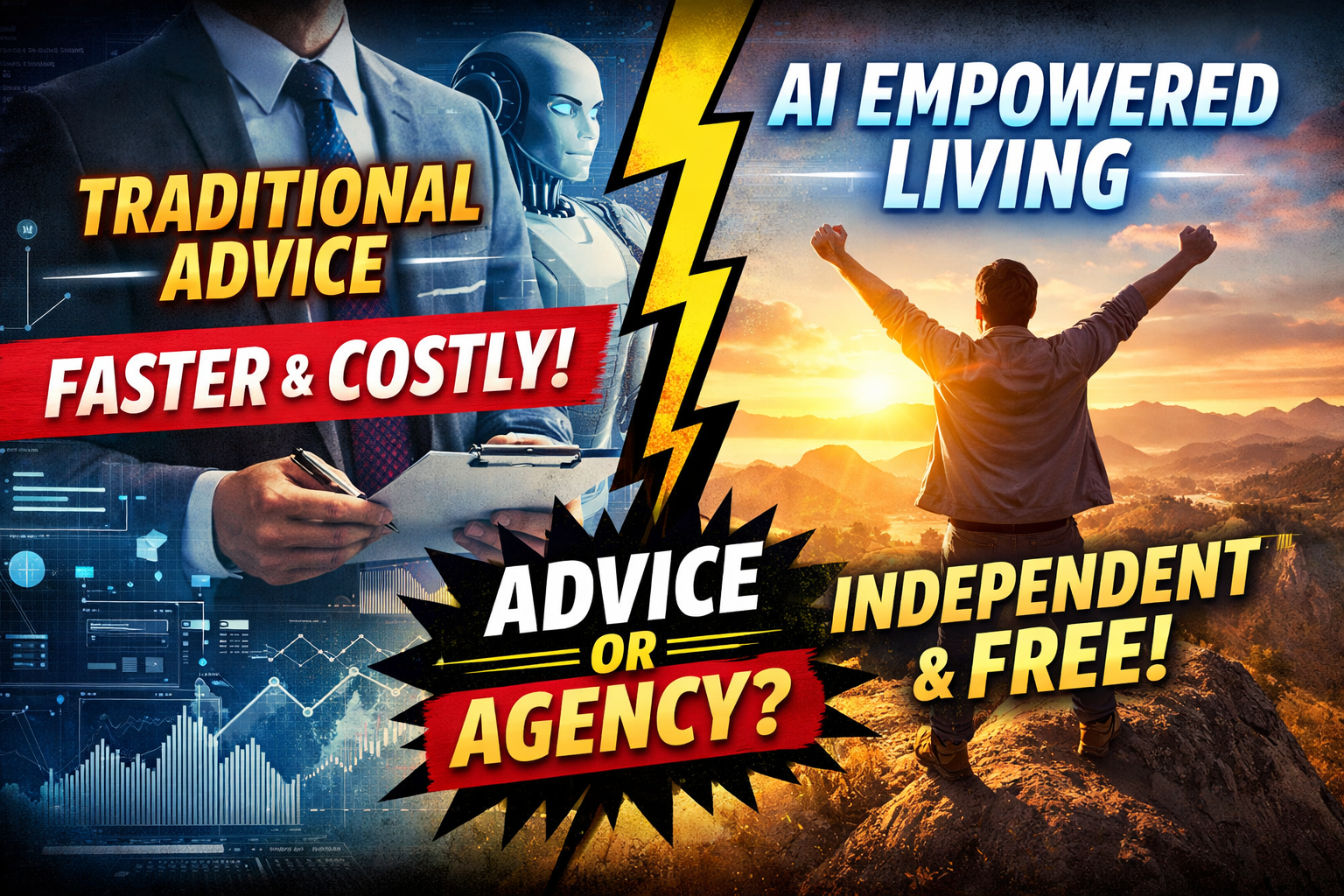
There’s a growing consensus across the financial advice sector:
AI is here to stay—but it must remain firmly in a supporting role.
Recent commentary from advisers and technology providers reinforces a familiar narrative:
- AI improves efficiency
- Humans retain control
- Advice remains central
On the surface, this sounds reasonable. Even reassuring.
But underneath, something far more significant is happening—something that challenges the very foundation of traditional financial planning.
The Industry Is Optimising the System—Not Rethinking It
Much of the current AI adoption in financial services focuses on:
- Faster suitability reports
- Automated documentation
- Streamlined compliance processes
- Increased firm capacity
This is progress.
But it’s operational progress, not structural change.
The underlying model remains untouched:
The client receives advice.
The firm delivers it.
AI makes it quicker.
The system becomes more efficient—but not more empowering.
The Quiet Assumption No One Is Questioning
Across these discussions, one assumption remains largely unchallenged:
The individual still needs advice to make financial decisions.
That assumption made sense in a pre-AI world.
It makes far less sense today.
Because for the first time in history, individuals now have access to tools that can:
- Model financial scenarios in seconds
- Translate complex concepts into plain language
- Explore multiple decision pathways
- Support structured thinking over time
Not perfectly. Not flawlessly. But meaningfully.
And that changes everything.
From Advice Delivery to Decision Capability
At the Academy of Life Planning, we see AI not as a back-office assistant—but as a front-line enabler of human capability.
This is the shift:
Traditional Model
- Adviser holds knowledge
- Client receives recommendations
- Value sits in answers
Emerging Model
- Individual engages with AI
- Decisions are explored, not dictated
- Value sits in clarity and capability
This doesn’t remove the need for professionals.
It redefines their role.
The Rise of the Thinking Partner
In a world where AI can handle:
- Calculations
- Projections
- Comparisons
- Documentation
The premium is no longer in producing answers.
It’s in helping people:
- Ask better questions
- Navigate uncertainty
- Align decisions with their life
- Avoid blind spots
This is where the Total Wealth Planner operates.
Not as a gatekeeper of advice—but as a thinking partner in moments that matter.
Human Capital: The Missing Dimension
One of the most striking gaps in current AI discussions is the absence of human capital.
Financial advice still focuses heavily on:
- Pensions
- Investments
- Protection
But overlooks the largest asset most people will ever have:
Their ability to earn, adapt, and create value over time.
AI amplifies this asset.
It enables individuals to:
- Explore new income pathways
- Re-skill more effectively
- Model career decisions alongside financial ones
This is not financial planning as traditionally defined.
This is life planning with financial intelligence embedded within it.
The Real Shift: From Dependency to Agency
The most important change AI introduces is not speed.
It’s agency.
For decades, the system has conditioned individuals to believe:
- Financial decisions are too complex
- Expertise must be outsourced
- Confidence requires permission
AI quietly challenges all three.
It doesn’t make people experts overnight.
But it gives them something just as powerful:
The ability to engage, question, and participate in their own planning.
A Fork in the Road
We are now at a clear inflection point.
Path One:
Use AI to make advice faster, cheaper, and more scalable
→ The existing system becomes more efficient
Path Two:
Use AI to build individual capability and restore autonomy
→ The system itself begins to evolve
Both paths will exist.
But only one leads to long-term transformation.
Where the Academy Stands
At the Academy of Life Planning, our position is simple:
AI should not just improve the delivery of advice.
It should reduce the need for it.
Not by removing support.
But by elevating the individual.
Through:
- The Total Wealth Plan (done-by-you, AI-assisted planning)
- The GAME Plan framework (Goals → Actions → Means → Execution)
- Access to thinking partners when decisions carry weight
We are building a model where:
- 90% is self-directed
- 10% is supported
- 100% is owned by the individual
Final Thought
The question is no longer:
“How can AI help advisers deliver better advice?”
A more important question is emerging:
“How can AI help people live better lives—without needing to depend on advice at all?”
That’s the shift.
And it’s already underway.
If you’re exploring what this means for your own life or practice,
you’re not alone.
And you’re not too early.
You’re right on time.
If you’re exploring what this shift means for your life or your practice,
take a closer look at how we’re approaching it at the Academy of Life Planning.
👉 http://www.academyoflifeplanning.com
Plan life first. Then money
 Academy of Life Planning