
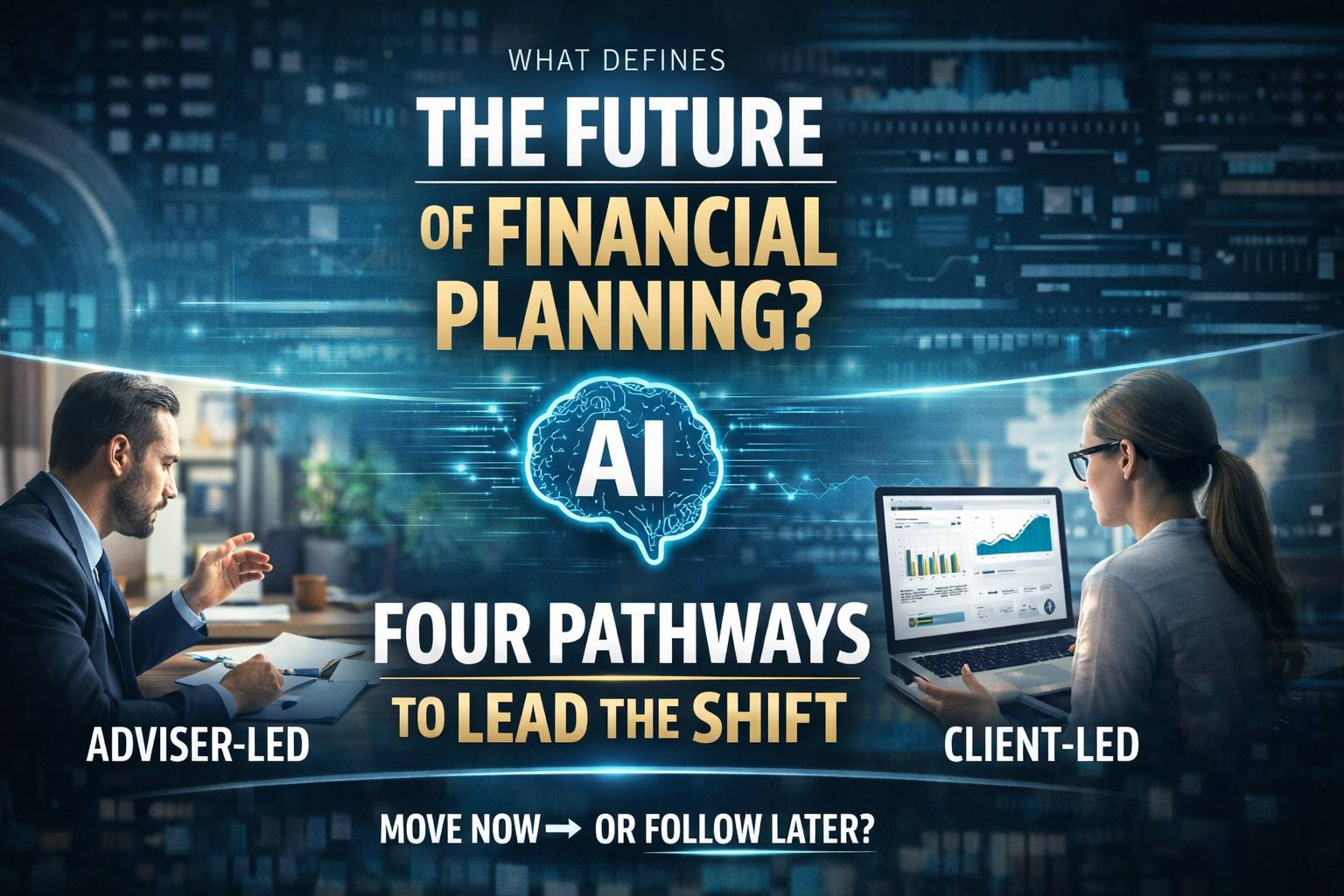
Why the advisers who move now will define the next decade
The Profession Has Already Changed
Something has shifted in 2026.
For years, advisers have understood the argument for moving beyond product-led advice. The logic has always been clear:
- Clients want clarity, not complexity
- Trust comes from alignment, not incentives
- Planning should lead — products should follow
But understanding is not the same as acting.
What held most people back was predictable:
- Regulatory anxiety
- Income uncertainty
- The risk of stepping away from a model that still “works”
That hesitation is now disappearing.
Because something new has entered the room.
Not regulation.
Not another platform.
Not another compliance layer.
AI — on the client’s side of the table.
Clients are now arriving:
- With their own projections
- With comparisons already run
- With questions that assume agency
And most importantly…
They are no longer comfortable handing that agency back.
This is not a future trend.
This is already happening.
The Model That Was Built for This Moment
What is interesting is this:
The Total Wealth Planning model was not created in response to AI.
It was created over a decade ago around a simple truth:
Most people can manage their own financial lives — most of the time.
What they need is:
- Structure
- Clarity
- Confidence
And then — in moments that truly matter —
they need a professional alongside them.
This is the 90/10 model.
And AI doesn’t replace it.
AI validates it.
AI now handles:
- Modelling
- Comparisons
- Education
- Scenario testing
But it cannot:
- Navigate emotional complexity
- Hold space in moments of stress
- Apply lived judgement across decades of experience
That is where the planner operates.
Not as a gatekeeper.
As a partner.
The Shift Few Are Talking About
This is not just a technology shift.
It is an agency shift.
From:
- Adviser-led → client-dependent
To:
- Client-led → adviser-supported
That changes everything:
- Pricing models
- Trust dynamics
- Professional identity
And it raises a quiet but important question:
Is financial advice becoming something closer to a profession — rather than a distribution model?
The advisers who recognise this early will not just adapt.
They will lead.
Four Pathways to Becoming a Total Wealth Planner
The Academy has rebuilt its professional development around one simple idea:
Different people are ready at different speeds.
But the destination is the same:
A conflict-free, client-aligned, commercially sustainable planning practice.
1. The 90-Day Glidepath™ — £3,995
For those ready to move now
This is a decisive transition.
Within 90 days:
- Accredited
- Website live
- Operating as a Total Wealth Planner
Then supported through:
- 9 months of 1-to-1 mentorship
- Practice Management Circle
- Full CPD and course access
This is not theory.
It is execution.
2. The Standard Pathway™ — £2,995
For those transitioning alongside an existing practice
Not everyone moves in one step.
This pathway allows you to:
- Build confidence gradually
- Introduce Total Wealth Planning alongside current work
- Transition when ready
Includes:
- 12 months mentorship
- Website setup
- Full Academy ecosystem
A slower shift.
Same destination.
3. The Community Pathway™ — £1,250
For those who grow through shared thinking
This is where identity shifts happen.
Through:
- Peer discussion
- Live group sessions
- Real-world case sharing
Because becoming a Total Wealth Planner is not just:
- Learning a framework
It is:
- Becoming something different
4. The Remote Pathway™ — £545
For independent, self-directed professionals
Global. Flexible. Accessible.
- Full online course
- CPD series
- Email support
- Accreditation on completion
Start anywhere.
Progress at your own pace.
The Question Most Advisers Ask (But Rarely Say Out Loud)
“What about regulation?”
It’s a fair question.
And the answer is simpler than most expect.
When you:
- Focus on planning, not products
- Do not recommend regulated investments
- Do not handle client money
You are operating within generic advice (PERG 8.26).
In practice, this means:
- Lower regulatory burden
- Fewer conflicts
- Higher client trust
The perceived barrier is often far greater than the real one.
What Actually Happens When Advisers Make the Shift
We now have over 60 planners who have made this transition.
Their experience is consistent:
- Clients respond better than expected
- Trust increases, not decreases
- Revenue becomes more stable, not less
- Work becomes more meaningful
And perhaps most importantly:
They stop feeling like they are selling.
The Moment That Matters
For 14 years, this has been a future conversation.
Now it is a present one.
The advantage of moving now is not incremental.
It is structural.
Because early movers build:
- New client relationships
- New positioning
- New identity
Before the rest of the market catches up.
And when it does—
It moves quickly.
A Simple Question
Not:
“Do I agree with this?”
Most advisers already do.
The real question is:
Am I ready to act on it?
If you are exploring that question, the Academy is here.
You don’t need to commit.
You just need to start the conversation.
 Academy of Life Planning