
Quilter, SJP, and the Real Question Facing Financial Planning
Two announcements this week tell us everything about where traditional financial advice is heading.
Quilter is rolling out AI tools to advisers.
St James’s Place is doing the same.
On the surface, this looks like progress.
And it is.
But only in one direction.
What the Industry Is Building
Quilter’s AI strategy focuses on three core areas:
- Transcribing and summarising client meetings
- Automating administrative tasks
- Supporting compliance and file checking
- Moving toward AI-generated recommendations
The stated goal is clear:
Increase adviser productivity and allow them to service more clients.
SJP echoes a similar theme:
Technology will strengthen the human relationship, not replace it.
This is important.
Because it reveals the underlying model hasn’t changed.
The Hidden Assumption
All of this innovation is built on one core assumption:
The adviser remains at the centre.
AI is being deployed to:
- Make advisers faster
- Make firms more scalable
- Improve operational efficiency
- Reduce compliance risk
But the structure stays intact:
👉 Client → Adviser → Product → Revenue
AI is simply making that pipeline more efficient.
What’s Missing
From a Total Wealth Planning perspective, something critical is absent.
The client’s agency.
There is no mention of:
- Helping clients think better
- Helping clients plan their own lives
- Building human capital
- Supporting independent decision-making
- Reducing reliance on advisers over time
Instead, the model becomes:
Better tools for advisers to manage more clients.
Not:
Better tools for people to manage their own lives.
Total Wealth Planning: A Different Starting Point
At the Academy of Life Planning, we start from the opposite direction.
Not:
👉 How do we make advisers more productive?
But:
👉 How do we make people more capable?
A Simple Comparison
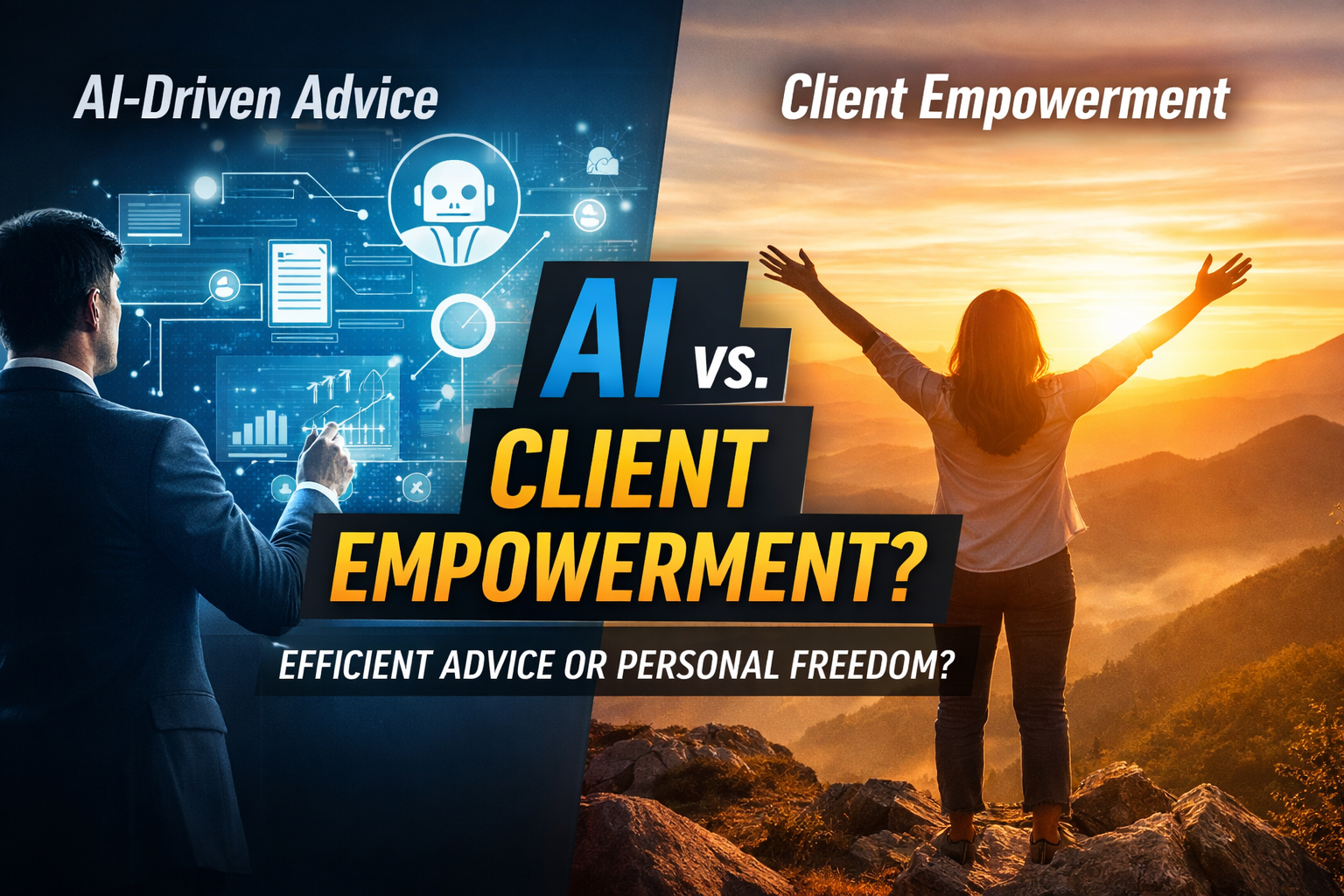
Traditional AI in Advice Firms (Quilter / SJP)
- AI assists the adviser
- Focus on efficiency and scale
- Improves compliance and process
- Moves toward automated recommendations
- Client remains dependent
- Human relationship is preserved… within the system
Total Wealth Planning (AoLP)
- AI assists the individual
- Focus on clarity, capability, and autonomy
- Builds decision-making confidence
- Structures thinking (Goals → Actions → Means → Execution)
- Reduces dependency over time
- Human planner steps in when needed (10%), not always (100%)
Two Very Different Futures
Future 1: The Augmented Adviser Model
- Advisers become more efficient
- Firms scale faster
- Clients are served more quickly
- AI improves recommendations
But fundamentally:
👉 The system stays the same
👉 Dependency remains
👉 Advice is still delivered to the client
Future 2: The Empowered Individual Model
- Individuals think more clearly
- People design their own lives
- Financial decisions sit within life decisions
- Human planners become strategic partners, not gatekeepers
And crucially:
👉 Advice is not delivered
👉 It is developed within the individual
The Strategic Risk for the Industry
The industry believes AI will strengthen adviser-client relationships.
That may be true.
But it may also be incomplete.
Because something else is happening at the same time:
- People are already using AI independently
- Clients are arriving more informed
- Some are bypassing advisers entirely
- Others only want help at key moments
So the real shift is not:
AI helping advisers serve clients better
It is:
AI helping clients need advisers differently
Where This Leaves Financial Planners
This is the moment of divergence.
You can:
1. Follow the Industry Path
Adopt AI to become faster, more efficient, and more scalable.
Or:
2. Cross the Bridge
Use AI to:
- Help clients think
- Help clients plan
- Help clients build capability
- Redefine your role as a Total Wealth Planner
The Real Question
AI is not the disruption.
Agency is.
So the real question is:
Are we using AI to make advice more efficient…
or to make people more free?
Final Thought
Quilter and SJP are building a more efficient version of the past.
Total Wealth Planning is building something fundamentally different:
A future where people don’t just receive advice…
they become capable of directing their own lives.
If you’re a financial planner watching this unfold, you’re not too late.
But the window to choose your path is narrowing.
Curious how others see this.
 Academy of Life Planning
Money Marketing: AI could help firms scale advice without replacing advisers | 17th March 2026
What stood out to me here is how “scale” is still being defined.
AI is being used to help firms deliver more advice, faster.
But that assumes the end goal is still… more advice.
What we’re seeing in parallel is something different:
People using AI to think things through themselves
→ before they ever speak to an adviser
Which raises a different possibility:
The future isn’t just scaling advice delivery.
It’s reducing unnecessary dependency on it.
AI might not just help firms serve more clients.
It may change when, why, and if clients need advice at all.
That’s a very different kind of “advice gap”.