
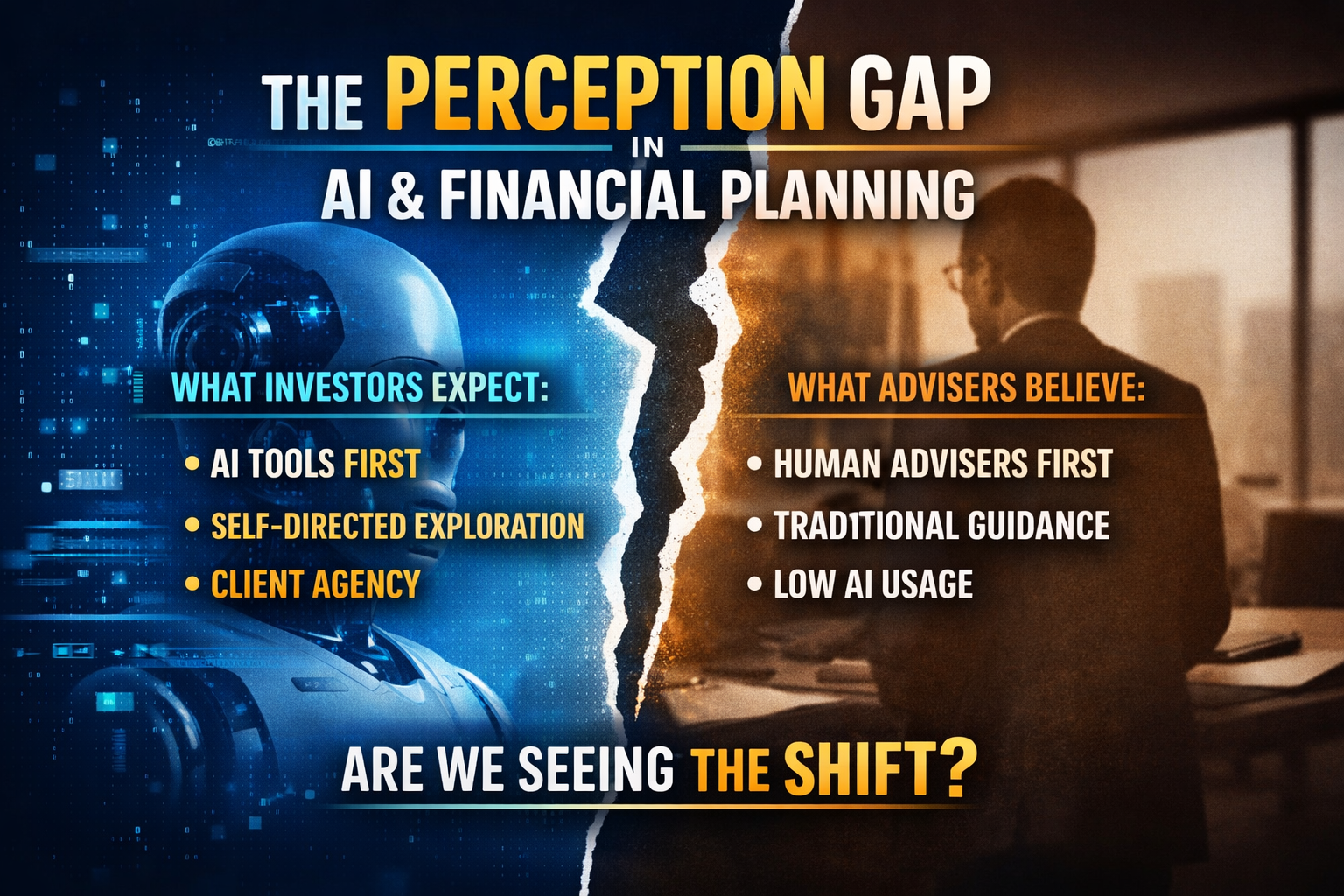
The Perception Gap in Financial Planning
Two pieces of evidence landed this week.
Individually they are interesting.
Together they reveal something much bigger.
1️⃣ What investors are saying
A new industry study reported in Financial Planning Today (12 March 2026) found growing openness to AI tools among investors.
The numbers are striking:
- 63% of investors have considered using AI-powered financial planning tools
- 72% would use AI for basic planning needs
- 49% see AI as a starting point before speaking to a human adviser
- Only 36% want a human adviser involved from the beginning
That is not a niche behaviour.
That is a mainstream shift in how people approach financial decisions.
Many clients are already exploring, questioning, modelling and learning before they ever speak to an adviser.
2️⃣ What advisers believe
Earlier this week I asked advisers a simple question:
What percentage of your clients are already using AI for financial questions?
From 54 responses:
- 37% believe fewer than 10% of clients use AI
- 22% believe 10–25% do
- 26% believe 25–50% do
- 15% believe more than half already do
So even among advisers who recognise AI adoption, most still believe usage is relatively low.
The perception gap
Put these two datasets together and something interesting appears.
Investors say:
AI is already becoming a starting point for financial thinking.
Advisers believe:
AI usage among clients is still relatively limited.
That gap matters.
Because perception gaps are often early signals of industry change.
They tell us that behaviour is shifting faster than professional assumptions.
What may actually be happening
Clients are beginning to think before they seek advice.
They are already using AI to:
- understand pensions
- interpret portfolio performance
- test financial scenarios
- translate complex language
- explore possible decisions
So when they arrive in a planner’s office, something has changed.
They arrive more informed, more curious, and more capable.
The model of financial planning is evolving
For decades, financial planning has largely been delegator-centred.
Clients delegate analysis and decision framing to the adviser.
But the emerging pattern suggests a different structure:
Clients explore → AI assists → planners guide.
In other words, the profession may be shifting toward agency-led financial planning.
Where the planner’s role becomes less about calculation and more about:
- interpreting complexity
- guiding life decisions
- helping clients think clearly
- providing wisdom and perspective
Not replacing advisers.
But evolving the role.
Why this matters
If this perception gap continues to widen, the profession will face a choice.
Ignore the shift.
Or evolve with it.
This is exactly why we built the 90-day bridge to Total Wealth Planning at the Academy of Life Planning.
Because the planners who thrive in the AI era will not be those who control the software.
They will be those who help people navigate life with clarity and wisdom.
Research Snapshot: Advice, Agency, and the Rise of AI
The results: A recent survey of 1,001 UK consumers with at least £100,000 in investible assets, conducted for Scottish Widows, highlights a growing shift in how clients approach financial advice.
Client behaviour
- 23% of advised clients have acted against their adviser’s recommendations.
When asked why, respondents cited several factors:
- 34% had not disclosed key information to their adviser
- 33% felt the recommendation wasn’t right for them at that moment
- 29% chose to follow friends or family advice instead
- 28% said the advice conflicted with their personal values
- 27% did not clearly understand the outcome of the proposed plan
Researchers described this as an “honesty gap”—a situation where incomplete disclosure from clients limits advisers’ ability to provide fully relevant guidance.
AI adoption signals
The same research also found strong interest in AI-assisted financial planning:
- 63% of investors have considered AI-powered planning tools
- 72% would use AI for basic financial planning tasks
- 49% see AI as a starting point before consulting a human adviser
- Only 36% want a human adviser involved from the outset
Strategic implication
Taken together, the findings suggest an emerging shift in how financial decisions are made:
- Advice increasingly competes with social networks and digital tools
- Clients are becoming more self-directed before seeking professional input
- AI is likely to become the first touchpoint for exploration and analysis, with advisers engaged for complexity and judgement
This pattern aligns with a broader move from delegator-centred advice toward a model where client agency and professional guidance work together.
The future of financial planning will be built around human agency.
If you want to learn how to deliver planning in this new environment:
• Book a 15-minute Clarity Call to explore the opportunity
• Or schedule a 60-minute Strategy Session (£200) for a deeper discussion and practical guidance.
 Academy of Life Planning