
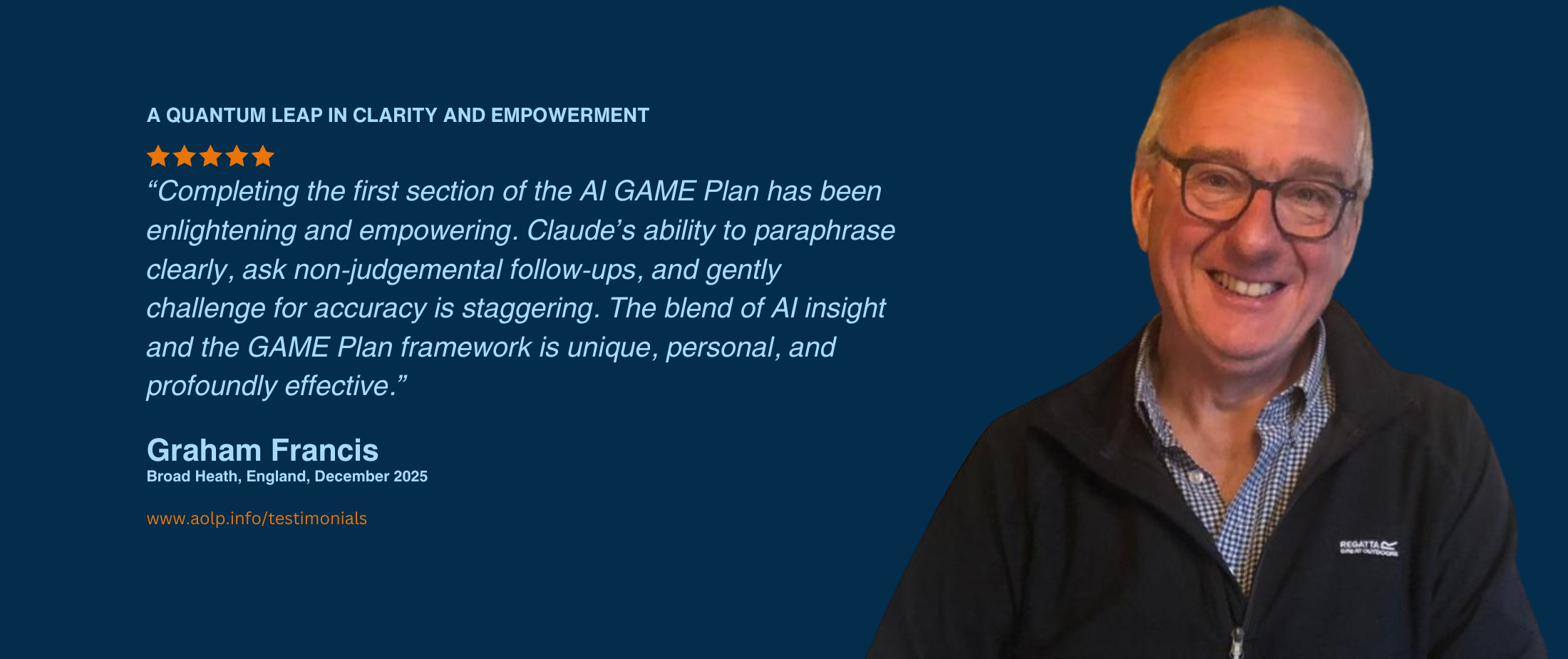
“If I’d discovered the movement and the GAME Plan a decade earlier, I might have clarified my life purpose far sooner and saved myself years of time and cost. But I’ve also learned this: nothing we do is ever wasted — time is only lost when we stop moving.” – Graham F, Planner, Feb 2026.
The financial advice profession is entering a structural shift. Not a trend. Not a tool change. A model change.
Advisers who recognise this early are discovering something remarkable:
Transitioning properly doesn’t just change what you do.
It multiplies how efficiently you can do it.
Across the Academy’s practitioner community, one pattern keeps appearing:
Those who cross the bridge intentionally experience repeated 10× gains — in time, clarity, client impact, and business momentum.
This article explains why.
The Hidden Cost of Transitioning Alone
Most advisers attempting to evolve from traditional advice into holistic planning try to self-engineer the transition.
They:
- test positioning through trial and error
- rewrite propositions repeatedly
- experiment with pricing models
- manually build systems
- learn coaching skills from scratch
- refine messaging through failed launches
This approach can work.
But it is slow, cognitively draining, and unnecessarily expensive.
The true cost isn’t money.
It’s iteration time.
What the Bridge Actually Does
The Academy bridge isn’t training.
It’s a structured acceleration environment designed to compress years of trial-and-error learning into a guided transition sequence.
It works because it removes five major friction points simultaneously:
1. Cognitive Load Reduction
Instead of designing frameworks, advisers use proven structures immediately.
Result:
10 hours of thinking → 1 hour of refinement
2. Decision Clarity
Rather than second-guessing positioning, practitioners test ideas within an existing strategic architecture.
Result:
Fewer wrong turns. Faster confidence.
3. Synthesis Instead of Searching
Traditional development requires gathering information from multiple sources and manually integrating it.
With structured planning systems, synthesis is built in.
Result:
Research time drops dramatically while insight depth increases.
4. Immediate Iteration Cycles
Most advisers review strategy annually.
Total Wealth Planners refine direction dynamically:
- strategic frameworks → reviewed quarterly
- direction and opportunities → updated when triggered by events
Result:
Progress compounds rather than stalls.
5. Identity Shift Support
The hardest part of transition isn’t technical.
It’s psychological.
Moving from:
product expert → life architect
Many advisers describe it as:
“Like asking engineers to become therapists.”
Without peer context, this shift can feel destabilising.
Inside a structured cohort, it becomes normalised.
Result:
Confidence accelerates instead of eroding.
Where the Real 10× Appears
Advisers often expect efficiency gains in admin or research.
Those happen.
But the largest multiplier appears elsewhere:
Purpose clarity.
Practitioners regularly report that what took them a decade to articulate alone becomes clear within months when guided through structured reflective planning cycles.
Why?
Because the right questions collapse years of unfocused searching.
Traditional Development vs Structured Transition
| Dimension | Solo Transition | Academy Bridge |
|---|---|---|
| Proposition clarity | Months/years | Weeks |
| Confidence | Fluctuating | Compounding |
| Client messaging | Trial-and-error | Tested frameworks |
| Business model | Iterative guesswork | Structured design |
| Professional identity | Uncertain | Supported evolution |
The difference is not talent.
It is architecture.
The Misconception Holding Advisers Back
Many professionals assume:
“I should figure this out myself first.”
But self-construction is only efficient when the terrain is known.
When entering a new professional paradigm, the faster route is guided adaptation.
Not dependence.
Leverage.
The Compounding Effect
Each 10× improvement doesn’t operate alone.
They stack:
- faster thinking
- faster iteration
- faster client impact
- faster clarity
- faster confidence
Stacked together, these don’t produce incremental growth.
They produce trajectory change.
Who the Bridge Is For
This transition pathway suits advisers who:
- sense traditional models are structurally outdated
- want deeper client impact
- prefer guidance to guesswork
- value autonomy but not isolation
- want to evolve before the market forces them to
Final Thought
Most advisers think the risk is changing too fast.
In reality, the risk is transitioning too slowly.
Because while you’re figuring it out alone, someone else is crossing the bridge with support — and arriving years earlier.
If you’re considering the move from adviser to Total Wealth Planner, the question isn’t whether the shift will happen.
It’s whether you’ll experience it as a long struggle…
or a structured acceleration.
 Academy of Life Planning