
For a profession that exists to manage risk, financial planning is making a strangely reckless bet right now.
The bet is this:
“AI will automate the technical work… but it will never replace me, because my clients need empathy.”
It sounds comforting. It’s also structurally weak.
Because the question isn’t whether humans matter.
The question is whether “empathy” remains a defensible business model when:
- AI can build plans, run scenarios, and explain trade-offs in plain English at scale
- People are already using AI for emotional support and decision-making
- Costs are collapsing and expectations are rising
- Regulators are actively expanding low-cost, scalable “support” models
In other words: the ground is moving.
And the biggest danger isn’t fear.
It’s false comfort.
This is the moment Total Wealth Planners were made for.
The uncomfortable truth: “Empathy” is not a moat — it’s a moving target
Many advisers are treating empathy like an unbreachable wall.
But in real life, empathy isn’t a wall. It’s a spectrum.
People don’t need perfect empathy to feel supported. They need:
- clarity
- reassurance
- validation
- a way to think
- someone (or something) to talk to when anxiety spikes at 2am
Millions are already choosing AI as a companion, a coach, a “thinking partner”.
So the claim “clients will always want a human” is not a fact about humanity — it’s a preference of an older service model.
Here’s the shift Total Wealth Planners must internalise:
Don’t sell “I’m human.” Sell the human outcomes.
The human outcomes are not niceness.
They are transformation.
The robo-adviser comparison is a decade out of date
A robo-adviser (in its classic form) was basically a portfolio allocator with a nice interface.
Today’s AI is different in kind, not degree:
- it converses
- it understands context
- it generates plans, not just allocations
- it explains trade-offs
- it adapts tone
- it iterates instantly
- it’s always on
- it costs pennies compared to legacy delivery
So when someone says “robo didn’t kill advisers”, they’re looking at a flip phone and concluding smartphones are overhyped.
That’s not prudence.
That’s miscalibration.
“AI handles the boring stuff” is always the first stage of displacement
Every disrupted profession told itself the same story:
- Tech automates admin
- Professionals celebrate productivity
- The definition of “admin” expands
- Tech eats core work
- The fee model cracks
- Survivors reposition around what remains uniquely valuable
In financial planning, you can already see the expansion:
- meeting summaries → plan drafting
- data entry → scenario modelling
- CRM notes → personalised client comms
- risk profiling → portfolio construction
- suitability skeletons → structured recommendations
This isn’t an insult to advisers.
It’s a reality about structured work:
Financial planning has defined inputs, rules, trade-offs, and outputs.
That’s exactly what AI gets good at, fast.
So if your proposition still leans heavily on producing the plan, your value will compress.
The plan is becoming a commodity.
The person is not.
Regulation won’t save the old model — it may speed up the new one
This is where many advisers reach for a comforting shield:
“Advice is regulated. AI can’t cross that boundary.”
But regulation exists largely because humans are inconsistent, conflicted, and poorly documented.
AI systems can be:
- standardised
- audited
- logged
- monitored
- corrected at scale
- improved centrally
From a regulator’s perspective, that’s attractive.
And in the UK, the direction of travel is already clear: more support, more scalability, more affordability.
If you build your future on “regulation will protect my job”, you’re betting your livelihood on the slowest-moving part of the system.
That’s not what professional risk managers do.
The real vulnerability isn’t “advice” — it’s the fee model
Let’s be direct.
The standard 1% AUM model was built for a world where ongoing human labour was necessary for:
- plan construction
- portfolio implementation
- reporting
- analysis
- admin
- compliance
- client communication
AI collapses the cost of all of that.
So the value conversation changes from:
“You’re paying for my expertise and time”
to:
“Why am I paying £5,000 a year when a planning engine can deliver 24/7 optimisation for £30–£100 a month?”
And here’s the ethical pressure point that’s coming, whether the industry likes it or not:
If a client can get equal or better planning outcomes at a fraction of the cost, then recommending the legacy model becomes a conflict of interest.
Costs compound.
Every adviser teaches this.
The profession cannot preach cost discipline on funds and ignore it on fees.
That tension will break something.
Better it breaks the old model than breaks trust.
So what survives? The Total Wealth Planner identity
The financial planner of tomorrow is not “replaced by AI”.
They’re separated into two categories:
Category 1: Plan-producers (value compresses)
If your week is dominated by:
- modelling
- report writing
- product comparisons
- plan assembly
- routine reviews
AI will do more of it, faster and cheaper.
Category 2: Total Wealth Planners (value concentrates)
If your work is dominated by:
- decision containment in moments of stress
- behavioural strategy
- values and trade-off navigation
- family dynamics and alignment
- identity transitions (retirement, redundancy, divorce, inheritance, business exit)
- human capital development (skills, income resilience, capability building)
- building a life-first architecture that money serves
Your value doesn’t disappear.
It gets sharper.
It becomes the premium layer.
And it becomes more honest.
Because you stop pretending your value is in the spreadsheet.
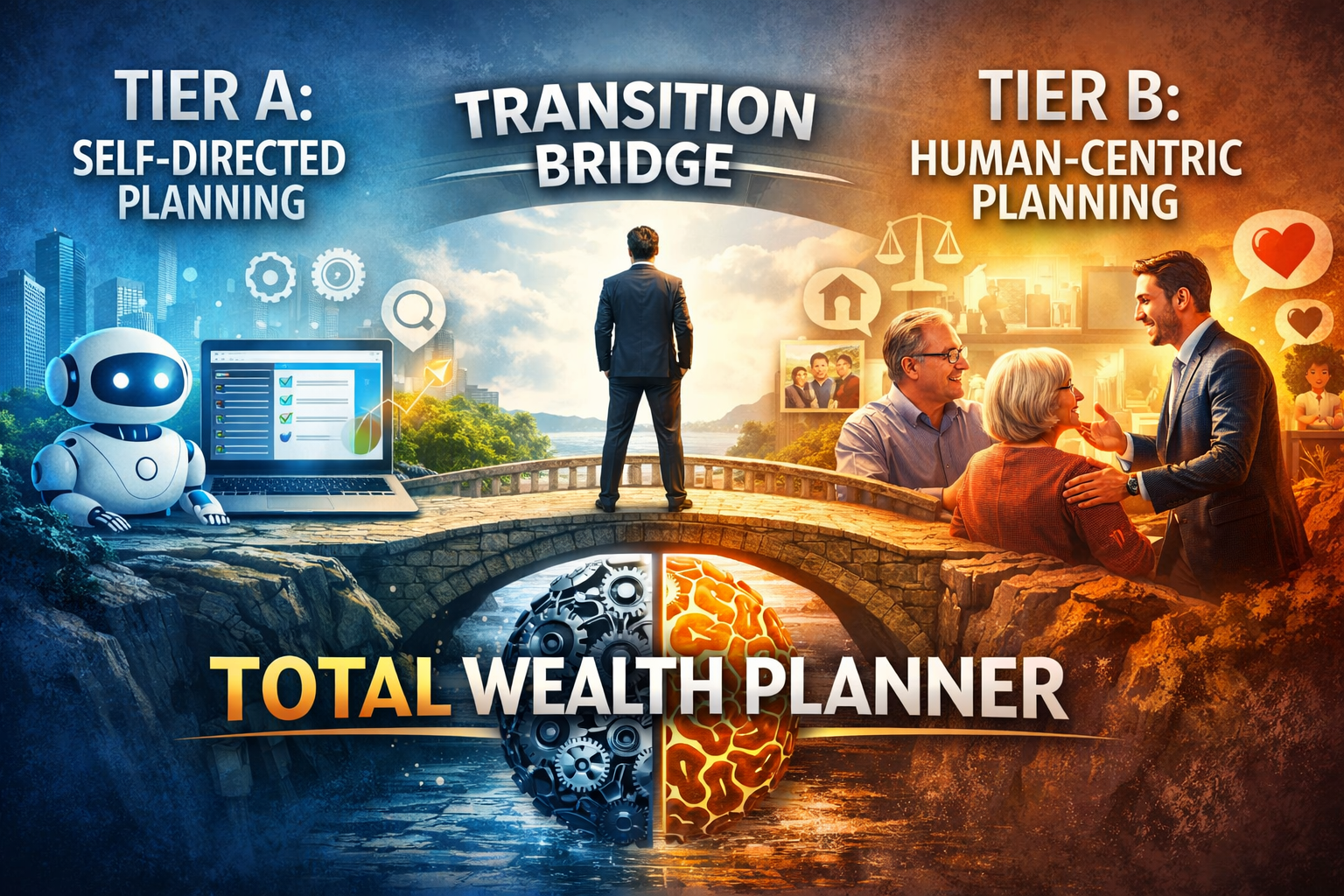
The AoLP two-tier model: Tier A and Tier B (and why it matters)
This is exactly why the Academy of Life Planning is building a two-tier proposition that matches how the world is changing.
Tier A: Self-directed planning at scale
totalwealthplans.com is the Tier A proposition.
This is where the majority of people should start — because most people don’t need a high-cost, human-led relationship to begin making progress.
They need:
- structure
- prompts
- clarity
- a plan they can iterate
- a way to turn confusion into steps
Tier A is empowerment-first: an engine that helps people plan life-first, money-second — without having to beg access to traditional advice models.
Tier B: Human-led intensives for complexity, transition, and fragility
totalwealthplanner.com is the Tier B proposition.
This exists for the moments where human presence changes outcomes, such as:
- high emotional load
- complexity across stakeholders
- life transitions
- decision paralysis
- conflict between partners
- “I know what I should do, but I can’t do it” moments
Tier B is where Total Wealth Planners earn premium fees for real human work — not data processing.
This is the future: not mass “annual reviews” — but fewer clients, deeper work, higher integrity.
The stepping-stone pathway: 12 weeks to become a planner of tomorrow
Here’s the practical question for advisers:
How do you move from today’s model to tomorrow’s model without blowing up your business?
You don’t leap.
You take stepping stones.
That’s why the Academy of Life Planning offers a 12-week stepping-stone programme designed to help planners shift from:
- plan production → life architecture
- AUM dependency → outcome-based value
- technical identity → human outcomes identity
- reactive service → structured, scalable delivery
- “I’m not a tech person” → confident AI orchestration
This isn’t about becoming a coder.
It’s about becoming the professional who can:
- deploy the planning engine
- interrogate it
- quality-check it
- translate it into human choices
- hold clients steady under stress
- and build human capital alongside financial capital
The future doesn’t reward denial.
It rewards capability.
The five moves every serious planner should make now
If you want a clean action list, it’s this:
- Audit your week
Highlight what AI can already do 80%+ as well as a human. Stop over-investing there. - Redesign your value around the residue
Behaviour, decisions, relationships, meaning, accountability, human capital. - Adopt a two-tier architecture
Tier A self-directed scale + Tier B human intensives. - Be radically transparent
“The engine does the technical work. I do the human outcomes.” - Train the missing skill stack
Coaching, behavioural strategy, communication under stress, family alignment, transition facilitation.
That’s what a Total Wealth Planner does.
Final thought: the riskiest position is “wait and see”
If you embrace AI and you’re wrong, you become faster and better.
If you dismiss AI and you’re wrong, you spend the next two years watching your fees, client expectations, and service model get undermined by something you refused to learn.
That’s not cautious.
That’s a concentrated risk position.
And financial planners, of all people, should recognise it.
Where to go next
- If you’re a consumer who wants to begin planning in a life-first way: totalwealthplans.com (Tier A)
- If you’re facing complexity, transition, or you want expert human support: totalwealthplanner.com (Tier B)
- If you’re a financial planner who can feel the ground moving and wants the stepping-stone pathway: the Academy of Life Planning’s 12-week programme is designed to help you make the shift without losing yourself or your business.
Curious how others see this.
 Academy of Life Planning